Most Chinese brands entering Europe have had to make a difficult choice: absorb the EU’s additional import tariffs of up to 37.6% on Chinese-made EVs and pass the cost on to buyers, or find another way, like GAC. In November 2025, the Chinese-based automaker signed a production deal with Magna Steyr, securing space on the assembly lines at the Austrian contract manufacturer’s plant in Graz. The Aion V started rolling off the line there in November 2025, followed by the Aion UT in March 2026. Cars built in Austria are not subject to the Chinese import tariffs, which means GAC can price both models at levels that would otherwise be impossible. It is the same logic behind BYD’s factory in Hungary and MG’s European production setup, and it is becoming a pattern worth paying attention to across Chinese brands manufacturing in Europe.
The Magna plant has 125 years of automotive production behind it, has built over four million vehicles for multiple manufacturers, and already assembles Xpeng models on the same lines. For GAC, it is a practical shortcut to European production without having to build a factory from scratch.
The two models share the same AEP 3.0 platform but sit in very different parts of the market. The Aion V is a family-sized SUV going up against the Volkswagen ID.4. The Aion UT is a compact hatchback that takes aim directly at the ID.3. Here is what both cars are actually like.
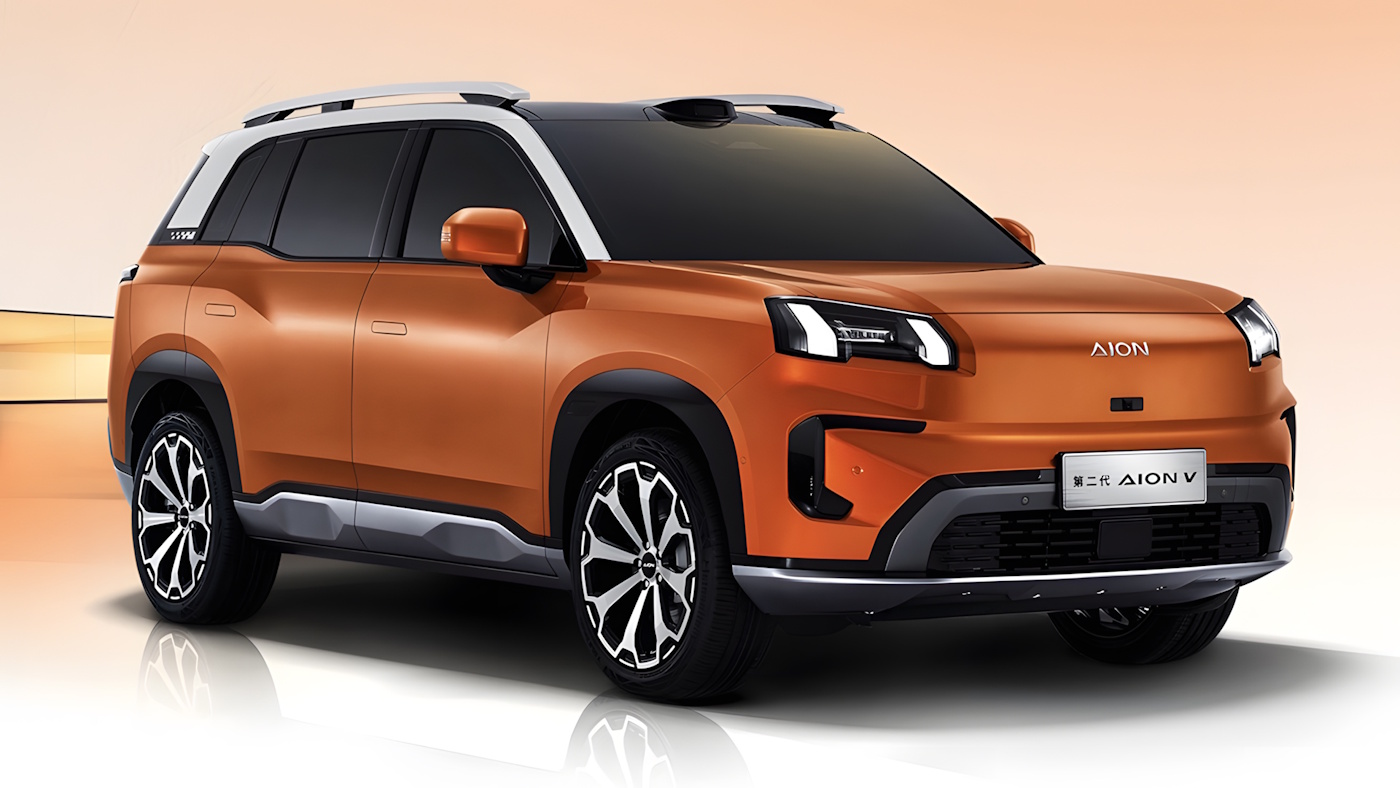
GAC Aion V: The Mid-Size SUV
At 4,600 mm long with a 2,770 mm wheelbase, the Aion V is in the same size territory as the Volkswagen ID.4 and Kia EV5. Even the base Premium trim gets a 14.6-inch floating touchscreen, digital instruments, Apple CarPlay, Android Auto and a heat pump. The boot holds 427 litres, which is about average for the class. The upper trim gets you front seat massage and a small built-in refrigerator with a warming function, which is not something you normally see on a €35,000 car. Level 2 driver assistance is standard across the range.

Under the floor sits a 75.3 kWh LFP battery driving a 165 kW (221 hp) front-mounted motor. The WLTP range of 510 km is genuinely good for the class, sitting above what the ID.4 and Enyaq offer at comparable prices. DC fast charging takes the battery from 10 to 80% in around 24 minutes, which is competitive. Euro NCAP gave it five stars, which matters when you are asking buyers to trust a brand they have probably never encountered before.
The Aion V lines up against the aforementioned Volkswagen ID.4, Skoda Enyaq and Kia EV5. It is cheaper than most of them at around €35,990, and it offers more range than any of them at that price. If you are shopping in this segment and looking at affordable EVs in Europe in 2026, the Aion V deserves a spot on the shortlist alongside the more familiar names.
| Specification | GAC Aion V |
|---|---|
| Length | 4,600 mm |
| Wheelbase | 2,770 mm |
| Battery | 75.3 kWh (LFP) |
| Motor power | 165 kW |
| WLTP range | 510 km |
| DC fast charging | 10-80% in 24 min |
| Boot volume | 427 litres |
| Euro NCAP | 5 stars |
| Drive type | Front-wheel drive |
| Vehicle warranty | 8 years / 160,000 km |
| Battery warranty | 8 years / 200,000 km |
| Starting price | from €35,990 |
GAC Aion UT: The Compact Hatchback
The UT stands for Urban Traffic, which tells you what GAC had in mind when they built it. Inside, the base trim comes with 14.6-inch touchscreen, 8.8-inch digital instruments, wireless Apple CarPlay and Android Auto, heated front seats and steering wheel, climate control, surround-view cameras, navigation and power-folding mirrors. Boot space is 440 litres.
The 60 kWh LFP battery has around 55 kWh usable. The front motor makes 150 kW (201 hp) and 210 Nm, with a 0-100 km/h time of 7.3 seconds and a 150 km/h top speed. GAC claims 430 km of WLTP range, and independent testing in mixed driving conditions has returned figures closer to 400 km. For a city-focused car, that is more than enough for daily use and weekend trips without range anxiety. DC fast charging peaks at 87 kW, with a 10-80% top-up in about 32 minutes. The car also has V2L capability, so you can plug in a laptop, power tools or a small appliance directly from the battery.

The Aion UT already started production at the Magna Graz plant in March 2026, with batteries for European cars supplied by Farasis Energy.
The Aion UT is most directly comparable to the Renault 5 E-Tech and BYD Dolphin. At €27,990, it starts below all of them in most European markets. The Leapmotor lineup is worth a look in the same price bracket, and our round-up of affordable European EVs covers the wider field. One caveat: early reviewers have noted that the driver assistance systems are overly intrusive and do not have an easy way to switch them off. GAC may address this through a software update, but it is worth asking about before you sign anything.
| Spec | GAC Aion UT |
|---|---|
| Length | 4,270 mm |
| Wheelbase | 2,750 mm |
| Battery | 60 kWh (LFP) |
| Motor power | 150 kW (201 hp) |
| Torque | 210 Nm |
| WLTP range | 430 km |
| Consumption | 16.4 kWh / 100 km |
| DC fast charging | 87 kW (10-80% in 32 min) |
| AC charging | up to 11 kW |
| 0-100 km/h | 7.3 seconds |
| Boot volume | 440 litres |
| V2L | Yes |
| Euro NCAP | Not yet rated |
| Vehicle warranty | 8 years / 160,000 km |
| Battery warranty | 8 years / 200,000 km |
| Starting price (Europe) | from €27,990 |
FAQ
Where are the GAC Aion V and Aion UT built for Europe?
Both are assembled at the Magna Steyr plant in Graz, Austria. GAC signed the production deal with Magna in November 2025. The Aion V started production there in November 2025 and the Aion UT followed in March 2026. Magna builds the cars; GAC handles distribution and sales.
Why is GAC making cars in Austria rather than shipping them from China?
The EU added tariffs of up to 37.6% on EVs imported from China, which would have made both cars significantly more expensive for European buyers. Building in Austria means GAC avoids those tariffs. It is the same reason BYD is building cars in Hungary and why other Chinese brands are looking at European production. My overview of EU tariffs on Chinese EVs explains how the system works in detail.
Which countries can you buy a GAC in Europe right now?
As of mid-2026, GAC is selling in Poland, Portugal, Finland and Greece. More markets are expected in the second half of 2026, with Germany widely expected to follow given how loudly GAC has talked about wanting to be there.
What is the main difference between the Aion V and the Aion UT?
Size and price, mostly. The Aion V is a proper family SUV at 4,600 mm long, with a larger 75.3 kWh battery, 510 km of range and a starting price of around €35,990. The Aion UT is a compact hatchback at 4,270 mm, with a 60 kWh battery, 430 km of range and a starting price of €27,990. Both sit on the same platform and share a similar approach to standard equipment.
Does the GAC Aion UT have a five-star Euro NCAP rating?
Not yet. The Aion V has five stars from Euro NCAP. The Aion UT had not been tested at the time of writing, though it is expected to go through the process given its European launch.
How does the Aion UT stack up against the Volkswagen ID.3?
They are almost identical in size: both around 4,270 mm long with a 2,750 mm wheelbase. The Aion UT starts at €27,990, which is less than most ID.3 configurations in Europe. Range is broadly similar: 430 km for the UT versus 435 km for the comparable ID.3 with the 58 kWh battery. The ID.3 has a much longer track record in Europe and a well-established service network. The Aion UT has more standard equipment at the entry price and adds V2L. At this price gap, it is a reasonable alternative if you are comfortable with a newer brand.
What is an LFP battery and does it matter?
LFP stands for lithium iron phosphate. Both the Aion V and Aion UT use LFP chemistry for their batteries, supplied by Farasis Energy for European models. LFP batteries tend to last longer over repeated charge cycles and are more thermally stable than NMC alternatives, which is why they are increasingly common in city-focused EVs. The trade-off is slightly lower energy density, meaning a larger pack is needed for the same range. If you want to know more, my LFP vs NMC explainer covers the topic in detail.
Featured Image Credit: GAC
Latest News