Tesla’s Full Self-Driving system has been trying to crack Europe for months and keeps running into walls. France’s Transport Minister Philippe Tabarot said publicly today that FSD lets the car exceed the speed limit when surrounding traffic is moving faster. Elon Musk fired back on X that the delay will cost lives. The next EU-level vote on FSD approval isn’t until October.
Into this, Xpeng’s founder He Xiaopeng announced few days ago in Munich that the company will bring its own assisted-driving software to Europe in early 2027. He’s been direct about what it’s competing with: Xpeng’s VLA system is the company’s answer to FSD. Whether it can actually get through European regulators is the question that matters most, and the answer is more complicated than the announcement suggests.
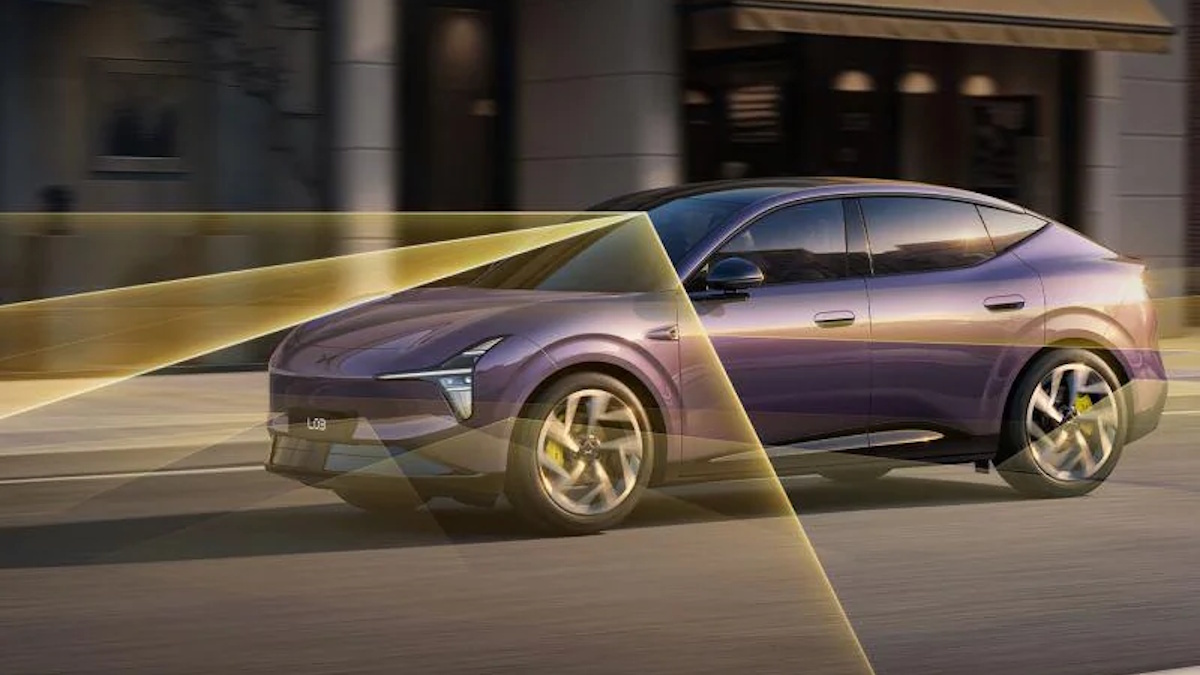
The L03 SUV Coupe launched simultaneously in China and Europe and is the first car carrying this ambition. Every version ships with Xpeng’s Turing AI chip and a version of the VLA system. The full European rollout, with multilingual voice control and Google Maps integration, is targeted for 2027.
What VLA Actually Is
VLA stands for Vision-Language-Action. It processes camera feeds, language instructions and driving decisions in a single neural network rather than through separate perception, planning and control modules. Tesla’s FSD works the same way. Both are camera-only, no LiDAR, no pre-built HD maps. The system has to figure out what’s happening in real time from what it can see, which is harder to build but means it can work on roads that have never been mapped.

Xpeng tested VLA on public roads in Munich three days before the L03 launch. That matters: it’s one thing to say you’ll bring software to Europe, another to already be driving on European streets with it. More on how Xpeng’s software stack works if you want to go deeper on the architecture.
He Xiaopeng has said he believes VLA already beats FSD on narrow roads and in complex urban situations. That’s a bold claim, though he acknowledged the comparison isn’t straightforward because the full version of FSD hasn’t been approved in China, so Chinese drivers can’t actually run both systems side by side.
The most concrete external proof of VLA’s credibility came from Volkswagen. As part of VW’s broader autonomous driving strategy, they became the first Western car company to license VLA 2.0 and the Turing chip for their own vehicles. That’s not a sponsorship deal, that’s a German car manufacturer paying for Chinese software to go into its cars.
The Regulatory Gap Is the Real Problem
Whether Xpeng’s system is technically good is almost beside the point right now. The approval process is the bottleneck, and it’s the same one Tesla has been stuck in for months.
EU-wide approval for a system that does what FSD or VLA does in urban environments requires a qualified majority vote at the Technical Committee on Motor Vehicles. At least 15 of the 27 member states, representing 65% of the EU’s population, need to vote yes. Germany, France and Italy together have enough population weight to block it, and not one of the three has approved FSD nationally. France just made that position public at ministerial level.
Five countries have approved FSD so far: the Netherlands, Lithuania, Estonia, Denmark and Belgium. That’s a start, but it’s nowhere near the qualified majority threshold. The October 2026 TCMV meeting is the next chance for a vote. The European Transport Safety Council has written to transport ministers across almost all EU member states urging them not to recognise the provisional Dutch approval until safety questions are answered publicly.
The specific problems France identified are worth paying attention to, because they’ll come up for any system with similar capabilities, including Xpeng’s. First, the Speed Offset feature: FSD adjusts cruising speed to match surrounding traffic rather than sticking to the posted limit. French and Swedish authorities have both objected to this. Second, driver monitoring in cities: France says FSD doesn’t adequately keep the driver alert enough during complex manoeuvres like lane changes, intersections and roundabouts.
Xpeng hasn’t said publicly whether VLA has a similar Speed Offset behaviour or how its driver monitoring handles city driving. Those are the exact questions European regulators will ask first.
What “Early 2027” Actually Means
When Xpeng says early 2027, the most likely interpretation is that the software arrives via an over-the-air update on cars already sold in Europe, with Google Maps and multilingual voice control included. The robotaxi programme is separate, targeting driverless operation in China in early 2027 on a different platform.

But the software arriving on the car is not the same as drivers being legally allowed to use it the way Xpeng intends. National and EU-level approvals need to happen first, and those don’t exist yet. Tesla has been in this same situation for months: over 50 million kilometres driven on European roads in supervised pilot mode while formal approval is stuck waiting for a vote.
The realistic picture is probably that early 2027 means the software is available in some supervised form, with the regulatory review running alongside it. That’s not a bad position, but it’s not “Xpeng’s FSD goes live in Europe next year” either.
What Xpeng Has Going for It
The timing does work in Xpeng’s favour in one specific way. Tesla’s FSD rollout in Europe has generated a lot of bad press: the French ministerial statement, Sweden’s formal recommendation against approval, the European Transport Safety Council writing to transport ministers across almost all member states. That regulatory noise means the conversation about advanced driver assistance is happening loudly right now. Any credible alternative automatically gets attention.
The Volkswagen deal also changes the picture. It’s much harder to treat Xpeng’s system as a foreign product when a major European manufacturer has already decided it’s good enough to put in their own cars. That counts for something when you’re asking European regulators to take you seriously.
And the Mona M03’s numbers have shown that Xpeng can build products that sell at real volume. That commercial track record matters when you’re trying to convince regulators you’re a long-term participant in their market, not a company running a short experiment.
The harder question is whether any system doing what FSD does in urban environments, camera-only, no maps, operating in cities across Europe, will get through the regulatory process quickly. France has made its position clear, and that position doesn’t specifically target Tesla. It targets the approach.
FAQ
What is Xpeng’s VLA system?
VLA stands for Vision-Language-Action. It’s a neural-network-based driving model that processes camera inputs and outputs driving actions in a single system, without LiDAR or pre-built maps. It’s the architecture behind Xpeng’s XNGP and NGP assisted-driving features and the company’s direct answer to Tesla’s FSD.
When will Xpeng’s assisted driving come to Europe?
He Xiaopeng confirmed early 2027 as the target for European deployment, including Google Maps integration and multilingual voice control. This refers to the software arriving on cars in Europe, not to regulatory approval for full use in all markets.
Why hasn’t Tesla FSD been approved across Europe?
EU-wide approval requires a qualified majority vote. Only five countries have approved FSD so far. France has specifically objected to FSD allowing speed limit violations when surrounding traffic is moving faster, and to driver monitoring gaps in urban environments. The next vote is scheduled for October 2026.
What did France’s Transport Minister say about FSD?
Philippe Tabarot said FSD allows the car to exceed the speed limit when surrounding traffic is moving faster, in some cases by as much as 50%, and that the system doesn’t guarantee adequate driver attention in cities during complex manoeuvres. France supports the technology in principle but says safety trade-offs aren’t there yet.
Why did Volkswagen license Xpeng’s software?
Volkswagen became the first Western car company to license Xpeng’s VLA 2.0 driving model and Turing chip for use in its own vehicles.
What level of autonomy is Xpeng targeting?
Xpeng’s roadmap, presented at the L03 Munich launch and detailed in Xpeng’s investor materials, targets Level 4 autonomy by 2028 on its next-generation platform, alongside an in-house AI foundation model. The current platform running on the L03 supports VLA 2.0 at up to 3,000 TOPS of computing power. Level 4 means the system handles all driving tasks in defined conditions without the driver needing to be ready to intervene.
Featured Image: Xpeng
Marko Lubar is the Founder and Editor of ElectricFleet Online, where he covers the latest developments in electric vehicles, battery innovation, autonomous driving, artificial intelligence, and the technologies shaping the future of mobility.
Learn more about Marko and the mission behind ElectricFleet Online on the About Us page.
Latest News