If your business operates in or around a European city, the pressure to go electric is no longer theoretical. Low-emission zones are expanding, diesel surcharges are increasing, and the running cost gap between an electric van and its diesel equivalent is now wide enough to matter to any operator doing regular urban routes. The good news is that the selection of electric city vans available in Europe has grown considerably, and there is now something for almost every type of operation, from a sole trader doing last-mile parcel drops to a small fleet running daily urban routes. Here is a full overview of what is available on the market, along with the numbers that actually matter for day-to-day use.
All range figures quoted in this article are WLTP-rated values. Real-world results will vary depending on load, speed, temperature and driving style, but WLTP is the standard used for official certification across Europe and gives the most consistent basis for comparison.
Two Categories Worth Separating
Before diving into individual models, it helps to split the market into two groups. The first is the traditional compact van category, where you have vehicles like the Renault Kangoo E-Tech, Citroen e-Berlingo and their badge-engineered siblings. These are proper panel vans with payloads in the 600 to 1,200 kg range, designed to carry meaningful loads over meaningful distances. The second is the micro van category, where the Leapmotor T03 LCV sits: a city-only tool with a very low payload limit but an extraordinary price point. Both categories have their uses, but they serve different operations.
The Stellantis Platform: Five Vans, One Architecture
One of the most important things to understand about the electric van market is just how much of it is built on a single Stellantis platform. The Citroen e-Berlingo, Opel/Vauxhall Combo Electric, Peugeot e-Partner, Fiat e-Doblo and Toyota Proace City Electric are all mechanically near-identical. They share the same 52 kWh LFP battery, the same 100 kW motor, the same 100 kW DC fast charging capability and broadly the same WLTP range of around 330 to 345 km. Payload varies slightly between variants but sits in the 600 to 780 kg range. They come in two body lengths, the shorter M/L1 and the longer XL/L2.
Choosing between them usually comes down to brand preference, dealer network and residual value considerations. The Citroen version is typically the most competitively priced. The Fiat and Peugeot versions sit in the middle. The Toyota Proace City Electric tends to appeal to operators who value Toyota’s reliability reputation and dealer coverage, and the Opel/Vauxhall Combo Electric is a strong choice in markets where Opel has a dense service network. The Citroen e-Berlingo is covered in detail below as the reference model for the platform.
Citroen e-Berlingo
The e-Berlingo is the benchmark in this class and arguably the most complete small electric van on the European market right now. According to Citroen’s official French specification page, the latest version delivers 337 km of WLTP range, a load volume of up to 4.4 m3, a maximum load length of 3.44 m, and a payload of up to 781 kg. DC fast charging at 100 kW means a 0 to 80% top-up in 30 minutes, usable during a lunch break or a depot stop.

The standard Enterprise trim includes rear parking sensors, cruise control with speed limiter and the My Citroen Play smartphone station. Stepping up to Driver trim adds a 10-inch infotainment screen with navigation and a Dynamic Surround View system. An optional pack on Max models brings blind spot monitoring and upgraded lane-keeping.
For operators running multiple vehicles, the Stellantis platform opens up the option of mixing e-Berlingo, Combo Electric and e-Partner vans in a single fleet while keeping parts and servicing largely consistent across all of them.
| Specification | Citroen e-Berlingo M / XL |
|---|---|
| WLTP range | 337 km |
| Battery | 52 kWh |
| Payload | up to 781 kg |
| Cargo volume | 3.3/3.8 m3 (M) – 3.9/4.4 m3 (XL) |
| DC fast charging | 100 kW (10-80% in 30 min) |
| Starting price | from ~€32,000 (ex VAT) |
Renault Kangoo E-Tech Electric
The Kangoo E-Tech is the most direct rival to the Berlingo platform and was, for a long time, the benchmark for electric vans in this class. It uses a 45 kWh battery delivering up to 280 km of WLTP range, which sits behind the updated Berlingo but is still more than adequate for the majority of urban and suburban route profiles. The Kangoo comes in two body sizes: the standard L1 with 3.3 m3 of load space and the L2 with 4.3 m3, which is actually the largest cargo volume in the compact class and can carry up to 702 kg of payload.

One standout feature is the Easy Inside Rack, a retractable overhead storage rail that holds items like tubes or ladders internally without needing a roof rack. It is a genuinely useful piece of thinking for tradespeople. DC rapid charging peaks at 80 kW, which is slower than the Stellantis platform, so a 10-80% charge takes around 40 minutes.
The Kangoo also underpins one close relative worth noting. The Nissan Townstar EV shares the same 45 kWh battery and mechanicals, typically priced between the Kangoo and the Mercedes eCitan, which is covered separately below.
| Specification | Renault Kangoo E-Tech L1 / L2 |
|---|---|
| WLTP range | 280 km |
| Battery | 45 kWh |
| Payload | 537 (L1) / 702 kg (L2) |
| Cargo volume | 3.3 m3 (L1) / 4.3 m3 (Maxi) |
| DC fast charging | 80 kW (15-80% in 40 min) |
| Starting price | from ~€34,000 (ex VAT) |
Ford E-Transit Courier
The E-Transit Courier is Ford’s entry into the compact electric van segment and one of the more recent additions to the class. It uses a 43 kWh battery with a WLTP range of up to 325 km. The load area offers 2.9 m3 of cargo volume with a length of 1,802 mm and standard payload of up to 700 kg.

Ford’s proposition extends beyond the vehicle itself. Every E-Transit Courier comes with a 5G modem as standard for connectivity to Ford Pro’s fleet management and telematics tools, which is useful for operators running multiple vehicles or needing to track utilisation. DC fast charging is rated at 100 kW, giving a 10 to 80% charge in around 23 minutes, one of the quicker times in this class. Safety kit includes AEB, lane-keeping assist, intelligent speed assist and hill hold as standard.
One honest note: the load volume at 2.9 m3 is smaller than the Berlingo or Kangoo, and the body is slightly narrower between the wheelarches at 1,220 mm. For operators who need the maximum volume or the largest pallet configurations, the Stellantis or Renault platform has an advantage. For those who value the Ford Pro ecosystem or the fast charging speed, the Courier makes a strong case.
| Specification | Ford E-Transit Courier |
|---|---|
| WLTP range | up to 325 km |
| Battery | 43 kWh |
| Payload | up to 700 kg |
| Cargo volume | 2.9 m3 |
| DC fast charging | 100 kW (10-80% in 26 min) |
| Starting price | from ~€30,000 (ex VAT) |
Kia PV5 Cargo
The Kia PV5 Cargo is the most interesting new entrant in this segment in 2026 and in some ways the most forward-looking van on the list. It is built on Kia’s dedicated E-GMP.S platform, which means it was designed as an electric van from the ground up rather than adapted from a combustion vehicle. That matters in practice: the flat floor drops to just 419 mm at the rear step, around 20 cm lower than the Volkswagen ID. Buzz Cargo and 12 cm lower than the Berlingo equivalents. For a driver loading and unloading dozens of times a day, that is a real ergonomic advantage.

Two battery options are available. The Standard Range 51.5 kWh version delivers 297 km of WLTP range with a payload of up to 790 kg. The Long Range 71.2 kWh version extends range to 416 km WLTP and has been validated in an unusual way: a Guinness World Record drive of 693 km on a single charge carrying 665 kg of payload on public roads near Frankfurt. The Standard range has a payload capacity of up to 790 kg, and in the Long Range spec the payload drops slightly to 690 kg, a trade-off common across electric vans with larger batteries.
Cargo volume is up to 4.42 m3, enough for two Euro pallets and notably more than any Stellantis platform variant. DC charging peaks at 150 kW for a 10-80% top-up in under 30 minutes. The PV5 Cargo starts at around €33,000 excluding VAT in Germany, with the Long Range adding roughly €3,000 to €4,000 on top.
It won Best Small Electric Van at the 2026 What Car? awards, and the platform is designed for up to 17 different body configurations including a crew cab and chassis cab, with more variants arriving through 2026 and 2027.
| Specification | Kia PV5 Cargo |
|---|---|
| WLTP range | 297 km (Standard) / 416 km (Long Range) |
| Battery | 51.5 kWh / 71.2 kWh |
| Payload | 790 kg (SR) / 690 kg (LR) |
| Cargo volume | 4.42 m3 |
| DC fast charging | 150 kW (10-80% in 30 min) |
| Starting price | from ~€33,000 (ex VAT) |
Mercedes eCitan
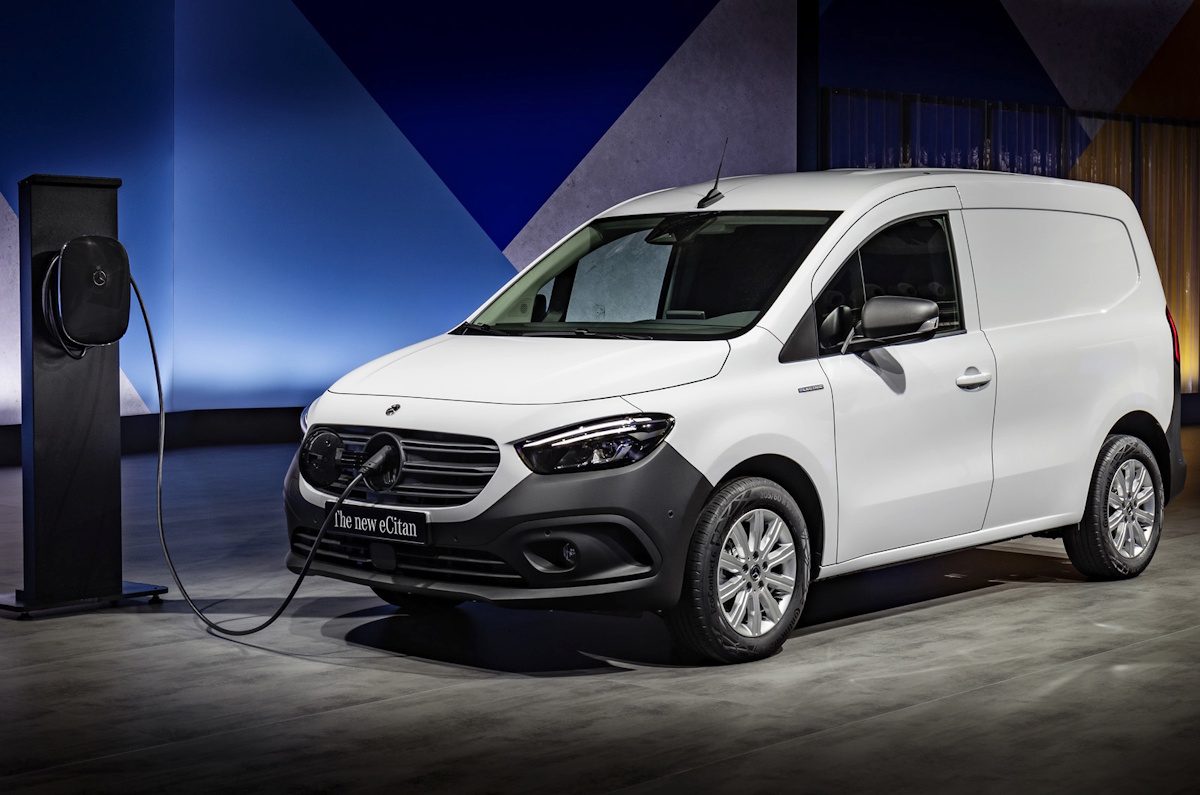
The Mercedes eCitan is the premium option in the compact electric van segment and shares its fundamental architecture with the Renault Kangoo E-Tech and Nissan Townstar EV. All three use the same 45 kWh battery and the same electric motor, but the eCitan wraps those mechanicals in a noticeably more refined package that includes the MBUX infotainment system, the multifunction steering wheel and details carried over from Mercedes passenger cars, giving the cabin a quality that stands apart from anything else in this class.

The WLTP range is officially up to 290 km. DC fast charging peaks at 75 kW, giving a 10-80% top-up in around 38 minutes. AC charging supports up to 22 kW three-phase, faster than most rivals on home or depot chargers.
The eCitan comes in two body lengths: the 4,498 mm L1 with 2.9 m3 of cargo volume and payload of up to 520 kg, and the 4,922 mm L2 with 3.6 m3 of cargo volume and payload up to 722 kg. The L2 model carries two Euro pallets. Towing capacity is up to 1,450 kg braked. Standard equipment across all trims includes active brake assist, active lane keeping assist, traffic sign assist and attention assist. The MBUX system integrates Mercedes me connectivity for remote climate control, locking and service scheduling via smartphone.
The trade-off is price. The eCitan starts notably above the Kangoo and Berlingo equivalents. Mercedes includes a four-year service and maintenance plan with every eCitan, which goes some way to closing the total cost of ownership gap.
| Specification | Mercedes eCitan |
|---|---|
| WLTP range | up to 283 km |
| Battery | 45 kWh |
| Payload | 544 kg (L1) / 722 kg (L2) |
| Cargo volume | 2.9 m3 (L1) / 3.6 m3 (L2) |
| DC fast charging | 75 kW (10-80% in 38 min) |
| Starting price | from ~€36,000 (ex VAT) |
Volkswagen ID.Buzz Cargo
The ID. Buzz Cargo is built on Volkswagen Group’s MEB platform and uses a 79 kWh battery delivering up to 453 km of WLTP range, by far the longest of any van on this list. A 150 kW rear motor produces 204 hp with 310 Nm of torque. DC fast charging peaks at 185 kW, giving a 5-80% charge in around 30 minutes. An optional AWD version with a second front motor is also available.
The cargo area offers 3.9 m3 of load volume, enough for two Euro pallets loaded crosswise and the maximum payload is 736 kg. The 636 mm loading sill is higher than the Kia PV5 Cargo, worth noting for drivers doing frequent manual loading. Sliding doors are fitted on both sides as standard in the UK; single-door is standard in most other European markets with twin doors as an option.

Standard equipment is comprehensive: LED headlights, front and rear parking sensors, a 12.9-inch touchscreen, wireless Apple CarPlay and Android Auto, and a full driver assistance suite. The ID. Buzz Cargo received Platinum, the highest Euro NCAP commercial vehicle safety award. For 2026, Volkswagen has confirmed a long-wheelbase variant with an 86 kWh battery and approximately 485 to 490 km of range. Full specifications and pricing for the LWB version had not been confirmed at the time of writing.
The honest caveat is cost. The ID. Buzz Cargo starts at around €41,000 to €48,000 excluding VAT depending on market and trim, significantly more than most rivals here. The infotainment touchscreen has also drawn criticism for sluggishness. For operators who can justify the price, the combination of range, charging speed, brand strength and safety credentials is hard to argue with. For those working on tighter margins, the Kia PV5 or Berlingo platform deliver comparable capability for considerably less.
| Specification | VW ID. Buzz Cargo |
|---|---|
| WLTP range | 453 km |
| Battery | 79 kWh |
| Payload | up to 736 kg |
| Cargo volume | 3.9 m3 |
| DC fast charging | 185 kW (5-80% in 30 min) |
| Euro NCAP | Platinum (commercial vehicle category) |
| Starting price | from ~€41,000 (ex VAT) |
Maxus eDeliver 3
Maxus is a brand that does not get as much attention as BYD or MG in European discussions, but it has been selling electric vans here longer than most. Part of SAIC Motor, the same Chinese state-owned group behind MG, Maxus has built its European identity almost entirely around commercial vehicles. The full Maxus EV lineup in Europe includes MPVs and pickups alongside the vans, but for urban delivery purposes the two relevant models are the eDeliver 3 and the newer eDeliver 5.

The eDeliver 3 is one of the few vans on this list that was designed as an electric vehicle from scratch rather than converted from a combustion platform. That design philosophy shows in the payload numbers. Thanks to extensive use of aluminium alloys and composites in the body structure, the eDeliver 3 is over 400 kg lighter than comparable Stellantis platform vans, which translates directly into more available payload: up to 1,045 kg in long-wheelbase configuration, a figure that outperforms most rivals in its price bracket.
The battery is a 50 kWh unit delivering up to 237 km of WLTP range. That is behind the Berlingo and Kangoo on range, but for typical urban delivery routes covering 100 to 150 km per day, it is more than adequate. DC fast charging peaks at 50 kW, a 0-80% charge taking around 45 minutes. Maxus has a growing dealer and service network across the UK, Ireland, the Netherlands, Sweden, Spain and several other European markets. Pricing starts at around €30,000 excluding VAT across the continent.
| Specification | Maxus eDeliver 3 |
|---|---|
| WLTP range | 237 km |
| Battery | 50 kWh |
| Payload | up to 1,070 kg |
| Cargo volume | 4.8 m3 |
| DC fast charging | 50 kW (0-80% in 45 min) |
| Starting price | from €30,000 (ex VAT) |
Maxus eDeliver 5
The eDeliver 5 is the more recent and more capable addition to the Maxus lineup. Launched in Europe at the end of 2024, it is built on Maxus’s new MILA platform and represents a genuine step up in range, payload and loading flexibility over the eDeliver 3.

The battery is a 64 kWh LFP unit delivering 335 km of WLTP range. The LFP chemistry means better cycle durability over high charge counts, which matters for vans doing daily high-mileage depot-to-depot routes. Payload reaches up to 1,200 kg, the highest of any van in this article. Cargo volume is 6.6 m3 in the 4.80 m L1 variant and 7.7 m3 in the 5.25 m L2, both notably larger than anything the Stellantis platform offers in the compact class.
The eDeliver 5 competes directly against the Berlingo and Kangoo on range while significantly exceeding them on payload and cargo volume. DC charging peaks at 70 kW for a 10-80% charge in 42 minutes. Pricing starts from €38,990 excluding VAT in Germany.
| Specification | Maxus eDeliver 5 L1 / L2 |
|---|---|
| WLTP range | 335 km |
| Battery | 64 kWh (LFP) |
| Payload | up to 1,200 kg |
| Cargo volume | 6.6 m3 (L1) / 7.7 m3 (L2) |
| DC fast charging | 70 kW (10-80% in 42 min) |
| Starting price | from €38,990 (ex VAT) |
The Micro Van Category
Not every urban delivery operation needs a full-sized panel van. For businesses doing light last-mile work, food or flower deliveries, or low-emission zone compliance on a tight budget, a car-derived micro van is often a more practical and considerably cheaper solution. Four models currently occupy this space in Europe: the Leapmotor T03 LCV, Citroen e-C3 Van, Dacia Spring Cargo and BYD Dolphin Cargo. They share the same basic concept but differ meaningfully on range, payload and price.
Leapmotor T03 LCV
The Leapmotor T03 LCV is based directly on the T03 passenger hatchback. It measures just 3,620 mm in length and has a payload of 220 kg and a cargo volume of 657 litres. Those are modest numbers by any van standard, but the price is not: €14,590 excluding VAT makes it one of the most affordable electric vehicles in Europe in any category, van or otherwise.

Production takes place at Stellantis’s Mirafiori plant in Turin, with first deliveries expected in summer 2026. The powertrain carries over from the passenger car: a 70 kW motor and a 37.3 kWh battery delivering 256 km of WLTP range. DC fast charging peaks at 45 kW, with a 30-80% charge in around 36 minutes. Standard equipment includes a 10.1-inch touchscreen, online navigation, 4G connectivity, AEB, lane-keeping assist and blind spot detection. We covered the T03 LCV launch in more detail in a separate article.
| Specification | Leapmotor T03 LCV |
|---|---|
| WLTP range | 256 km |
| Battery | 37.3 kWh |
| Payload | 220 kg |
| Cargo volume | 657 litres |
| DC fast charging | 45 kW (30-80% in 36 min) |
| Starting price | from €14,590 (ex VAT) |
Citroen e-C3 Van
The e-C3 Van is a newer addition to this micro category and a direct alternative to the T03 LCV. Based on the e-C3 passenger car, it has been converted with a full-height mesh and solid bulkhead, leaving a cargo area of 730 litres under the load cover and 1,220 litres without it. Payload is 300 kg, meaningfully more than the T03 LCV’s 220 kg, though still firmly in the light-load category.

Where the e-C3 Van stands out is on range. The 44 kWh LFP battery delivers around 320 km of WLTP range, notably more than the T03 LCV, and the DC fast charging capability at 100 kW means a 20-80% top-up in under 30 minutes. In the UK, it is available for under £20,000 after the Plug-in Van Grant, making it one of the cheapest ways to get into an electric commercial vehicle with a genuinely usable range. In European markets, pricing typically falls in the €20,000–€21,000 range.
| Specification | Citroen e-C3 Van |
|---|---|
| WLTP range | 320 km |
| Battery | 44 kWh (LFP) |
| Payload | 300 kg |
| Cargo volume | 730 litres (with cover) / 1,220 litres |
| DC fast charging | 100 kW (20-80% in 26 min) |
| Starting price | ~£20,000 / ~€20.000 |
Dacia Spring Cargo
The Dacia Spring Cargo is the cheapest electric van on this list, and by a meaningful margin in most European markets. It shares its starting price with the Leapmotor T03 LCV at around £14,995 excluding VAT in the UK, before the £2,500 plug-in van grant brings it down further. The concept is identical to the T03 LCV and e-C3 Van: rear seats removed, mesh bulkhead fitted, N1 commercial vehicle homologation, while the load bay offers 1,085 litres and a payload of 370 kg.
The battery is a 24.3 kWh LFP unit. WLTP range is officially 225 km on the combined cycle, though it rises somewhat on the urban cycle due to lower average speeds and more regenerative braking opportunity. In independent testing, real-world results have come in closer to 200 km, which is noticeably less than the e-C3 Van. DC fast charging peaks at 40 kW, with a 20-80% charge taking approximately 45 minutes, slower than the e-C3 Van’s 100 kW capability.

What the Spring Cargo does well is package a surprisingly complete standard spec at an entry-level price. Standard equipment includes front and rear parking sensors, a reversing camera, a 10-inch touchscreen with navigation and smartphone replication, cruise control, air conditioning and Vehicle-to-Load (V2L) bidirectional charging. For a business that occasionally needs to power tools or equipment on site, V2L is a genuinely useful feature.
The honest verdict, echoed by What Car? and Autotrader reviews, is that the Spring Cargo sits closer to a cargo bike alternative than a conventional small van. It is right for light urban work where the priority is lowest possible acquisition cost and ease of access. If range or payload are important, the e-C3 Van carries further and the T03 LCV offers more cargo volume at a lower price.
| Specification | Dacia Spring Cargo |
|---|---|
| WLTP range | 225 km |
| Battery | 24.3 kWh (LFP) |
| Payload | 370 kg |
| Cargo volume | 1,085 litres |
| DC fast charging | 40 kW (20-80% in 45 min) |
| Starting price (UK) | from £14,995 (ex VAT) |
BYD Dolphin Cargo
The BYD Dolphin Cargo is the newest addition to the car-derived van category in the UK, announced in late May 2026 and available to order immediately through BYD retailers. The conversion from the Dolphin hatchback is carried out in the UK, with the rear seats permanently removed and a full metal bulkhead installed. The resulting load area offers 1,093 litres of space including a 47-litre underfloor compartment, a maximum load length of 1,250 mm and a minimum width between the wheelarches of 1,018 mm.
The powertrain carries over unchanged from the Dolphin passenger car: a 204 hp motor and a 60.4 kWh LFP Blade Battery. The official WLTP combined range is 265 miles (426 km), with an urban-cycle figure of 347 miles. The combined figure is the relevant one for most operators and it comfortably leads the micro van category by a wide margin. AC charging supports up to 11 kW, and DC fast charging is available though BYD’s press material does not specify a peak kW figure for the Cargo variant.

Standard equipment is based on Dolphin Comfort trim and includes a 360-degree parking camera, heated front seats, a heat pump, Apple CarPlay and Android Auto, and Vehicle-to-Load capability. Pricing is £29,358 excluding VAT, or £36,305 including VAT.
A few things worth noting that the press material does not flag clearly. The payload figure is not stated in the official UK release, which is an unusual omission for a commercial vehicle launch. The load length of 1,250 mm and minimum width of 1,018 mm are modest, and the maximum load height of 710 mm will restrict what can actually fit inside. This is a car-based conversion and the interior dimensions reflect that. The £29,358 ex-VAT price also puts it significantly above the other micro vans here and close to the Citroen e-Berlingo Van territory, so it sits in an unusual position in the market. For operators whose primary need is urban range and who carry compact but frequent loads, it is an interesting option. For those who need to carry larger or heavier items regularly, the Berlingo or Kangoo remain more appropriate choices.
| Specification | BYD Dolphin Cargo |
|---|---|
| WLTP range | 427 km |
| Battery | 60.4 kWh (LFP Blade) |
| Payload | not officially stated |
| Cargo volume | 1,093 litres (incl. 47 L underfloor) |
| Load length | 1,250 mm |
| DC fast charging | 88 kW (10-80% in 40 min) |
| Starting price (UK) | £29,358 (ex VAT) |
Volvo EX30 Cargo
The EX30 Cargo occupies an unusual position in this market. It is a car-derived van like the Spring Cargo and T03 LCV, based on the EX30 passenger SUV with rear seats removed and a flat load floor installed. But in terms of price and powertrain options, it sits well above the other micro vans and closer to proper compact panel van territory and that’s why I’m covering it separately.
Volvo Car UK launched the EX30 Cargo in March 2026 with 1,000 litres of load space, a 390 kg payload and a WLTP range of up to 483 km (300 miles) on the extended range variant. The conversion is carried out as a second-stage process in the UK, and can be applied to both new orders and existing stock across model year 2026 and 2027 vehicles. A Cross Country Cargo version is also available with additional ground clearance for operators who need more rugged capability.

The base trim includes adaptive cruise control, wireless Apple CarPlay and Android Auto, parking sensors and a rear-view camera. The Plus trim adds heated front seats, a heated steering wheel, two-zone climate control and wireless smartphone charging. The EX30’s five-star Euro NCAP safety rating from 2024 applies to the Cargo variant.
Pricing starts from £36,010 for the P5 standard range version, available exclusively through Volvo Car UK’s fleet sales channels. European pricing and availability outside the UK had not been confirmed at the time of writing, so this is currently a UK-only product.
Two things are worth flagging: first, £36,010 excluding VAT puts the EX30 Cargo above the starting price of the Citroen e-Berlingo Van, which is a proper panel van with 781 kg of payload and up to 4.4 m3 of cargo volume. For operators comparing the two, the Berlingo offers considerably more carrying capacity for a similar or lower outlay. Second, the 390 kg payload and 1,000-litre cargo volume reflect the EX30’s passenger car origins. It is not a van that replaces a Berlingo or Kangoo. It is a product for fleet buyers who want Volvo’s safety credentials, brand identity and technology in a compact commercial vehicle, and for whom those factors outweigh the payload limitations.
| Specification | Volvo EX30 Cargo |
|---|---|
| WLTP range | Up to 483 km (295 miles) |
| Battery | 51kWh / 69 kWh |
| Payload | 390 kg |
| Cargo volume | 1,000 litres |
| Load Length | 1,340 mm |
| Charging | 11 kW AC (DC fast charging available) |
| Starting price (UK) | from £36,010 (ex VAT) |
What to Consider Before Buying
Payload versus range
Every electric van involves a compromise between battery size and payload. A heavier battery extends range but reduces how much you can carry. The Kia PV5 Long Range illustrates this: the larger battery adds around 120 km of WLTP range but reduces maximum payload by 100 kg compared to the Standard Range version. The Maxus eDeliver 5 sidesteps this tension more effectively than most, combining 335 km of range with up to 1,200 kg of payload. For most urban operations, the Standard Range battery of any van on this list will cover a full working day’s routes without midday charging.
Charging infrastructure
If you can charge at a depot or home overnight using an 11 kW or 22 kW AC charger, range concerns largely disappear for urban routes. The DC fast charging speeds become relevant only when you need to add significant range during the working day, or when running longer inter-urban routes. The Ford E-Transit Courier’s 100 kW charging and 23-minute 10-80% time is a meaningful advantage here, as is the ID. Buzz Cargo’s 170 kW capability. The Volkswagen Group has a useful guide on planning fleet charging infrastructure on their VWCV Fleet Solutions pages if you are setting up depot charging for the first time.
Low-emission zone compliance
All vehicles on this list qualify for zero-emission status in European low-emission zones, including the stricter Clean Air Zones in the UK. If this is your primary reason for going electric, any of these meets the requirement from day one.
Badge engineering and fleet consistency
If you are running a mixed fleet and value parts consistency across vehicles, the Stellantis platform (Berlingo, Combo, e-Partner, e-Doblo, Proace City Electric) gives you that across five brands from a single architecture. The Renault-Mercedes-Nissan platform does the same across three brands.
Not just delivery vans
If your interest in EVs extends beyond the commercial vehicle world, it is worth knowing that the same manufacturers making these vans are also building impressive passenger cars. Our guide to city EVs with the best real-world range covers the passenger car side of the equation, and if you have a young driver in the household who recently passed their test, our guide to the best EVs for new drivers is worth a read alongside this one.
Coming Soon
The Renault Estafette E-Tech is in development and expected during 2027, positioned as a larger city delivery vehicle above the Kangoo. Renault’s partnership with Volvo through the Flexis joint venture is also set to deliver a new electric Trafic and other van platforms from this year onwards.
The Mobilize Bento is worth a mention for ultra-urban operations: a micro delivery vehicle measuring just 2.43 m in length, designed to fit three abreast in a standard parking space. It targets the same last-mile niche as the T03 LCV but at an even more compact scale.

If your operations require something between the compact van class and a full-size Transit-equivalent, the Citroen e-Jumpy is also worth mentioning. It sits one size up from the Berlingo, with payload up to 1,275 kg and WLTP range of up to 350 km. It is the same vehicle as the Peugeot e-Expert, Fiat E-Scudo, Opel Vivaro Electric and Toyota Proace Electric, all sharing the same Stellantis platform. For genuine city centre delivery work the e-Jumpy is large enough to feel cumbersome in tight urban environments, so most operators with compact route profiles will be better served by the Berlingo or Kangoo. For mixed urban and suburban operations with heavier loads, it fills the gap cleanly.
FAQ
Which electric van has the longest range in this class?
The Volkswagen ID. Buzz Cargo leads on range at 461 km WLTP, followed by the Kia PV5 Cargo Long Range at 416 km. The Maxus eDeliver 5 and Citroen e-Berlingo platform both reach around 335 to 343 km, and the Renault Kangoo E-Tech, Mercedes eCitan and Ford E-Transit Courier sit at around 283 to 300 km.
What is the cheapest electric delivery van in Europe?
The Leapmotor T03 LCV and Dacia Spring Cargo are joint cheapest at around £15,000 excluding VAT in the UK. The Spring Cargo has a higher payload at 370 kg but a shorter WLTP range at around 225 km combined. The T03 LCV has slightly more cargo volume and a longer range at 256 km but a lower payload of 220 kg. The Citroen e-C3 Van is the next step up, offering better range at around 320 km. The BYD Dolphin Cargo leads the micro van category on range at 426 km combined but costs significantly more at £29,358 excluding VAT. Among traditional compact vans, the Citroen e-Berlingo Van and Ford E-Transit Courier start around €32,000 excluding VAT.
What is the difference between the Citroen e-C3 Van and the Leapmotor T03 LCV?
Both are car-derived micro vans suited to light urban delivery work. The e-C3 Van has a higher payload at 300 kg versus 220 kg, a longer WLTP range at around 320 km versus 256 km, and faster DC charging at 100 kW. The T03 LCV is cheaper at €14,590 excluding VAT and is already in production with summer 2026 deliveries confirmed. Neither is a substitute for a conventional compact van if you regularly carry loads above 300 kg.
What is the difference between the Citroen e-Berlingo Van and the e-Berlingo MPV?
They share the same name and platform but are fundamentally different vehicles. The e-Berlingo Van is a panel van with a full-height bulkhead, no rear seats, and a payload of up to 781 kg. The e-Berlingo MPV is a passenger car with five or seven seats and no meaningful cargo payload. All specifications in this article refer to the Van version.
Are the Citroen e-Berlingo and Opel Combo Electric the same van?
Mechanically, yes. Both are built on the same Stellantis platform with the same 50-52 kWh battery, 100 kW motor and broadly the same dimensions. Differences are limited to styling, infotainment systems and trim levels. The same is true of the Peugeot e-Partner, Fiat e-Doblo and Toyota Proace City Electric.
Is the Kia PV5 Cargo better than the Citroen e-Berlingo?
For most operators, the PV5 Cargo Long Range offers meaningfully more range, a lower loading step and faster charging. The Berlingo platform has a longer track record, wider dealer coverage in most European markets and is available now in all configurations. The PV5 is the more future-facing product; the Berlingo is the more proven one.
What is Maxus and why is it not better known?
Maxus is a commercial vehicle brand owned by SAIC Motor, the same Chinese state-owned group behind MG. It has sold electric vans in Europe since the early 2020s but has focused primarily on fleet and business customers rather than consumer marketing, which limits its public profile. Its eDeliver range offers strong payload figures and purpose-built EV architecture that competes well against the established European players.
What payload do I need for urban delivery work?
Most parcel and light trade deliveries fall well within the 600 to 800 kg limit of conventional compact electric vans. If you regularly carry heavier loads, the Maxus eDeliver 5 at up to 1,200 kg or the eDeliver 3 at up to 1,070 kg are worth a close look. The T03 LCV at 220 kg is suitable for parcels, flowers, food and similarly light loads only.
Do these vans qualify for government grants in Europe?
Grant availability varies by country and changes regularly. In the UK, the Plug-in Van Grant provides up to £2,500 off small electric vans under 2.5 tonnes and £5,000 off larger models. Germany, France, the Netherlands and several other EU countries have their own fleet electrification incentives. It is worth checking current national schemes before purchase, as availability and amounts shift frequently.
Featured Image Credit: Mercedes-Benz
Marko Lubar is the Founder and Editor of ElectricFleet Online, where he covers the latest developments in electric vehicles, battery innovation, autonomous driving, artificial intelligence, and the technologies shaping the future of mobility.
Learn more about Marko and the mission behind ElectricFleet Online on the About Us page.
Latest News