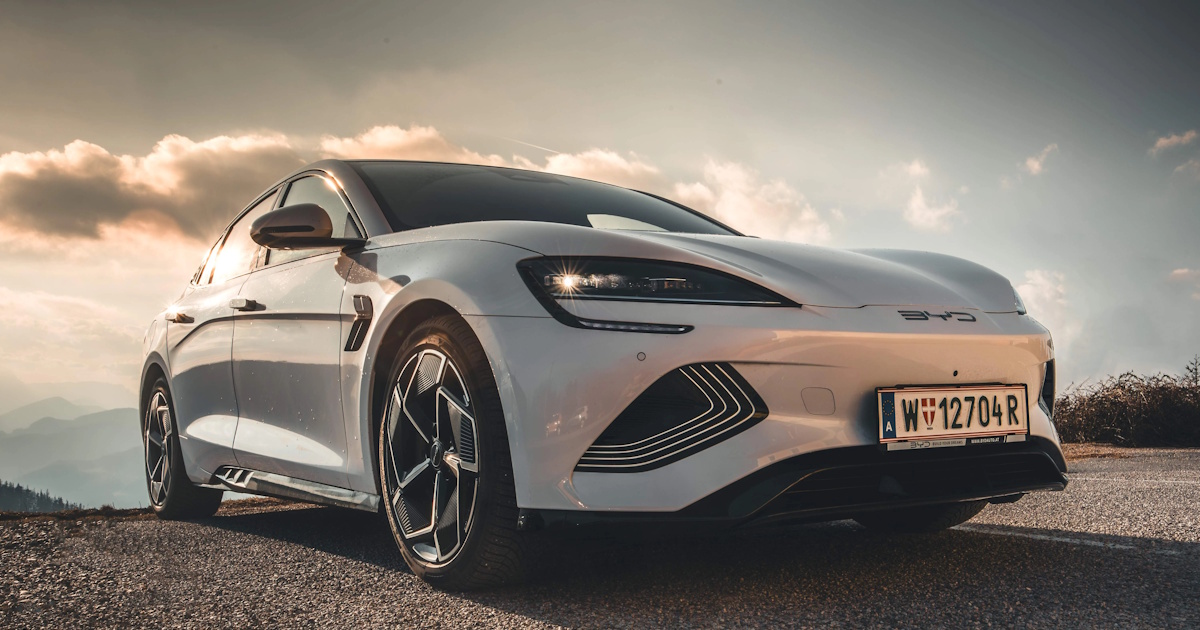
BYD has been selling EVs in Europe since 2021, but up until now every single car arrived here from China. That’s finally starting to change. In January 2026, BYD began trial production at its new factory in Szeged, Hungary, with full series production expected to ramp up during the second part of the year. It’s a huge project too, reportedly worth up to €4 billion, and once fully operational the plant could build as many as 300,000 cars per year. More importantly, it signals a completely new stage in BYD’s European expansion.
The main reason is actually pretty simple. Back in October 2024, the EU introduced additional tariffs on Chinese built EVs, including an extra 17% duty specifically targeting BYD on top of the standard 10% import tax. I already covered the full breakdown and political background in my overview of EU tariffs on Chinese electric vehicles, but the short version is this: once a car is assembled inside the EU, those extra tariffs no longer apply. That changes the maths quite a lot for companies like BYD.
At the same time, competition in Europe is becoming much tougher. Legacy manufacturers are finally launching more affordable EVs in larger numbers, which I also covered in my overview of the most competitive new EVs arriving in Europe this year. Put simply, BYD cannot rely only on imported cars anymore if it wants to stay competitive long term. Local production makes pricing, logistics and delivery times much easier to manage.
Why Hungary
The obvious question is, why Hungary? Part of the answer is political. Hungary has maintained relatively close ties with China compared with many other EU countries, especially under Prime Minister Viktor Orbán, and that has helped make the country one of the main destinations for Chinese industrial investment in Europe. I explored that broader trend in my article about Chinese EV manufacturers building cars in Europe, because BYD is definitely not the only company moving production closer to European buyers.
What’s also interesting is that BYD does not plan to simply copy its Chinese lineup into Europe unchanged. The company has openly said it wants to adapt its range around European tastes, especially in the B and C segments where most cars are actually sold here. European buyers generally prefer smaller and more efficient vehicles than Chinese customers, while also paying much closer attention to things like WLTP range figures, ride quality, handling and perceived build quality. The models planned for Szeged reflect that pretty clearly.
BYD Dolphin Surf
The Dolphin Surf is the first model confirmed for production at the Szeged plant and the most strategically important: BYD’s executive vice president Stella Li described it as the vehicle that “will lead the BYD vehicles built in Europe for Europe.” It is the European version of the Seagull, the best-selling EV in China, adapted for European safety standards and preferences with an extended body, revised suspension, and larger battery options than the Chinese original.

The result is a five-star Euro NCAP-rated city car available in three trims and two battery sizes. The smaller 30 kWh Blade LFP battery delivers around 220 km of WLTP range, while the top 43.2 kWh version reaches up to 322 km. I covered why it earned its five-star Euro NCAP rating in a separate article. With local production removing the tariff surcharge, the Dolphin Surf is positioned to compete directly with the Renault Twingo on price.
| Specification | BYD Dolphin Surf |
|---|---|
| Body type | City hatchback |
| Battery options | 30 kWh / 43.2 kWh (LFP) |
| WLTP range | Up to 220 km / up to 322 km |
| Euro NCAP rating | 5 stars (2025) |
BYD Dolphin
The Dolphin is a step up from the Dolphin Surf in both size and ambition. At 4,290 mm it sits firmly in the B-segment hatchback class, competing with the Peugeot e-208 and Vauxhall Corsa Electric on footprint while offering more interior space than either. It uses BYD’s e-Platform 3.0 and, like the Dolphin Surf, uses Blade LFP battery chemistry throughout.

Two battery sizes are available in Europe: the 44.9 kWh version for the Active and Boost trims with up to 340 km of WLTP range, and the 60.4 kWh version for the Comfort and Design trims with up to 427 km. A five-star Euro NCAP rating applies across the range. The Dolphin is one of BYD’s most important volume models in Europe and a solid alternative to the Volkswagen ID.3 Neo.
| Spec | BYD Dolphin |
|---|---|
| Body type | Hatchback |
| Battery | 44.9 kWh / 60.4 kWh (LFP) |
| WLTP range | up to 427 km |
| Euro NCAP | 5 stars |
BYD Atto 2
The Atto 2 is BYD’s most affordable compact SUV for Europe and one of the brand’s most important tools for reaching first-time EV buyers. It sits below the Atto 3 Evo in size and price while offering BYD’s characteristic combination of generous standard equipment and Blade LFP battery chemistry. I covered the full lineup and regional trim differences in this guide to the BYD Atto 2 in Europe, and it features among my picks for the best affordable urban SUV EVs for city driving.

Two battery options are available across European markets: a 45.1 kWh LFP pack with around 312 km of WLTP range (with a 51.1 kWh version offered in the UK instead of the 45.1 kWh battery), and a 64.8 kWh LFP pack with up to 420 km. The Atto 2 has received a five-star Euro NCAP rating and comes with a 6-year vehicle warranty and 8-year battery warranty across all European markets. It is also included in my comparison of affordable Chinese family EVs in Europe.
| Specification | BYD Atto 2 |
|---|---|
| Body type | Compact SUV |
| Battery | 45.1 kWh (51.1 in UK) / 64.8 kWh (LFP) |
| WLTP range | Up to 420 km |
| Euro NCAP rating | 5 stars |
BYD Atto 3 Evo
The Atto 3 Evo is the updated version of one of BYD’s best-established models in Europe, and it addresses the main criticisms of the original: slower charging, older software, and an interior that was beginning to feel dated. I covered the full update in this detailed guide to the Atto 3 Evo. The 74.8 kWh LFP Blade battery is shared across both European trims, Design and Excellence, while DC charging has been increased to 220 kW. That means a 10 to 80% charge now takes around 25 minutes.

The Atto 3 Evo delivers up to 510 km of WLTP range depending on trim. The interior update brings improved materials and a more fluid software experience, and the front trunk adds practical storage. It holds a five-star Euro NCAP rating and is one of the models named as likely candidates for Hungarian production as the plant scales up. It also appears on my list of 800V EVs available in Europe: the Atto 3 uses an 800V platform, making it capable of ultra-fast charging on compatible infrastructure.
| Spec | BYD Atto 3 Evo |
|---|---|
| Body type | Compact SUV |
| Battery | 74.8 kWh (LFP) |
| WLTP range | up to 510 km |
| Euro NCAP | 5 stars |
BYD Seal
The BYD Seal is BYD’s premium electric sedan for Europe, competing directly with the Tesla Model 3. It is the most performance-oriented model on this list, which uses an 82.5 kWh Blade LFP battery, produces 390 kW (530 hp), reaches 100 km/h in 3.8 seconds, and delivers up to 570 km of WLTP range. DC fast charging peaks at 150 kW for a 30 to 80% charge in around 26 minutes on the AWD variant.

The entry-level uses a 61.4 kWh battery with up to 460 km of WLTP range. The Seal earned a five-star Euro NCAP rating with 89% adult occupant protection, one of the higher scores in its class. It comes with a 15.6-inch rotating touchscreen, panoramic roof, 53-litre frunk, and a full suite of driver assistance systems as standard. While the Seal is positioned above the core B and C segment focus for the Hungarian plant, its volume in Europe makes it a credible candidate for local production as output scales.
| Spec | BYD Seal |
|---|---|
| Body type | Saloon |
| Battery | 61.4 kWh / 82.5 kWh (LFP) |
| WLTP range | up to 570 km |
| Euro NCAP | 5 stars |
BYD Seal U
The Seal U is BYD’s mid-size family SUV and one of its most important models for the European market, targeting the same buyers as the Tesla Model Y, Volkswagen ID.4 and Škoda Enyaq. I covered it in detail in this full guide to the BYD Seal U in Europe. It is available in two trims in Europe: the Comfort with a 71.8 kWh Blade LFP battery and 420 km of WLTP range, and the Design with an 87 kWh battery and 500 km of WLTP range.

Both trims use a 160 kW front-wheel drive motor and offer generous standard equipment including a panoramic roof, heat pump, V2L capability, and a wide driver assistance suite. DC charging is 115 kW on the Comfort and 140 kW on the Design, with 10 to 80% in around 43 minutes. The Seal U holds a five-star Euro NCAP rating.
You might notice that every BYD model uses an LFP battery. If you want to understand the difference between the LFP chemistry used across BYD’s entire European range and the NMC batteries used by some competitors, I covered it in my guide to LFP vs NMC batteries.
| Spec | BYD Seal U |
|---|---|
| Body type | Mid-size SUV |
| Battery | 71,8 kWh / 87 kWh (LFP) |
| WLTP range | up to 500 km |
| Euro NCAP | 5 stars |
What Else Might Be Coming?
BYD is building a second European plant in Manisa, Turkey, which is still under construction, with production expected to start by the end of this year. According to Reuters, the Turkish site could ultimately become even more important than the Hungarian plant, potentially producing a larger share of BYD’s European EV output once fully ramped up. Turkey also benefits from a customs union with the EU, which provides tariff-free access for manufactured goods similar to EU membership.
Sources suggest the Turkish factory will produce models such as the Seal U and Sealion 5, with additional vehicles potentially added later. The split between Hungary and Turkey reflects both logistics (serving Europe from multiple entry points) and the practical reality that labour costs in Turkey are significantly lower than in Hungary.
A third European plant, reportedly planned for Spain, has also been mentioned but not confirmed. Spain’s decision to abstain from the EU tariff vote, along with its active efforts to attract Chinese automotive investment, makes it a plausible candidate. If realised, BYD’s European production network would span southern, central, and eastern Europe with meaningful capacity across all three regions.
FAQ
Is BYD building cars in Europe now?
Yes. In January 2026, BYD started trial production at its first European factory in Szeged, Hungary. Full-scale production is expected in the second half of 2026.
Why is BYD building a factory in Europe?
The main reasons are EU import tariffs on Chinese-built EVs, rising competition, and the need for lower costs and faster delivery times. Producing inside the EU helps BYD avoid additional tariffs and improve competitiveness.
How big is BYD’s factory in Hungary?
The Szeged plant is a major investment worth around €4 billion. Once fully operational, it could produce up to 300,000 vehicles per year.
Which BYD models will be built in Europe?
The first confirmed model is the BYD Dolphin Surf, followed by other models such as the Dolphin, Atto 2, Atto 3 Evo, Seal, and Seal U as production scales up.
Why did BYD choose Hungary for its factory?
Hungary has strong political and economic ties with China and has become a key destination for Chinese automotive investment. Its central location in Europe also helps with logistics and distribution.
Will BYD change its cars for the European market?
Yes. BYD is adapting its lineup specifically for Europe, especially in the B and C segments, where preferences differ from China in terms of size, efficiency, and driving dynamics.
Are all BYD EVs in Europe using LFP batteries?
Most BYD models in Europe use Blade LFP battery technology, which is known for durability, safety, and cost efficiency compared to NMC batteries used by some competitors.
Is BYD building another factory in Europe?
Yes. A second plant is under construction in Manisa, Turkey, expected to start production around the end of 2026. A potential third plant in Spain has also been discussed but not confirmed.
How does EU policy affect BYD’s strategy?
EU tariffs introduced in 2024 added extra duties on Chinese-made EVs, making local production in Europe significantly more attractive for companies like BYD.
Featured Image Source: BYD
Marko Lubar is the Founder and Editor of ElectricFleet Online, where he covers the latest developments in electric vehicles, battery innovation, autonomous driving, artificial intelligence, and the technologies shaping the future of mobility.
Learn more about Marko and the mission behind ElectricFleet Online on the About Us page.
Latest News