Nio registered only three vehicles in Germany in May 2026, according to data reported by eletric-vehicles.com (EV). That puts the brand’s year-to-date total in Europe’s largest auto market at just 12 units through the first five months of the year, down nearly 89 percent compared to the same period in 2025, when Nio averaged around 21 registrations per month. The drop is not simply a bad run of sales months. It reflects a deliberate and ongoing restructuring of how Nio operates across Europe, a shift from a direct-sales model to a distributor-led approach that has left the brand in a transitional limbo in its core Western European markets.
What the Numbers Actually Look Like
To put the scale of the decline in context: Nio registered 22 vehicles in Germany in May 2025. This May it registered three. The year-to-date figure of 12 units compares to 105 in the same period of 2025. In the first quarter alone, Nio managed just eight registrations in Germany, an 87 percent fall year on year.
Even before this year’s deterioration, the trajectory was already heading in the wrong direction. Nio sold 325 vehicles across Germany for the whole of 2024, which was itself an 18.3 percent decline from 2023. So the current situation is not a sudden reversal but the continuation of a trend that has been running for some time, now accelerated by the company’s structural overhaul.
It is also worth noting that a portion of past registration figures may not reflect genuine retail demand. According to EV, which has reported extensively on this topic, Nio’s subscription programme has been distorting vehicle registration data in Europe since it launched in 2022. Cars registered under subscription arrangements count as registrations even when they are not traditional sales to private buyers.
The Restructuring Explained
Nio has broken its single pan-European operation into six separate units, and the most significant of these is a newly created Europe Sales and Network Development division, whose purpose is to expand Nio’s reach through general distributors or dealerships across the continent, with Norway as the only exception.

Nio originally entered European markets with a direct-to-consumer model, operating its own showrooms and handling sales without intermediaries. That approach worked reasonably well in Norway, where the EV market is mature and buyers are comfortable researching and purchasing premium electric cars. In Germany, it did not gain traction at the scale needed to justify the operating costs involved.
The restructuring has come alongside a freeze on new product investment for Europe: Nio informed its European partners that no model updates would arrive until late 2027 and that no new battery swap stations would be added to the network. The cars currently available in Germany were produced in 2023 and 2024 under Nio’s second-generation platform, while the brand has already moved to its third-generation architecture for Chinese buyers. That gap matters when competitors are constantly refreshing their lineups.
Leadership Turnover in Germany
Germany has now seen four different people in the top operational role since Nio entered the market in October 2022. Ralph Kranz, who came from Volvo Germany, was hired in March 2022 to build the business and left in early 2024 after registrations failed to scale. Marius Hayler, who had led Nio’s successful entry into Norway, was moved to Germany in October 2023 and lasted eight months before departing to join Polestar. His successor, David Sultzer, was ousted earlier in 2026 following what was then the brand’s weakest sales month since entering the country.
The pace of leadership change is partly a symptom of a business that has struggled to find a workable model in a market that is very different from Norway. Germany is competitive, price-sensitive and dominated by established brands with deep dealer networks. Nio’s premium positioning and relatively high prices have made it difficult to shift volume, and the leadership changes have not solved the underlying structural issues. The broader Nio Europe leadership picture has shifted significantly over the past year, with management changes reaching beyond just the German market.
The Physical Footprint in Germany
Nio currently operates four flagship showrooms in Germany, located in Berlin, Frankfurt, Düsseldorf and Hamburg. These are the so-called Nio Houses, large branded spaces in city centres that are designed to function as community venues rather than traditional dealerships. In China, where the concept originated, they are genuinely popular gathering places. In Germany, the format has proved expensive to operate without the customer base to support it.

In a sign of how the economics are looking, Nio has begun renting out co-working spaces inside its European showrooms to third parties, charging up to 20 euros per hour for meeting rooms and up to 50 euros per hour for podcast studios. According to a Manager Magazin report, Nio is also looking for sub-tenants for all four German showrooms. The Nio Deutschland GmbH annual report for 2023 disclosed a net loss exceeding 58 million euros on gross revenue of approximately 9.4 million euros, with negative equity widening from around 22.3 million euros to nearly 80.4 million euros in a single year.
What Is Actually on Sale and How It Is Being Sold
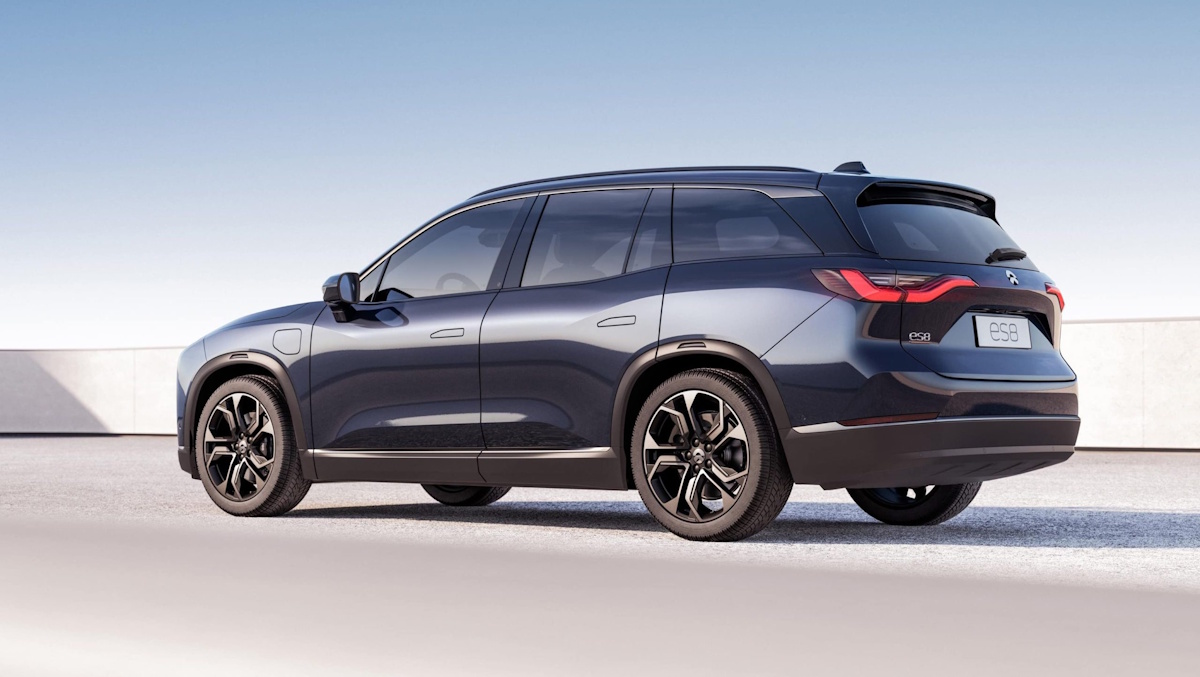
The German lineup currently consists of the ET5 sedan, the ET5 Touring estate variant, the EL6 SUV, and the second-generation EL8 large SUV. All four are available under Nio’s subscription programme. Inventory at the time of reporting was limited, with only a small number of ET5 Touring and EL6 vehicles listed.
Nio has been running a 0 percent interest financing promotion on 48-month terms for the ET5, ET5 Touring and EL6, initially set to expire on 31 March but subsequently extended to 30 June 2026. Notably, the offer applies specifically to vehicles with short-term registrations of up to 24 months, which suggests pre-registered or demonstration stock rather than new-build units.
One product notably absent from Germany is the Firefly, Nio’s more affordable sub-brand aimed at urban buyers. Firefly has begun deliveries in Norway and the Netherlands, and its smaller, more accessible price point might logically have broader appeal in the German market. For now, Firefly’s European strategy appears focused on markets where Nio already has an established, functioning distribution setup.
The Tariff Problem Has Not Gone Away
On top of the internal restructuring challenges, Nio continues to operate under the weight of EU tariffs on Chinese-made electric vehicles. Nio faces an additional duty rate that sits meaningfully above the standard 10 percent tariff applied to non-Chinese EVs. Those tariffs directly compress the margin available on every car sold, making an already difficult pricing equation harder still. You can read a full breakdown of how EU tariffs on Chinese electric vehicles work and which brands are affected.
Unlike some Chinese EV brands that have explored local European assembly as a way to sidestep those duties, Nio has not announced any manufacturing plans in Europe. That means every car it sells on the continent continues to carry the full tariff burden, which has a direct knock-on effect on the pricing it needs to charge to maintain any semblance of profitability per unit.
The Wider Nio Group Picture
It is worth separating what is happening with the Nio brand in Germany from the overall health of the Nio group. In China, the company has been recovering. Nio reported strong monthly deliveries in May 2026, and its new ES9 SUV has generated meaningful waiting times. The group’s sub-brands are also growing: Onvo’s L60 and the upcoming L90 are being positioned for the European market at more competitive price points than the main Nio brand has attempted, and Firefly delivered 5,663 vehicles globally in May, its second-best month of 2026.

The Nio brand itself made significant job cuts in 2025, with around 10,600 positions eliminated, roughly 40 percent of R&D staff. That cost-cutting exercise was aimed at reaching profitability in China, and it came with a clear message that the international expansion would be managed more carefully going forward.
Germany’s numbers are a reflection of that recalibration. Nio entered Europe with ambition and a premium proposition that made sense on paper but proved difficult to execute in practice. The current low registration figures are partly the cost of transitioning between models, between leadership teams and between business models. Whether the distributor-led approach will eventually produce better results remains to be seen. What is clear is that Nio is not currently treating Germany as a market where it can afford to invest at full scale.
Norway Has Seen a Similar Pattern
Germany is not an isolated case. Nio’s registration figures in Norway have also declined significantly, though Norway has historically been a stronger market for the brand. The pattern across multiple European countries points to systemic issues rather than market-specific ones.
Denmark has recently shown some movement, with the brand registering its first vehicles of the year there in May under a distributor arrangement. That could be an early indicator of whether the new model can generate traction, though three registrations in a single month is a very thin basis for optimism.
The German EV Market Is Growing, Just Not for Nio
The broader context makes Nio’s situation more striking rather than less. Germany registered 59,969 battery electric vehicles in May 2026, up 39.3 percent year on year, giving BEVs a 25 percent share of total new car registrations for the month. Tesla posted a 322.4 percent increase in registrations. BYD grew 232.1 percent to reach a 2.6 percent registration share. The EV market in Germany is not the problem, because other brands are finding buyers. Nio, at the moment, is not.
Featured Image Credit: Nio
Marko Lubar is the Founder and Editor of ElectricFleet Online, where he covers the latest developments in electric vehicles, battery innovation, autonomous driving, artificial intelligence, and the technologies shaping the future of mobility.
Learn more about Marko and the mission behind ElectricFleet Online on the About Us page.
Latest News