The article was updated on 16 July 2026 to reflect the latest information from the official European launch.
Xpeng launched the L03 globally today (16 July 2026) at an event in Munich, making it the first Mona-series model to go on sale simultaneously in China and Europe. The car has been known in China as the Mona L03 but will be sold internationally under the Xpeng L03 name, dropping the Mona badge entirely for overseas markets. Xpeng CEO He Xiaopeng described the compressed China-to-Europe timeline as “the fastest product rollout we’ve ever had”, and the Munich location for the global debut was a deliberate statement about where the brand sees its next growth coming from.
The L03 is the second model in the Mona series, following the M03 sedan that became Xpeng’s single biggest sales driver in 2025. The M03 delivered 175,689 units in 2025, accounting for around 41% of Xpeng’s total deliveries. It has not been available in Europe. The L03 changes that: a SUV Coupe body on the same mass-market pricing philosophy, designed for simultaneous global rollout from day one. It is one of the more interesting additions to the growing list of Chinese EVs worth considering in Europe, and one of several Chinese manufacturers now producing or selling at scale on the continent.
Xpeng currently assembles its G6, G9 and P7+ from kits at Magna Steyr’s facility in Graz, Austria. A fourth model has been announced for the same plant, and the L03 is the likely candidate. European pricing is confirmed across several markets and is covered in a dedicated section below.
Design and Dimensions
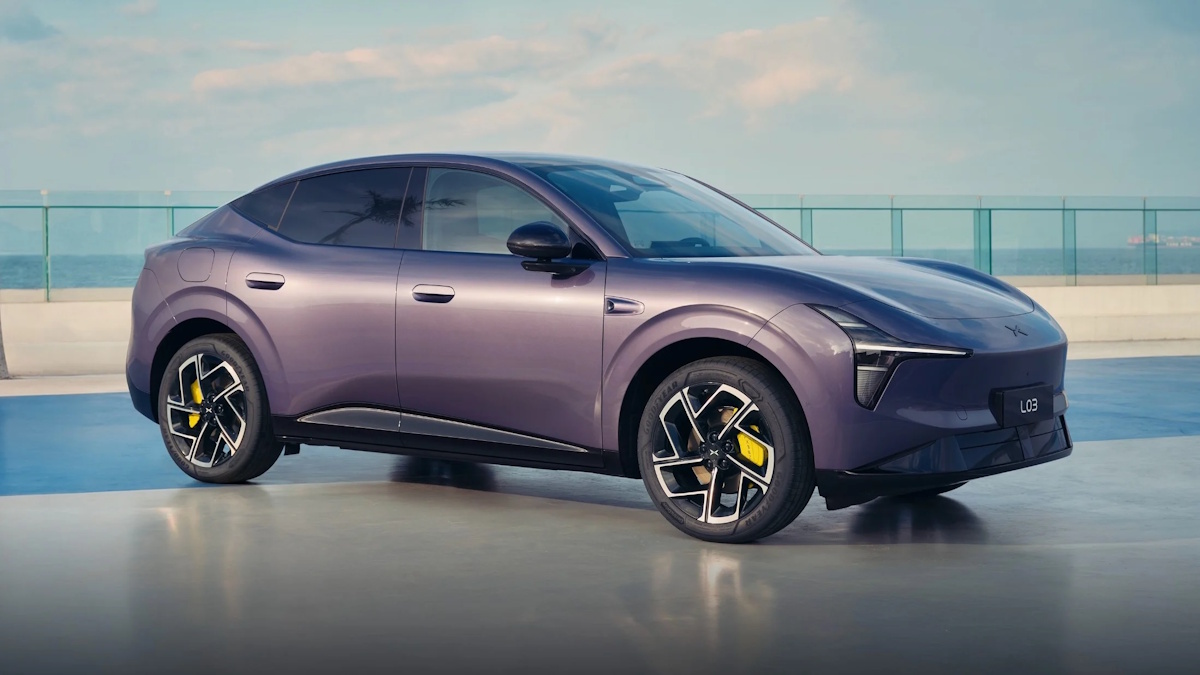
The L03 is a SUV Coupe with a fastback roofline and a low, wide stance. At 4,650 mm long, 1,920 mm wide and 1,600 mm tall on a 2,850 mm wheelbase, it sits right on the boundary between the compact and mid-size SUV segments. The car rides on 18 or 20-inch wheels depending on specification.

The door handles deserve a specific mention. The L03 uses manual pull-up door handles rather than electronic push-button or flush systems. This is not purely a stylistic choice: the Chinese government has banned electronic door handles on new EVs for safety reasons, citing concerns about occupant egress in the event of a power failure or collision. The result is a more conventional but also more reliable solution.
The aerodynamic work is notable. Twenty-three distinct optimisations across the exterior bring the drag coefficient to Cd 0.228, which Xpeng claims contributes approximately 59 km of additional range compared to a less optimised body.
| Practicality | Xpeng L03 |
|---|---|
| Length / width / height | 4,650 / 1,920 / 1,600 mm |
| Wheelbase | 2,850 mm |
| Boot space (seats up) | 367 l / 539 l (floor to roof) |
| Boot space (seats folded) | 1,640 litres |
| Frunk | 102 litres |
| Rear seat split | 40 / 20 / 40 |
| Towing capacity | 1,500 kg |
| Euro NCAP | Testing scheduled for 2027 |
| Drag coefficient | Cd 0.228 |
The Euro NCAP note is worth expanding on. The L03 is scheduled for testing in 2027, which means it will be assessed under the new 2026 Euro NCAP protocol rather than the previous framework. That protocol introduces four separate safety stages and includes real-world driving tests for speed sign accuracy, making it the most demanding assessment framework Euro NCAP has ever used. It will be a meaningful test of whether the L03’s safety architecture holds up to the new standard.

The interior centres on a 15.6-inch 2.5K central touchscreen and an 8.88-inch instrument cluster alongside a head-up display. A 20-speaker audio system with over 1,000W output is standard, alongside Road Noise Cancellation. The front passenger seat is a zero-gravity configuration with 14-point massage. There are 37 storage spaces throughout the cabin, including a 10-litre pull-out drawer under the rear seats. A 1.31 m² panoramic sunroof with low-E double-silver coating is fitted as standard. Towing capacity is 1,500 kg braked.
Battery, Range and Charging
The BEV version uses a single 183 kW (246 hp) electric motor, paired with LFP batteries in two capacities: 56 kWh and 69 kWh. CLTC range is 525 km and 625 km respectively, with energy consumption of 11.9 kWh per 100 km. The WLTP range for the top 69 kWh battery is up to 520 km, according to Xpeng’s official website.
Charging uses a 3C fast charging system capable of accepting up to 220 kW DC, with a 10-80% charge in 19.1 minutes. The L03 also supports V2L bidirectional charging at up to 6 kW. 0-100 km/h takes 6.6 seconds and top speed is 180 km/h (Long Range trim).
The L03 uses a 400V platform rather than the 800V architecture found in the more expensive Xpeng G6. This is a deliberate cost-saving decision that allows Xpeng to hit a lower price point, with the trade-off being a lower peak DC charging speed than the G6. The 10-80% time of 19.1 minutes is still competitive for a car in this segment and price range.
| Specification | Xpeng L03 |
|---|---|
| Battery | 56 kWh LFP / 69 kWh LFP |
| WLTP range | Up to 520 km (depending on trim) |
| Motor power | 183 kW (246 hp) |
| Drive | RWD / AWD |
| DC charging | up to 220 kW |
| DC 10-80% | 19.1 minutes |
| V2L | Yes, 6 kW |
| 0-100 km/h | 4.5 s to 7.8 s (depending on trim) |
| Top speed | 180 km/h |
Technology and Smart Driving
The L03’s technology package is where Xpeng is making its strongest pitch at this price point. Every version comes with Xpeng’s in-house Turing AI chip as standard. Lower specifications run a single Turing chip at 750 TOPS of computing power, supporting a distilled version of Xpeng’s second-generation Vision-Language-Action assisted driving system. Higher specifications step up to dual or triple Turing chips at up to 2,250 TOPS combined, running the full second-generation VLA platform.
The international versions of the L03, including European models, will replace all Chinese-market apps with a fully translated English interface and Google Voice Assistant integration. The L03 relies on cameras and radar for its driver assistance stack, without LiDAR, which is a conscious cost-saving choice that also reflects Xpeng’s confidence in its camera-based VLA system.
Pricing in Europe
With the launch confirmed, Xpeng has published pricing across several European markets via its official configurator. The prices below reflect the full cost after homologation, transport, dealer margins and applicable tariffs. The gap between Chinese (143,800 yuan, or €18,500) and European pricing is significant, but it is broadly in line with what other Chinese brands have experienced when entering the European market.
What the confirmed prices make clear is that the L03 is not a budget alternative to the Tesla Model Y. At €34,990 to €35,600 in the main continental markets, it sits below the Model Y in most countries but not by a margin that changes the category of buyer it is targeting. That makes the L03’s specification, range and technology package considerably more relevant as a direct comparison. For a full overview of Tesla Model Y alternatives in Europe, the L03 now belongs on that list.
| Country | Xpeng L03 | Tesla Model Y |
|---|---|---|
| Germany | €35,600 | from €39,000 |
| France | €34,990 | from €37,400 |
| Netherlands | €34,990 | from €41,000 |
| Denmark | 239,995 DKK (~€32,200) | 304,990 DKK (~€40,900) |
| UK | Announced, price TBC | from £41,990 |
Competitors in Europe
The L03 at 4,650 mm long sits at the larger end of the compact SUV segment. With confirmed European pricing in the €34,990 to €35,600 range, the competitive picture is now clear: this is a direct rival to the Tesla Model Y, Skoda Enyaq and Volkswagen ID.4, not a budget alternative to smaller cars.

The Tesla Model Y is the most obvious rival, with pricing that the L03 undercuts in every confirmed market, sometimes substantially as in Norway and Denmark. The Model Y has a Supercharger network advantage and considerably stronger brand recognition in Europe.
The Skoda Enyaq measures 4,649 mm long, almost identical to the L03, starting from around €36,000 with up to 578 km WLTP range and a five-star Euro NCAP rating.
The Volkswagen ID.4 at 4,584 mm long starts from around €37,000 with up to 546 km WLTP and five-star Euro NCAP credentials.
The Kia EV5 at 4,615 mm long is designed explicitly for global markets and is competitively priced for the class.
The BYD Sealion 7 at 4,830 mm is slightly larger but targets similar buyers, starting from around €42,000 with up to 502 km WLTP and a five-star Euro NCAP rating. My full Sealion 7 guide covers it in detail.
European Context
The L03 arrives at a moment when Xpeng is genuinely building momentum in Europe. The brand now operates in 28 European countries, having more than doubled its regional footprint over the past year. Germany saw a record month of 549 registrations in March 2026, as covered in my dedicated Germany piece. The P7+ has begun deliveries in France, as covered in my France deliveries piece.
If the L03 is assembled at Magna Steyr in Graz alongside the G6, G9 and P7+, it avoids some of the EU tariff exposure that affects Chinese-imported vehicles, which is likely part of why the pricing lands where it does. Full details of current Xpeng L03 specifications and configurator options are available at xpeng.com.
FAQ
What is the Xpeng L03?
The Xpeng L03 is a SUV Coupe with its global launch set for 16 July 2026 in Munich. In China it carries the Mona L03 name, but internationally, including in Europe, it is sold as the Xpeng L03. It is the second model in the Mona series, following the M03 sedan.
How much does the Xpeng L03 cost in Europe?
Confirmed prices from the official Xpeng configurator: Germany €35,600, France €34,990, Netherlands €34,990, Denmark 239,995 DKK (approximately €32,200), Norway 265,933 NOK (approximately €22,600). UK pricing had not been confirmed at time of writing.
How does the L03 price compare to the Tesla Model Y?
The L03 is cheaper than the Model Y in every confirmed market. In Germany the gap is around €3,400. In France around €2,400. In Norway and Denmark the difference is more significant due to local EV incentive structures. The L03 is not dramatically cheaper, but it does consistently undercut the Model Y while offering comparable or greater range and a more extensive technology package.
What is the WLTP range of the Xpeng L03?
Xpeng’s official website confirms a WLTP range of up to 520 km for the top battery.
How fast does the L03 charge?
The L03 supports DC fast charging up to 220 kW, with a 10-80% charge time of 19.1 minutes. It also supports V2L at up to 6 kW. Note that the L03 uses a 400V platform, unlike the Xpeng G6 which uses 800V.
Has the Xpeng L03 been tested by Euro NCAP?
Not yet. Euro NCAP testing is scheduled for 2027, which means the L03 will be assessed under the new 2026 protocol, the most demanding framework Euro NCAP has introduced. That protocol tests cars across four separate safety stages and includes real-world driving tests.
Why does the L03 have physical door handles?
The Chinese government has banned electronic door handles on new electric vehicles for safety reasons, specifically regarding occupant egress in the event of a collision or power failure. The L03 uses manual pull-up door handles as a result.
What is the difference between the Xpeng L03 and the Mona L03?
They are the same car. The Mona badge is used for the Chinese domestic market. For international markets including Europe, the car is sold as the Xpeng L03.
Featured Image Credit: Xpeng
Marko Lubar is the Founder and Editor of ElectricFleet Online, where he covers the latest developments in electric vehicles, battery innovation, autonomous driving, artificial intelligence, and the technologies shaping the future of mobility.
Learn more about Marko and the mission behind ElectricFleet Online on the About Us page.
Latest News