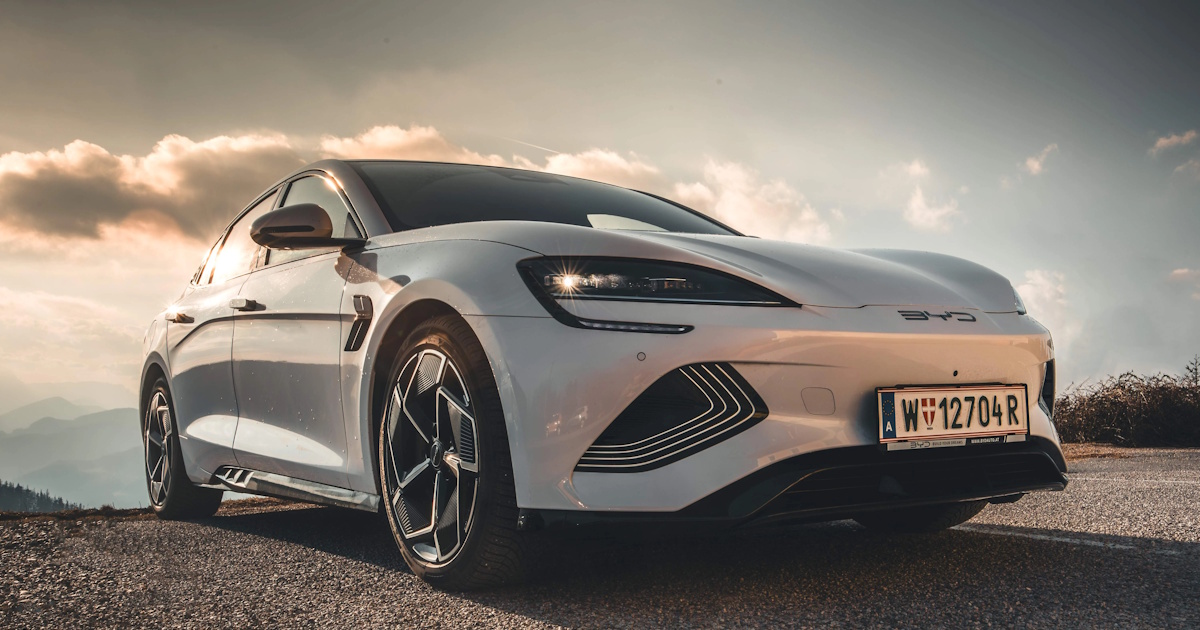
BYD is not a new name in Europe anymore. The Chinese manufacturer has been selling electric cars on the continent since 2022 and now offers one of the widest EV lineups of any single brand available here. Eight models are currently on sale across various European markets, ranging from a small city hatchback starting below €20,000 to a flagship SUV that competes with the Mercedes GLB on space and the Kia EV9 on price. Every one of them uses BYD’s own Blade Battery technology and is built on the company’s e-Platform 3.0, which BYD develops and manufactures entirely in-house.
Some of these models are now also assembled in Europe, at BYD’s factory in Hungary. That matters for pricing in countries where the EU’s additional tariffs on Chinese-imported EVs apply, and it matters for delivery times and local content requirements as the European market matures.
Here is what each model is, what it offers, and who it is for.
Table of Contents
- BYD Dolphin Surf
- BYD Dolphin
- BYD Atto 2
- BYD Atto 3 Evo
- BYD Seal
- BYD Seal U
- BYD Sealion 7
- BYD Tang
- A Note on the BYD Han
- Warranty
- FAQ
BYD Dolphin Surf
The Dolphin Surf is BYD’s most affordable European model and the one most likely to appear on a shortlist for a first car or a budget-conscious city driver. It’s a compact hatchback at 3,990 mm long, narrow enough for tight city streets and short enough to fit in spaces larger cars can’t manage.
Two battery sizes are available. The entry Active trim uses a 30 kWh LFP Blade Battery for a WLTP range of around 220 km. The Boost and Comfort trims step up to a 43.2 kWh LFP unit, good for around 322 km WLTP in Boost spec and around 310 km in Comfort trim, which has a more powerful motor.
It’s one of the best EVs for new drivers given its manageable size, safety kit and affordable entry price, and it has also earned recognition among city EVs with the best real-world range. It’s also one of the more interesting rivals for the upcoming Volkswagen ID.Polo.
BYD Dolphin
The standard Dolphin is a different car from the Dolphin Surf despite sharing the name. It is a proper C-segment hatchback at 4,290 mm long, directly targeting the Volkswagen ID.3 and its rivals. Where the Surf is a city car, the Dolphin is an everyday family hatchback with more space, more range and a more complete equipment list.

The larger battery (60.4 kWh) is delivering up to 427 km of WLTP range. The motor produces 150 kW (204 hp) with 310 Nm, good for a 0-100 km/h time of 7.3 seconds. AC charging is 11 kW, DC peaks at 88 kW with a 10-80% time of around 35 minutes. Boot space is 364 litres, expandable to 1,310 litres with the rear seats flat, and there is no frunk. A 360-degree parking camera comes as standard. All versions also include V2L.
BYD Atto 2
The Atto 2 is a subcompact SUV at 4,310 mm long, positioned between the Dolphin hatchback and the larger Atto 3 Evo. It sits in a competitive bracket alongside cars like the Renault 4, Volvo EX30 and Smart #1.
Two pure-electric trims are available in Europe: the Boost with a 45.1 kWh LFP battery for around 312 km WLTP, and the Comfort with a 64.8 kWh LFP battery for around 420 km WLTP and 155 kW DC charging (10-80% in 25 minutes). Both include 11 kW AC charging. Boot space is 400 litres, expanding to 1,340 litres flat. There is no frunk. A 12.8-inch rotating touchscreen, heat pump and 360-degree camera are standard across the range. In the UK market, the offering is slightly different: the 45.1 kWh battery option is not available, replaced instead by the 51.1 kWh battery for the Boost trim.
BYD Atto 3 Evo
The Atto 3 Evo is a significant step up from the original Atto 3. BYD has replaced the previous front-wheel-drive setup and 60.5 kWh battery with a rear-wheel-drive layout, a 74.8 kWh LFP Battery, and an 800V architecture enabling 220 kW DC fast charging. That is the biggest single change: the 10-80% charge time drops to around 25 minutes.

WLTP range is up to 510 km on the Design RWD and 470 km on the Excellence AWD, both from the same battery. A 101-litre frunk has been added for the first time, alongside a larger 490-litre boot. The Design makes 230 kW (313 hp) and hits 0-100 km/h in 5.5 seconds. The Excellence makes 330 kW (449 hp) combined and manages 3.9 seconds. It’s a strong alternative to the Volkswagen ID.3 Neo for buyers who want more performance and faster charging in a similar-sized package.
BYD Seal
The Seal is BYD’s D-segment electric sedan and the most driver-focused car in the lineup. At 4,800 mm long on a 2,920 mm wheelbase, it’s a proper large saloon, and the closest Chinese competitor to the Tesla Model 3 in terms of positioning and proportions.
The larger battery comes with a 82.5 kWh capacity. The Design RWD produces 230 kW (313 hp) and covers up to 570 km WLTP with a 0-100 km/h time of 5.9 seconds. The Excellence AWD combines a 160 kW front motor and 230 kW rear motor for 390 kW (530 hp) total, 0-100 km/h in 3.8 seconds and around 520 km WLTP. DC charging peaks at 150 kW on both variants, with a 30-80% time of around 36 minutes. AC is 11 kW. Boot space is 400 litres and there is a 53-litre frunk. The Seal earned a five-star Euro NCAP rating. One honest note from independent testers: real-world range on motorways can fall considerably short of the WLTP figure, and the range estimation system has drawn criticism for being less reliable than some European rivals.
BYD Seal U
The Seal U is the SUV version of the Seal, though it is a substantially different vehicle underneath. It’s a mid-size crossover at 4,785 mm long, closer in character to the Skoda Enyaq or Kia EV5 than to the Seal sedan. The base trim uses a 71.8 kWh LFP battery with 420 km of WLTP range, and the higher Design trim steps up to an 87 kWh LFP unit for up to 500 km WLTP.

All versions are FWD. AC charging is 11 kW, and DC charging peaks at 110 kW (71.8 kWh) or 130 kW (87 kWh). Boot space is 552 litres, but there is no frunk.
BYD Sealion 7
The Sealion 7 is BYD’s mid-size performance SUV, a step above the Seal U in both size and ambition. It measures 4,830 mm long with a 2,930 mm wheelbase, and its low-slung coupe-style roofline sets it apart from the more conventional crossover shapes in the BYD lineup. It’s one of the top-scoring cars for electric SUV child safety and a serious alternative to the Tesla Model Y. More detail on specs and trims is in my dedicated Sealion 7 guide.
Three trims cover the European range. The base trim uses an 82.5 kWh LFP battery with 482 km WLTP and RWD (230 kW). The Design trim uses the same battery in AWD configuration (390 kW combined) for 456 km. The Excellence package steps up to a 91.3 kWh LFP pack with 502 km WLTP and the same AWD setup. DC charging is 150 kW on Comfort and Design (10-80% in 32 minutes) and 230 kW on Excellence (10-80% in 24 minutes). All versions get 11 kW AC charging, a 58-litre frunk and 520 litres of boot space.
BYD Tang
The Tang is the biggest and most expensive BYD available in Europe: a large seven-seat electric SUV at 4,970 mm long on a 2,820 mm wheelbase, competing directly with the Kia EV9 and Mercedes GLB. It uses a 108.8 kWh LFP Blade Battery delivering 530 km of WLTP combined range, with a real-world figure in mixed driving closer to 450-460 km according to independent tests.

The AWD setup combines a 180 kW front motor and 200 kW rear motor for 380 kW (517 hp) total and 0-100 km/h in 4.9 seconds. DC fast charging peaks at 170 kW with a 30-80% time of around 48 minutes, which is slower than several rivals. AC charging is 11 kW. Cargo space is flexible: 235 litres with all seven seats in use, expanding to 1,655 litres with the second and third rows folded. There is no frunk. The Tang scored five stars from Euro NCAP with strong adult and child protection results.
A Note on the BYD Han
The Han was part of BYD’s original European launch in 2022, alongside the Tang and Atto 3. It’s a large electric sedan with a 521 km of WLTP range, and on paper it was an impressive proposition. In practice, it never found its footing in Europe. The entry price of around €72,000 placed it in premium territory against well-established rivals, and sales across markets were minimal.
The Han is still listed on BYD’s European website, but it’s no longer an active model in the majority of Europe. Stock is depleted and there’s no indication of a new version arriving to replace it. The successor, the BYD Dahan, has been revealed for the Chinese market and is a more ambitious car in every respect, but there’s no confirmed European launch date or pricing. Until that changes, the Han is more of a footnote in BYD’s European story than a current purchase option.
Warranty
BYD offers the same core warranty terms across all models in Europe, and it’s worth understanding before comparing with rivals. The vehicle warranty covers six years or 150,000 km. The battery and drive unit carry a separate eight-year or 250,000 km warranty. Anti-corrosion protection runs for twelve years with no mileage limit. Roadside assistance is included. Servicing is required every 20,000 km or 12 months, whichever comes first, to keep the warranty valid.
These terms are consistent across European markets. The battery warranty at 250,000 km is notably generous compared to most rivals, including Volkswagen Group, which offers eight years at 160,000 km, and several Korean manufacturers. The six-year vehicle warranty is also longer than the three-year standard of many European brands.
| Warranty | Coverage |
|---|---|
| Vehicle | 6 years / 150,000 km |
| Battery and drive unit | 8 years / 250,000 km |
| Anti-corrosion | 12 years, unlimited mileage |
| First service interval | 20,000 km or 12 months |
FAQ
Which BYD is the cheapest in Europe?
The BYD Dolphin Surf Active is the most affordable entry point, starting roughly from €19,000 in France. For a car with longer range, the Boost trim of the same model at around €22,000 is the realistic starting point for most buyers.
Do all BYD models use LFP batteries?
Yes. Every BYD currently sold in Europe uses LFP (lithium iron phosphate) Blade Battery technology. LFP chemistry is more thermally stable than NMC alternatives and can be charged to 100% regularly without significant degradation, which suits the long-distance warranty BYD offers. The trade-off is slightly lower energy density, meaning larger packs are needed for the same range. My LFP vs NMC explainer covers this in more detail.
Which BYD has the longest range?
The BYD Seal Design RWD leads at 570 km WLTP, followed by the Tang at 530 km and the Seal Excellence AWD at 520 km. Among SUVs, the Tang at 530 km is the range leader.
Where are BYD cars made for the European market?
BYD produces some of its European models at its factory in Debrecen, Hungary, which came online in 2025. The Dolphin Surf is among the models assembled there. The Hungary plant helps BYD avoid additional EU tariffs on Chinese-imported EVs, which affects pricing in certain markets.
Which BYD has five-star Euro NCAP?
The Dolphin Surf, Seal, Sealion 7 and Tang all carry five-star Euro NCAP ratings. The Atto 2 has not yet been tested. The Atto 3 Evo is the updated version of the original Atto 3, which was rated five stars, but the Evo has not yet received its own published result.
Featured Image Source: BYD
Latest News