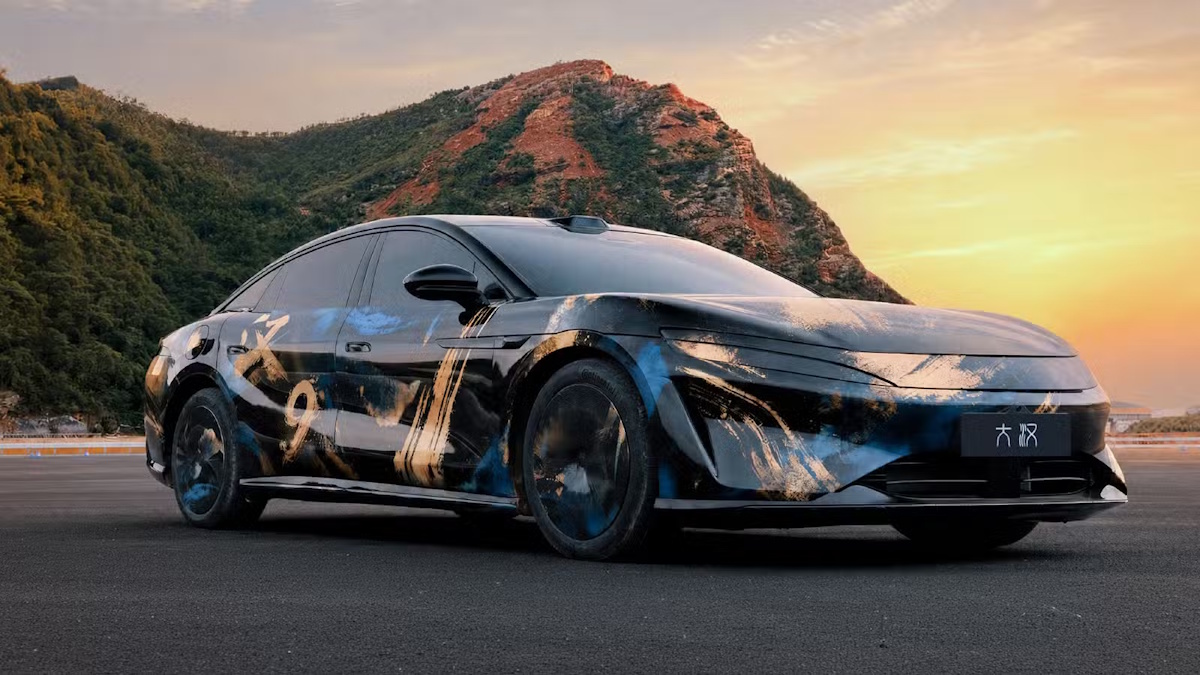
The BYD Han has been around since 2020 and spent much of that time proving that a Chinese electric sedan could genuinely compete with German alternatives. It worked, more or less. The Han became one of BYD’s most recognisable models and helped establish the brand’s credibility in the premium space. But the Han is getting old, and BYD’s ambitions have grown considerably. Enter the Dahan, also known as the Great Han, the brand’s first D-segment flagship sedan and a direct step up from everything that came before it. BYD just revealed the first official images, with a market launch planned for Q3 this year. The Han lineup is not going away entirely, but the Dahan is clearly where BYD wants people to be looking.
The name, incidentally, was chosen by BYD’s own customers. The brand ran a public crowdsourcing campaign with six candidate names, and Dahan won by a comfortable margin. It is a small detail but says something about how BYD is trying to build a relationship with the premium end of its audience.
What It Looks Like
The Dahan is still officially camouflaged in the released images, but spy shots have already revealed most of the exterior. The design follows BYD’s Dragon Face language, the same family look you see across the Dynasty range, but pushed considerably further upmarket. The front end has an integrated headlamp setup with a prominent horizontal trim piece connecting both sides, similar to what appeared on the Han L. From the side, it has a long wheelbase, a low stance and a fastback roofline that starts its descent at the B-pillar. The rear gets a full-width taillight assembly and a redesigned bumper that gives the whole thing a more formal appearance than the standard Han.

Inside, BYD says the cabin borrows from the Great Tang SUV, the brand’s upcoming flagship SUV that collected over 30,000 pre-orders within 24 hours of going on sale in late April 2026 and passed 100,000 total orders within two weeks. That is a useful reference point for what buyers can expect in terms of interior quality and technology. All variants of the Dahan get a roof-mounted LiDAR system as standard, supporting full-scenario intelligent driving assistance.
One note on those pre-order numbers: in the Chinese automotive market, “pre-orders” typically mean interest registrations, not binding purchase commitments backed by a deposit. BYD and most other Chinese manufacturers use these figures heavily in their marketing, but the conversion rate to actual sales is consistently much lower. The Great Tang’s 100,000 registrations in two weeks is an encouraging signal of consumer interest, but it tells you nothing reliable about how many cars will actually be delivered.
Powertrain and Range
The Dahan will be offered in both pure electric and plug-in hybrid configurations. The pure electric versions use BYD’s second-generation Blade Battery, an LFP unit paired with a 1,000V high-voltage architecture. That combination enables megawatt-level flash charging, part of BYD’s broader push into ultra-fast charging that I have covered separately when looking at BYD flash charging and the tradeoffs involved.
Two pure electric variants are confirmed. The Flagship Edition runs all-wheel drive with LiDAR and achieves a CLTC range of around 880 km. The Exclusive Edition is rear-wheel drive, also with LiDAR, and stretches the CLTC figure to approximately 1,008 km. CLTC ratings are measured under Chinese test conditions and tend to run higher than WLTP, which is the standard used in Europe. A realistic WLTP equivalent for the Exclusive Edition would be in the region of 750 to 800 km, and for the Flagship Edition closer to 650 to 700 km. Either way, these are extraordinary numbers for a production saloon.
Why This Matters: BYD Needs This to Work
There is some important context worth including here. BYD had a difficult start to 2026. Net profits dropped sharply in the first quarter due to price competition in China and rising supply chain costs. The Han L, the current mid-cycle updated Han, has been struggling badly: April sales fell 69.5% year-on-year to just over 1,000 units. That is a car that was supposed to revitalise the lineup, and it has clearly not done the job.

The Dahan is BYD’s answer to that problem. Moving upmarket is both a commercial necessity and a brand evolution. If the brand wants to sustain margins while competing against Nio, Xpeng, Xiaomi and an increasingly aggressive Huawei automotive division, a proper D-segment flagship is not optional. The Great Tang SUV’s pre-order numbers suggest buyers are willing to spend at this level on a BYD product, and the Dahan is trying to replicate that enthusiasm in the saloon segment.
BYD’s overall numbers are also improving after a rocky stretch. Wholesale volume reached 383,453 new energy vehicles in May 2026, a small year-on-year increase that ended an eight-month declining streak. More importantly, the production bottleneck caused by upgrading factories to build the second-generation Blade Battery appears to have been resolved in May, which means supply should no longer be the limiting factor going forward. BYD is also one of the world’s top 10 automakers by global sales, and the Dahan is part of a wider push to ensure it stays there while also moving into segments where margins are better.
Will It Come to Europe?
That is the obvious question for anyone reading this outside China. There is no confirmed European launch for the Dahan at this stage. BYD is already producing cars in Europe through its factory in Hungary, but current Hungarian production is focused on more accessible models. A flagship D-segment saloon at premium pricing is a harder sell in Europe than the Atto 3 or the Dolphin, and BYD will want to see how the car performs in China before committing to a European rollout.
What we know is that BYD’s overseas sales hit a record 160,644 units in May 2026, up 80.4% year-on-year. The appetite for premium Chinese EVs internationally is clearly growing. If the Dahan lands well in China, a European announcement seems more likely than not within the next 12 to 18 months. Watch the Han page on the site for updates as the story develops, and my earlier reporting on the upcoming Han flagship with 900V charging has more background on how this car has been developing.
FAQ
What is the BYD Dahan?
The Dahan, also called the Great Han, is BYD’s new D-segment flagship sedan. It sits above the existing Han in the Dynasty lineup and is the brand’s most ambitious saloon to date. Official images were released on 8 June 2026, with a market launch expected in Q3 2026.
How is the Dahan different from the BYD Han?
The Han is a C-segment executive saloon that launched in 2020. The Dahan is a full D-segment flagship, physically larger, positioned higher in the market, and built on more advanced technology including second-generation Blade Battery and a 1,000V charging architecture. The two models coexist in the Dynasty lineup, with the Dahan targeting buyers who want something closer to a Mercedes E-Class or BMW 5 Series in ambition.
What is the range of the BYD Dahan?
BYD has announced two pure electric variants. The Flagship Edition with AWD delivers around 880 km on the CLTC cycle, which would translate to approximately 650 to 700 km under WLTP conditions. The Exclusive Edition with RWD claims around 1,008 km CLTC, or roughly 750 to 800 km on a WLTP-equivalent basis.
Does the Dahan have LiDAR?
Yes. LiDAR is standard on all variants of the Dahan and supports full-scenario intelligent driving assistance, including functions that typically require a clear line of sight in more complex traffic environments.
Will the BYD Dahan be sold in Europe?
There is no confirmed European launch date. BYD is currently building cars in Hungary for the European market, but current production there is focused on more affordable models. A European arrival for the Dahan is possible within 12 to 18 months if the Chinese launch goes well, but nothing has been announced.
When does the BYD Dahan go on sale?
BYD has confirmed a Q3 2026 launch in China. Pricing has not yet been announced, but the Great Tang flagship SUV, its platform sibling, launched with pre-sale prices starting at around RMB 250,000 (approximately €32,000), rising to RMB 320,000 (approximately €41,000) for the top variant.
Featured Image Source: BYD
Marko Lubar is the Founder and Editor of ElectricFleet Online, where he covers the latest developments in electric vehicles, battery innovation, autonomous driving, artificial intelligence, and the technologies shaping the future of mobility.
Learn more about Marko and the mission behind ElectricFleet Online on the About Us page.
Latest News