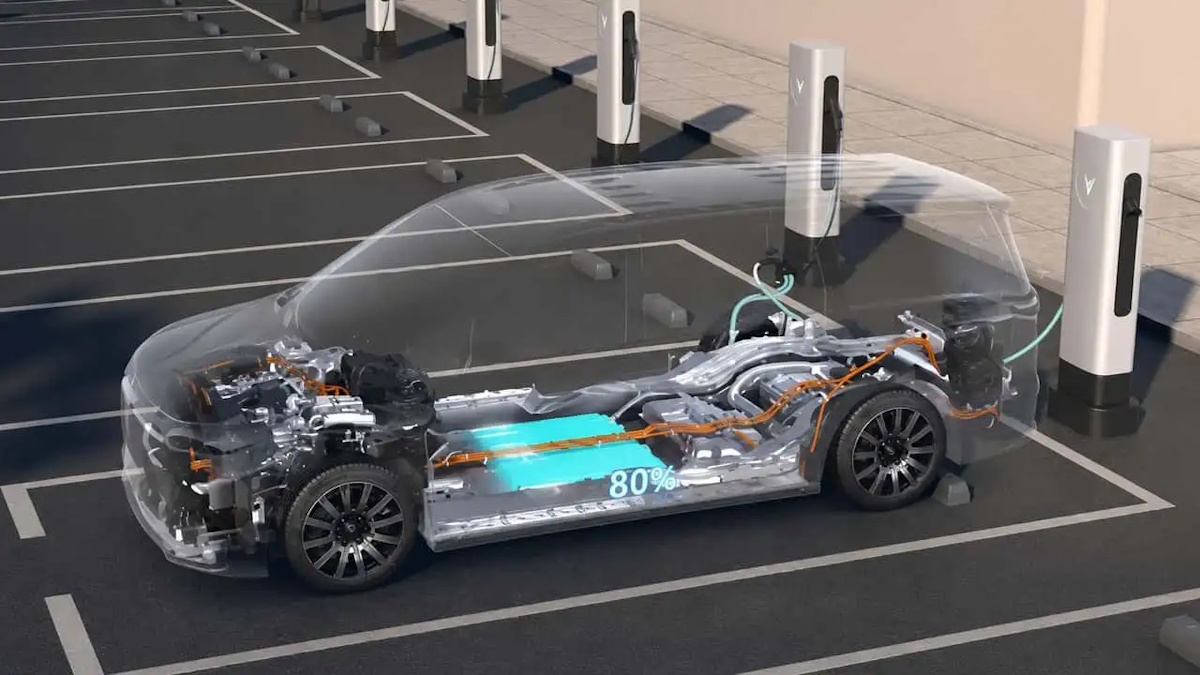
China’s charging speed war just gained a serious new competitor. Dongfeng, the state backed giant better known for commercial trucks and its Nissan joint venture, has unveiled an in house developed 1.5 MW ultra fast charger that goes head to head with BYD’s most powerful hardware. Dongfeng held the reveal on July 29 at its Global Innovation Center in Wuhan, alongside a new kilovolt electric drive system built for the same generation of high voltage charging.
What Dongfeng Actually Unveiled
The headline number is a single charging connector capable of delivering up to 1,500 kW, exactly matching the peak output of BYD’s second generation Flash Charger from March. Here is how the two stack up on paper.
| Specification | Dongfeng megawatt charger | BYD Flash Charger (Gen 2) |
|---|---|---|
| Peak single gun power | 1,500 kW | 1,500 kW |
| Peak current | 1,500 A | Not disclosed |
| Voltage range | 150V to 1,000V | Not disclosed |
| Host cabinet power | 1.2 MW, expandable to 2.4 MW+ | Not disclosed |
| System efficiency | 96.7% or higher | Not disclosed |
| Efficiency certification | Level 1 under GB 46519 2025 | Not disclosed |
| Announced deployment | Not yet confirmed | 20,000 stations in China by end of 2026 |
Dongfeng’s system is built around a 1.2 MW host cabinet, and operators can pair multiple cabinets together to push total installed capacity to 2.4 MW or beyond. If both guns at a station are in use at once, the available power gets shared automatically between the two cars. The wide 150V to 1,000V voltage window is the more interesting engineering detail here, since it means the same hardware can serve older, lower voltage EVs and next generation kilovolt platforms without needing separate equipment.
One thing worth being clear about. Dongfeng has not disclosed a charging curve or a 10 to 70 percent time for any of its own production vehicles. The charger itself does not create fast charging on its own, the battery chemistry and thermal management on the car side still decide how much of that 1,500 kW actually gets used. BYD’s own claim of a five minute top up only applies to vehicles running its latest Blade Battery, and pushing charging speeds that far already raises real questions, as I covered when BYD’s megawatt charging tests reportedly hit 76°C in battery temperature.
Dongfeng Is Not Stopping at 1.5 MW
Alongside the charger, Dongfeng rolled out the iD5-300SN, its first kilovolt electric drive. It uses a 1,500V rated silicon carbide power module, runs across a 450V to 1,000V range, and produces up to 300 kW of peak power, which Dongfeng says is around 30 percent denser than its previous generation drive. The unit is built to work with today’s 800V platforms while remaining expandable to future 1,200V architectures.
That drive will sit under Dongfeng’s Mach platform, and the first car built on it is expected to be a full size SUV from Epicland, a premium brand Dongfeng is developing jointly with Huawei. For now, Epicland is a China only project with no confirmed date for European availability.
Dongfeng also confirmed a next generation charger family is already in development, with outputs ranging from 720 kW right up to 2.4 MW and built in battery storage to buffer the load on the local grid. That last point matters more than it sounds. A megawatt draw from a single charging bay is a serious ask for any electrical network, and buffering with onsite batteries is the same approach BYD already uses at its own Flash Charging stations.
Everyone In China Is Racing The Same Clock
Dongfeng and BYD are not fighting this battle alone. Hongqi recently claimed an experimental battery that goes from 10 to 70 percent in three minutes and 41 seconds, and CATL says its third generation Shenxing LFP cell can hit 10 to 80 percent in under four minutes. It is worth remembering that CATL is also the company pushing hardest on the alternative approach, and I looked at how BYD’s flash charging is already narrowing the gap with Nio’s battery swapping model earlier this year. Charging and swapping are increasingly converging on the same five minute target, just from opposite directions.
None of this happens in isolation from the wider battery story either. China is currently taxing conventional lithium cells while exempting sodium ion and solid state chemistry, which is exactly the kind of policy push that speeds up developments like this one, something I broke down in more detail in the next generation battery race piece. CATL’s sodium ion push already has a European foothold too, through its grid storage deal with Alfen, so the crossover between Chinese charging hardware and European infrastructure is not entirely theoretical.
What This Means For Dongfeng In Europe
Here is the part that actually matters for European buyers. Dongfeng is genuinely trying to grow here. The company announced a joint venture with Stellantis earlier this year to sell its premium Voyah brand across Europe, with plans to eventually localise production at Stellantis’ Rennes plant in France to meet Made in Europe rules. Voyah already launched its Free model in Germany, which I covered in my piece on that launch, so the brand is not starting from zero here. Dongfeng Europe has talked about tripling sales to around 80,000 units in 2026, spread across the Dongfeng, Voyah and M-Hero brands.
The Dongfeng Box, the brand’s small entry level EV, is already on sale in several European markets, though I would flag that it only managed a three star Euro NCAP rating under the tougher 2025 protocol, so it is not a car I would recommend without reservations.
What Dongfeng has not said is whether any of this 1.5 MW charging technology, the iD5-300SN drive, or the Epicland brand has a European rollout plan. Nothing announced so far points that way, and the practical challenge is bigger than one company’s roadmap. European charging networks are still overwhelmingly built around 150 to 350 kW hardware, and the grid connections needed to support a single 1.5 MW bay are simply not common infrastructure here yet. BYD is already ahead on this front, with plans to install more than 3,000 high power stations across Europe by the end of 2026, so if any Chinese brand brings megawatt charging to this continent first, BYD remains the far more likely candidate.
My Take
Watching Dongfeng and BYD trade megawatt figures is entertaining, but the number on the spec sheet is the easy part. The challenge is everything around it, the battery chemistry that can actually absorb that power without overheating, the grid connections needed to feed it, and a vehicle lineup built specifically to use it. Dongfeng has now ticked the first box. Whether any of this reaches a European charging bay in the next few years depends far more on Europe’s own grid capacity than on anything Dongfeng decides in Wuhan.
FAQ
How powerful is Dongfeng’s new charger? It delivers up to 1,500 kW through a single charging connector, matching the peak output of BYD’s second generation Flash Charger.
Can Dongfeng’s charger really charge a car in five minutes? Dongfeng has not disclosed a charging time for its own vehicles. The hardware supports very high power, but actual charging speed depends on the car’s battery and thermal system, not just the charger.
Is Dongfeng bringing this charging technology to Europe? Not that the company has announced. Dongfeng is expanding in Europe through its Stellantis joint venture for the Voyah brand, but nothing has been said about bringing the 1.5 MW charger or the iD5-300SN drive to European markets.
What is the iD5-300SN? It is Dongfeng’s first kilovolt electric drive, built around a 1,500V rated silicon carbide power module with up to 300 kW of peak power, designed to work with the new charging platform.
Does BYD or Dongfeng have more charging stations planned for Europe? BYD is currently the more advanced of the two here, with plans for more than 3,000 high power stations across Europe by the end of 2026. Dongfeng has not announced a comparable rollout.
Featured Image: Dongfeng
Marko Lubar is the Founder and Editor of ElectricFleet Online, where he covers the latest developments in electric vehicles, battery innovation, autonomous driving, artificial intelligence, and the technologies shaping the future of mobility.
Learn more about Marko and the mission behind ElectricFleet Online on the About Us page.
Latest News