Zeekr is a premium EV brand owned by Geely, the same Chinese group that also owns Volvo, Polestar and Smart. That’s relevant because Zeekr shares platforms and technology with those brands, which goes some way to explaining why its cars feel different from many of the Chinese EVs currently arriving in Europe. The design operation is based in Gothenburg, the European headquarters is in Amsterdam, and the cars are engineered to a level that tends to surprise people who haven’t heard of the brand before.
There are currently four models available in Europe: the Zeekr X, Zeekr 001, Zeekr 7X and Zeekr 7GT. Every Zeekr model tested by Euro NCAP so far has received a five-star rating, while the 7GT is still awaiting its assessment. All four come with a 22 kW onboard AC charger as standard, which is notable because most rivals stop at 11 kW and 22 kW AC is genuinely useful if you have a compatible home wallbox or workplace charger. All four also include a frunk, though the size varies considerably between models and configurations.
One important caveat before we get into the details: owner feedback from the European community points to ADAS systems that can be overly intrusive, and OTA software updates for European cars have been slower to arrive than what Chinese owners receive. Zeekr has been addressing this progressively, but it’s worth knowing about before you buy.
Zeekr is already present in several European markets, including the Netherlands, Sweden, Norway, Germany and France, with the company planning to expand its footprint across Europe in the coming years. Here’s what each car actually is, and what the numbers look like side by side.
Table of Contents
- Zeekr X: The Compact Urban SUV
- Zeekr 001: The Luxury Shooting Brake
- Zeekr 7X: The Mid-Size Family SUV
- Zeekr 7GT: The Electric Estate
- The 009: Coming to Europe
- The Software Situation in Europe
- Warranty
- FAQ
Zeekr X: The Compact Urban SUV
The Zeekr X is the entry point into the Zeekr lineup and the most city-focused car of the four. It’s a compact crossover SUV measuring 4,432 mm long, which puts it in the same bracket as the Smart #1 and Volvo EX30, both of which share the same Geely SEA platform underneath. The design is distinctive for the class: frameless doors, a coupe-style roofline and a B-pillar-mounted circular display that shows charging status from outside the car. It’s available in three variants across RWD and AWD configurations.

The battery is a 69 kWh NMC unit, and the WLTP range is up to 415 km for the AWD Privilege and around 405 km for the Long Range RWD, with the Core RWD at 330 km. AC charging tops out at 22 kW and DC at 150 kW, with a 10-80% charge taking between 18 and 30 minutes, depending on a trim. The boot holds 404 litres with the seats up, which is on the smaller side for the class, and there’s a small frunk. If you’re comparing it with other urban SUVs, my guide to the best urban SUV EVs for city driving covers the wider field. It’s also one of the more interesting alternatives to the Volkswagen ID.3 if you want something compact but with more SUV character.
| Specification | Zeekr X |
|---|---|
| Battery | 41 kWh (LFP) / 61 kWh (LFP) / 69 kWh (NMC) |
| WLTP range | 330 km / 405 km / 415 km |
| Motor / drive | RWD or AWD |
| AC charging | Up to 22 kW |
| DC charging | Up to 230 kW (10-80% in 18 min) |
| Boot space | 404 litres |
| Frunk | Yes |
| Euro NCAP | 5 stars |
Zeekr 001: The Luxury Shooting Brake
The 001 is the one that put Zeekr on the map in Europe. It’s a large, low-slung shooting brake: 4,955 mm long with a 2,999 mm wheelbase. That’s genuinely big, and the proportions are striking. It’s available as a long-range RWD or a performance AWD, both using a 100 kWh NMC battery.

The RWD makes 200 kW and covers up to 620 km WLTP. The AWD makes 400 kW, drops to around 590 km WLTP and gets from 0-100 km/h in 3.8 seconds. The 001 uses a 400V architecture with 22 kW AC and 200 kW DC charging. The boot is 539 litres with seats up and expands to a huge 2,144 litres flat, more than many mid-size SUVs. There’s also a 32-litre frunk.
| Specification | Zeekr 001 |
|---|---|
| Battery | 100 kWh (NMC) |
| WLTP range | Up to 620 km (RWD) / 585 km (AWD) |
| Motor / drive | RWD (200 kW) or AWD (400 kW) |
| AC charging | 22 kW |
| DC charging | 200 kW (10-80% in ~30 min) |
| Boot space | 539 L (seats up) / 2,144 L (flat) |
| Frunk | 32 litres |
| Euro NCAP | 5 stars |
Zeekr 7X: The Mid-Size Family SUV
The 7X is Zeekr’s most practically minded car and the one most likely to be on a family’s shortlist. It’s a five-seat mid-size SUV at 4,787 mm long, built on the PMA2+ platform which it shares with the Smart #5 and Polestar 4. The boot holds 539 litres, there’s a frunk of 66 litres on RWD models (42 litres on AWD), and the rear seat legroom is genuinely generous. It comes in three variants: Core RWD, Long Range RWD and Privilege AWD.

Here’s where it gets interesting on the charging side. The 7X uses an 800V architecture and can accept up to 480 kW of DC power, which puts the 10-80% charge time at 13 minutes for the Core model and 16 minutes for the Long Range. That’s class-leading, and I’ve covered Zeekr’s Golden Battery technology in more detail separately. The Core uses a 75 kWh LFP battery for 480 km WLTP. The Long Range and Privilege use a 100 kWh NMC battery for up to 615 km WLTP. All versions have 22 kW AC as standard.
It’s one of the stronger options in the Tesla Model Y alternatives category, and worth looking at if Euro NCAP child safety scores matter to you: our guide to electric SUVs with the best child safety ratings covers where it stands.
| Spec | Zeekr 7X |
|---|---|
| Battery | 75 kWh (LFP) / 100 kWh (NMC) |
| WLTP range | 480 km / 543 km / 615 km |
| Motor / drive | 310 kW (RWD) or 475 kW (AWD) |
| AC charging | 22 kW (all variants) |
| DC charging | up to 480 kW (10-80% in 13-16 min) |
| Boot space | 539 litres |
| Frunk | 66 L (RWD) / 42 L (AWD) |
| Euro NCAP | 5 stars |
Zeekr 7GT: The Electric Estate
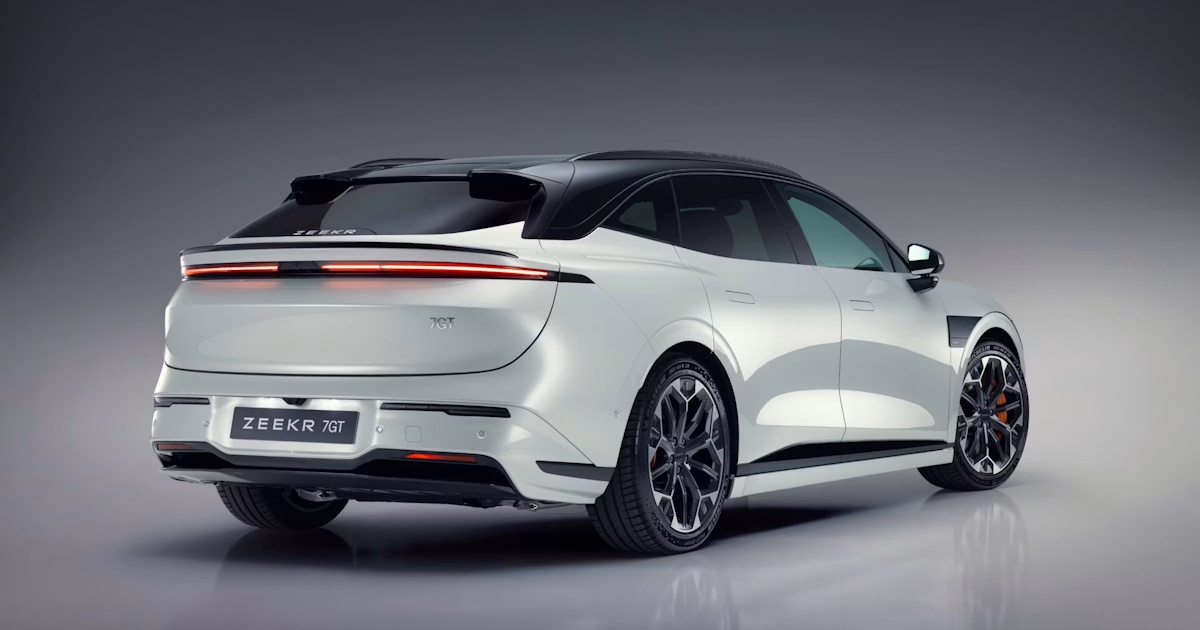
The 7GT is the newest arrival and the most unusual choice of the four. It’s an electric estate car, a body style that almost no other EV manufacturer in Europe is currently offering. The car is 4,817 mm long with a 2,900 mm wheelbase and sits low at 1,460 mm tall, giving it a sporting GT profile rather than the upright stance of a conventional estate.

Like the 7X, it runs on an 800V architecture with the same battery options: 75 kWh LFP in the Core RWD and 100 kWh NMC in the Long Range RWD and Privilege AWD. DC charging peaks at 480 kW, with the 10-80% time at 13 minutes for the Core and around 16 minutes for the Long Range. The Long Range RWD achieves 655 km WLTP, the highest figure in the Zeekr Europe lineup. The AWD Privilege drops to around 558 km and sprints from 0-100 km/h in 3.3 seconds.
Boot space is 456 litres with seats up and 1,390 litres folded. The frunk is 65 litres on RWD models and 32 litres on the AWD. A standout feature on Long Range and Privilege trims is the 35.5-inch augmented reality head-up display, projected across the full width of the windscreen. In France, Zeekr has already confirmed availability and pricing for all four models.
| Spec | Zeekr 7GT |
|---|---|
| Battery | 75 kWh (LFP) / 100 kWh (NMC) |
| WLTP range | 519 km / 558 km / 655 km |
| Motor / drive | RWD or AWD |
| AC charging | 22 kW (all variants) |
| DC charging | up to 480 kW / 800V (10-80% in 13-16 min) |
| Boot space | 456 L (seats up) / 1,390 L (folded) |
| Frunk | 65 L (RWD) / 32 L (AWD) |
| Euro NCAP | No data |
The 009: Coming to Europe
The Zeekr 009 is a large electric MPV that sits outside the mainstream four-model lineup but is worth a mention. It’s not a compact city car or a family SUV but a proper seven-seat luxury people carrier with a 116 kWh battery, up to 670 km WLTP range and 22 kW AC charging. Ive covered it in full in a separate article if that’s the kind of vehicle you’re looking for.
The Software Situation in Europe
This is the section that tends not to appear in official press materials, but it’s relevant if you’re actually living with one of these cars day to day.
Zeekr does issue OTA software updates for European cars. The OS 1.2 update for the 001, released in 2025, reduced the frequency of ADAS audio alerts, lowered the maximum speed at which Lane Keep Assist operates from 180 to 130 km/h, made its interventions smoother, and reduced the sensitivity of the Driver Monitoring System. The OS 1.3 update for the X followed, reducing the blind spot detection alarm from a continuous sound to two cycles, improving Emergency Lane Keeping Assist on narrow roads, and fixing various camera-related bugs.
That’s progress. The issue that European owners raise consistently, however, is that these updates arrive considerably later than equivalent updates for Chinese-market cars, and the gap between what Chinese owners have access to and what European owners are running can be significant. Advanced navigation-integrated driving assistance features that are available in China via OTA haven’t made it to Europe yet. Owners of the 7X in particular have reported that the European ADAS specification is more limited than what’s available in other markets.
The second recurring theme is that even after updates, some ADAS systems remain more sensitive than most European drivers are used to. Lane-keeping interventions that feel abrupt, Driver Monitoring System warnings that trigger too easily, and blind spot alerts that can feel persistent are comments that appear regularly in the European owner community. These aren’t safety issues, and they don’t affect the Euro NCAP rating. But if you’re the kind of driver who finds intrusive systems irritating enough to switch them off, it’s worth knowing that Zeekr’s ADAS tuning for Europe is still catching up with where it needs to be.
The underlying hardware is capable. The Qualcomm Snapdragon 8295 chip that powers the infotainment across the 7X, 7GT and newer models is a genuinely fast platform, and the OTA infrastructure is in place. The question is pace, and that’s something Zeekr will need to demonstrate more convincingly as it expands across more European markets.
Warranty
The vehicle warranty operates on a 5+5 structure. Every new Zeekr comes with five years or 100,000 km of standard coverage. If you have your car serviced within the Zeekr-authorised service network throughout the ownership period, that extends to a total of ten years or 200,000 km, whichever comes first. The battery carries a separate eight-year or 200,000 km warranty. Three years of roadside assistance is included from the date of registration.
Accessories fitted before delivery by an authorised dealer are covered for the full warranty period. Accessories fitted after delivery carry 24 months or 20,000 km of coverage.
| Warranty | Coverage |
|---|---|
| Vehicle (standard) | 5 years / 100,000 km |
| Vehicle (extended, Zeekr service network) | 10 years / 200,000 km |
| Battery | 8 years / 200,000 km |
| Roadside assistance | 3 years from registration |
| Paintwork | 4 years |
| Corrosion | 12 years |
| Accessories (fitted before delivery) | Full warranty period |
| Accessories (fitted after delivery) | 24 months / 20,000 km |
FAQ
Does every Zeekr model come with 22 kW AC charging?
Yes. All four models available in Europe come with a 22 kW onboard AC charger as standard. That’s unusual in this segment and genuinely useful if you have access to a 22 kW wallbox at home or at work, since it significantly reduces overnight charging times compared to the 11 kW chargers most rivals offer.
Which Zeekr models use an 800V architecture?
The Zeekr 7X and 7GT both use 800V architecture with DC charging capability of up to 480 kW. The Zeekr 001 uses a 400V architecture with up to 200 kW DC, and the Zeekr X supports up to 230 kW DC. The 800V system delivers the fastest top-ups on longer journeys.
What battery type does each Zeekr use?
The entry-level Core variants of the 7X and 7GT use LFP (lithium iron phosphate) batteries, which are more durable over high charge cycles but slightly less energy-dense. The Long Range and AWD variants of those models, plus both 001 variants and the X, use NMC (nickel manganese cobalt) batteries. My LFP vs NMC explainer covers the trade-offs in detail.
What is Zeekr’s warranty?
Every new Zeekr comes with a 5+5 vehicle warranty: five years or 100,000 km as standard, extendable to ten years or 200,000 km if the car is serviced within the Zeekr-authorised network. The battery carries a separate eight-year or 200,000 km warranty. Three years of roadside assistance are included from registration. Paintwork is covered for four years and corrosion protection for twelve years.
Does the Zeekr X have five-star Euro NCAP?
Yes. The Zeekr X was named the safest EV of 2024 by Euro NCAP, earning the highest combined score of any car tested that year.
Are Zeekr’s ADAS systems reliable in Europe?
The hardware is capable, but European owners have reported that driver assistance systems can be overly intrusive, and OTA software updates arrive later in Europe than in China. Zeekr has been addressing this with updates that have reduced Lane Keep Assist sensitivity and lowered the frequency of Driver Monitoring System alerts. It’s improving, but worth factoring in if you’re sensitive to intrusive safety systems.
Featured Image Source: Zeekr
Latest News