Electric cars feel like a 21st century idea, something that started with the Tesla Roadster or maybe the Nissan Leaf. It’s not true. The electric car is older than the Ford Model T, older than the traffic light, and older than some of the countries currently building them. By 1900, roughly a third of all cars on American roads ran on batteries, not petrol. I wanted to go back and find out who actually built the first one, and along the way I found a small cast of engineers, taxi drivers, a Belgian speed demon and Thomas Edison himself, all wrestling with exactly the same problems EV buyers argue about today: range, weight, charging and cost.
So Who Actually Built the First One?
The answer is that it depends what you count as a “car.”
Small scale electric experiments go back further than most people expect. Hungarian inventor Ányos Jedlik built a tiny electric motor and used it to power a model vehicle in 1828. American blacksmith Thomas Davenport did something similar in 1834, running a small electric car on a short circular track. Scottish inventor Robert Anderson is often credited with a cruder electric carriage sometime between 1832 and 1839. None of these carried a person anywhere useful, and none of them could be recharged. They ran on early primary cell batteries that had to be replaced with fresh chemicals once drained, which made them closer to science demonstrations than transport.
The real turning point came in 1859, when French physicist Gaston Planté invented the rechargeable lead-acid battery. For the first time, a vehicle could plug back in rather than needing its power source rebuilt every time it ran flat. French engineer Camille Faure improved the design further in 1881, increasing how much charge the batteries could hold and how reliably they gave it back.
That same year, French electrical engineer Gustave Trouvé fitted an improved Siemens electric motor and one of these rechargeable batteries to a tricycle and drove it down a street in Paris. It’s widely considered the first practical, person carrying electric vehicle ever demonstrated in public. Trouvé never patented it. French law at the time required inventors to deposit a working model with the patent office, and he wasn’t willing to hand his over, so he moved on and adapted the same motor into what became the first outboard boat engine instead.

Three years later, in 1884, British engineer Thomas Parker built an electric car in Wolverhampton, England, that’s often cited as the first proper production electric car, though the only surviving documentation is a photograph from 1895. Parker had already electrified sections of the London Underground, and he kept driving his own electric cars to work for years afterward, at a legally mandated top speed of 4 mph on country roads. In 1888, German engineer Andreas Flocken built the Flocken Elektrowagen, a four wheeled, carriage bodied electric car that some historians point to as the first vehicle that actually looked and functioned like what we’d now call a car, rather than a motorised tricycle.
So depending on how strict your definition is, credit goes to Trouvé for the first practical demonstration, Parker for the first production example, or Flocken for the first proper four wheeled car. What’s not in dispute is the date. All of this happened between 1881 and 1888, roughly two years before Karl Benz’s Patent Motorwagen made the combustion engine a going concern. Electric cars didn’t follow the petrol car. They came first.
Six Electric Cars History Forgot
Once the basic technology existed, a genuinely strange and inventive few decades followed. Here are six of the more interesting machines from it, why each one was actually built, what it was good and bad at, and what happened to it.
Egger-Lohner P1 and the Lohner-Porsche Mixte (Vienna, 1898 to 1901)
This one has a twist. A 22 year old engineer named Ferdinand Porsche, decades before he founded the car company that bears his name, built his first ever vehicle for Austrian carriage maker Jacob Lohner, and it was fully electric. The Egger-Lohner C.2 Phaeton, which Porsche stamped “P1” for Porsche Number One, appeared on the streets of Vienna in June 1898. It used an eight sided electric motor Porsche designed himself, producing three to five horsepower, good for a top speed of around 35 km/h and a range of roughly 80 km. That September, Porsche entered it in an international electric vehicle race in Berlin and won by 18 minutes, with more than half the field failing to even finish.
The P1’s problem was the same one every car in this list shares: batteries were heavy. At nearly 1.4 tonnes for a small carriage with a modest motor, most of that weight was Tudor lead-acid battery. Porsche’s response, over the next two years, was genuinely clever. Rather than trying to make the battery lighter, he built an electric motor into each wheel hub, eliminating the transmission entirely, and then added a small petrol engine purely to spin a generator and top up the batteries as the car drove. The result, unveiled in 1900 as the Semper Vivus and sold from 1901 as the production ready Lohner-Porsche Mixte, was the world’s first hybrid car. It’s essentially the same concept behind a modern range extended EV, a century before anyone used that term.
Only a small number of Mixte units were ever built, and the finished car weighed close to two tonnes once you added a combustion engine and generator on top of the batteries and hub motors. It was never going to be cheap or light enough for mass adoption, and once cheaper, simpler petrol cars arrived, Porsche’s own attention drifted toward combustion engines for the next century. Electric power would wait a very long time to become his company’s focus again.
La Jamais Contente (Paris, 1899)
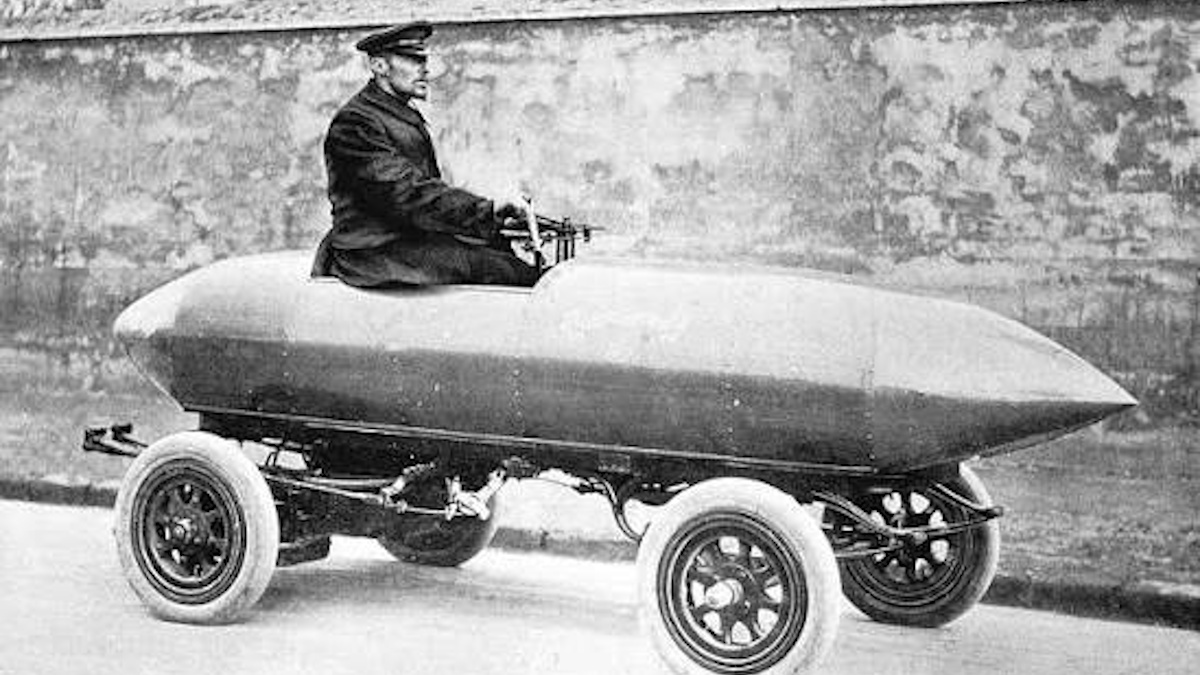
This is the one I’d want to have seen in person. Belgian racing driver Camille Jenatzy, nicknamed the Red Devil for his beard, wasn’t trying to build a car people could buy. He built La Jamais Contente for one specific purpose: to take the land speed record back from a French rival in a public rivalry that had been escalating for months. On 29 April 1899, on a stretch of road near Paris, it hit 105.88 km/h, the first time any vehicle, electric or otherwise, had gone over 100 km/h.
Everything about it was built around shedding weight, since a heavier car needs more battery, and more battery adds yet more weight, the same spiral EV engineers still fight today. The torpedo shaped body was made from Partinium, an alloy of laminated aluminium, tungsten and magnesium that had never been used in a car before. Two 25 kW Postel-Vinay motors drove the rear axle directly. It was never meant to carry passengers, go long distances, or be practical in any way, and it wasn’t. It was a one-off, hand-built purely to set a number, and it succeeded spectacularly at that single job. The car survives today in the National Car and Tourism Museum in Compiègne, France.
The Electric Vehicle Company’s Taxi Fleet (New York, from 1897)
Long before Uber, New York City had a fleet of electric taxis, and the reason they existed was entirely practical. Petrol cars of the 1890s needed hand cranking, stalled constantly and stank of fuel, which made them a poor fit for a driver doing dozens of short city trips a day. The Electric Vehicle Company built a fleet of battery powered cabs, nicknamed Electrobats, to solve exactly that problem, and it grew to around 600 vehicles at its peak.

The clever part was how they dealt with limited range. Rather than waiting hours to recharge a depleted battery, drivers swapped the entire battery pack for a fresh one at a central depot, getting a cab back on the road in minutes. It was a genuinely well designed solution to a real limitation of the batteries of the day, which struggled to hold enough charge for a full working shift. What killed the company wasn’t the technology at all. It collapsed in the early 1900s after a stock manipulation scandal involving its founders, and the idea of a large scale electric taxi fleet more or less disappeared for the next hundred years.
Baker Electric (Cleveland, from 1899)
Baker built seventeen different electric passenger models by 1907, alongside a range of electric delivery trucks that stayed in production until the company folded in 1914, a solid fifteen year run. The pitch was simple: no crank starting, no gear shifting, no petrol smell, which made it genuinely appealing to buyers who found early petrol cars intimidating or unpleasant to operate. Its most famous owner was Thomas Edison, who bought one of the earliest Baker models as his personal car and later designed his own nickel-iron battery, which Baker then offered as a premium option over the standard lead-acid pack.
The nickel-iron option mattered because it lasted far longer and tolerated abuse that would ruin a lead-acid battery, though it was heavier, less efficient and more expensive to buy. In 1910, a Baker Electric Victoria fitted with these batteries set a distance record of just over 200 miles on a single charge, driven at a steady 12 mph, a genuinely serious number for the era. Baker never solved the core problem of speed and weight though. Its cars topped out around 20 mph, fine for city errands but useless as roads improved and people started wanting to travel further and faster, which is ultimately what petrol cars offered and Baker’s electric platform never could.
Detroit Electric (Detroit, 1907 to 1939)
Built by the Anderson Electric Car Company, the Detroit Electric stayed in production for more than three decades, an almost unheard of run for any early electric car maker, and it survived that long by knowing exactly who it was for. It never went faster than about 20 mph, and nobody who bought one cared. It didn’t need a hand crank to start and ran near silently, which made it hugely popular with a wealthy, largely female clientele who had no interest in wrestling with a temperamental petrol engine just to run errands around town. Clara Ford, wife of Henry Ford, drove a Detroit Electric for years despite her husband building an empire on the internal combustion engine.
With a lead-acid pack it managed around 80 miles of range, rising to over 100 miles with Edison’s optional nickel-iron batteries from 1911, which cost an extra $600, a huge sum at the time. That range was genuinely competitive for city use even decades later, but the car’s low top speed and high price, several times that of a contemporary Model T, kept it a niche product for the wealthy rather than a mass market one. Production finally ended in 1939, not because the concept failed, but because the company simply couldn’t keep up as petrol cars got cheaper, faster and more capable every single year.
Woods Dual Power (Chicago, 1916)
The idea of a hybrid car wasn’t unique to Porsche. The Woods Motor Vehicle Company, which had been building pure electric cars since the 1890s, launched the Dual Power in 1916, pairing a small petrol engine with an electric motor and a lead-acid battery pack. The logic was to use the electric motor alone for quiet, simple low speed driving around town, then bring in the petrol engine above roughly 15 mph for real road speed, giving buyers the smooth city manners of an electric car without its useless top speed.

It was slow to switch between the two power sources and expensive at around $2,700, more than double the price of a well equipped petrol car of the same size, and it never sold in serious numbers before Woods folded a few years later. But the basic engineering logic, an electric motor handling low speed work while a combustion engine covers everything else, is essentially the same idea behind hybrid cars built a century afterward.
What Actually Killed the Early Electric Car
None of these cars failed because electric power was a bad idea. They were quiet, easy to start and genuinely well suited to city driving, exactly the argument made for EVs today. What killed them was Cadillac’s electric starter motor, introduced in 1912, which removed the one real advantage petrol cars lacked: an easy way to start the engine without a dangerous hand crank. Combine that with cheap Texas oil, Henry Ford’s assembly line making petrol cars far cheaper than anything battery powered, and roads that were rapidly extending well beyond what an early EV’s range could cover, and the electric car spent the next eighty years as a footnote rather than a mainstream choice.
What’s Old Is New Again
Reading back through all six of these, what strikes me most is how many of their engineering solutions are back in use today, just with better materials doing the same job.
The Electric Vehicle Company swapped entire battery packs to solve range and charging time in 1897. Nio is doing essentially the same thing with its battery swap stations across China and Europe right now, for exactly the same reason: it’s still faster than waiting for a full recharge.
Porsche’s hub motors and petrol powered generator on the Lohner-Porsche Mixte is, mechanically, the same idea behind a modern range extended EV, where a small combustion engine exists purely to charge the battery rather than drive the wheels. It’s the same logic behind several Chinese EREV models currently expanding across Europe, just with a lithium battery and a far more efficient generator doing what Porsche’s 1900 setup did with lead-acid cells and raw mechanical ingenuity.
Edison’s nickel-iron batteries against Baker and Detroit Electric’s standard lead-acid packs was, in its own way, the same trade-off buyers weigh today between LFP and NMC chemistry. One option was heavier and less energy dense but far more durable and tolerant of abuse, the other gave better performance for less weight but needed gentler treatment to last. That exact tension, longevity versus energy density, never actually went away, it just moved to different chemistries, and it’s the same tension driving the current race toward sodium-ion and solid-state batteries as manufacturers look for the next material that solves it better than the last one did.
And Camille Jenatzy chasing a speed record purely to prove what an electric motor could do has a very direct modern equivalent in the six-figure performance EVs that use Nürburgring lap times and straight line speed to grab headlines the same way a torpedo shaped car on a public road did in 1899. Even the Woods Dual Power’s basic pitch, electric for the boring bits, petrol for the rest, describes a huge share of hybrid and plug-in hybrid sales today almost word for word.
None of these six cars led directly to the EV in your driveway or the one you’re cross-shopping right now. But the problems they were built to solve, weight, range, charging speed, cost, and how to make an electric motor genuinely useful rather than just a novelty, are the exact same problems every EV engineer is still working on. The battery chemistry changed. The actual questions really haven’t.
FAQ
Who invented the first electric car?
There’s no single, undisputed answer. French engineer Gustave Trouvé demonstrated the first practical, person-carrying electric vehicle on a Paris street in 1881. British engineer Thomas Parker built what’s often called the first production electric car in 1884. German engineer Andreas Flocken built the first four wheeled electric car resembling a modern car body in 1888.
Were electric cars really more popular than petrol cars at one point?
Yes, briefly. Around 1900, roughly a third of all cars on American roads were electric, alongside steam powered cars and early petrol vehicles. Electric cars were especially popular in cities, where their limited range mattered less and their ease of starting mattered more.
When did hybrid cars actually get invented?
Ferdinand Porsche built the first working hybrid, the Lohner-Porsche Mixte, in 1900 and 1901, using a petrol engine to power a generator that fed electric motors in each wheel hub. The Woods Dual Power followed in 1916 with a more conventional layout, using an electric motor for low speeds and a petrol engine above around 15 mph.
Why did electric cars disappear for most of the 20th century?
The main factor was Cadillac’s electric starter motor, introduced in 1912, which removed the need to hand crank a petrol engine and eliminated one of the electric car’s biggest practical advantages. Cheap oil, mass produced petrol cars from Ford, and expanding road networks that outpaced early EV range did the rest.
What was the fastest early electric car?
La Jamais Contente, driven by Camille Jenatzy, reached 105.88 km/h in 1899 near Paris, the first vehicle of any kind to exceed 100 km/h.
Did any of these old ideas actually come back in modern EVs?
Several did. Battery swapping, pioneered by New York’s electric taxi fleet in 1897, is now used by Nio. Porsche’s generator-charged hub motor system from 1900 is mechanically similar to today’s range extended EVs. And the trade-off between Edison’s durable nickel-iron batteries and standard lead-acid packs mirrors the modern choice between LFP and NMC battery chemistry.
Featured Image: Techno-Science.net
Marko Lubar is the Founder and Editor of ElectricFleet Online, where he covers the latest developments in electric vehicles, battery innovation, autonomous driving, artificial intelligence, and the technologies shaping the future of mobility.
Learn more about Marko and the mission behind ElectricFleet Online on the About Us page.
Latest News