When people think about road safety, the usual suspects come to mind: airbags, seatbelts, stronger body structures, AEB. All of those things have helped. But there is another development quietly taking shape that could end up being just as significant, and most drivers have never heard of it.
Modern cars are becoming connected devices. Instead of relying purely on their own cameras, radar and sensors, they are starting to exchange information with other vehicles, traffic lights, road infrastructure and management systems in real time. The overarching term for this is V2X, short for Vehicle to Everything. In European policy language you will also see it called C-ITS, which stands for Cooperative Intelligent Transport Systems. The names sound dry, but the idea behind them is genuinely interesting.
The goal is to give vehicles awareness of hazards before the driver can physically see them.
Why Your Car’s Sensors Are Not Enough on Their Own
Today’s cars already do impressive things. Many can brake automatically for pedestrians, keep themselves in a lane, monitor blind spots and warn about potential collisions. The limitation is that all of these systems can only react to what their own sensors can detect. When those systems are poorly calibrated or fail in unexpected situations, the consequences can be serious. And for buyers trying to separate genuinely safe cars from those that aren’t that safe, my list of EVs with poor Euro NCAP ratings is a useful starting point.
A camera can’t see around a blind corner on a rural road. Radar can’t see through a row of buildings. Even the most sophisticated sensor suite has a hard physical limit: it only knows what is directly within range. The same applies when a vehicle breaks down behind a truck, when an accident happens beyond a hill crest, or when an emergency vehicle approaches from a direction that is not yet visible. In all of these situations, your car has no information until the hazard is already in front of you. V2X is designed to close that gap.
What V2X Actually Does
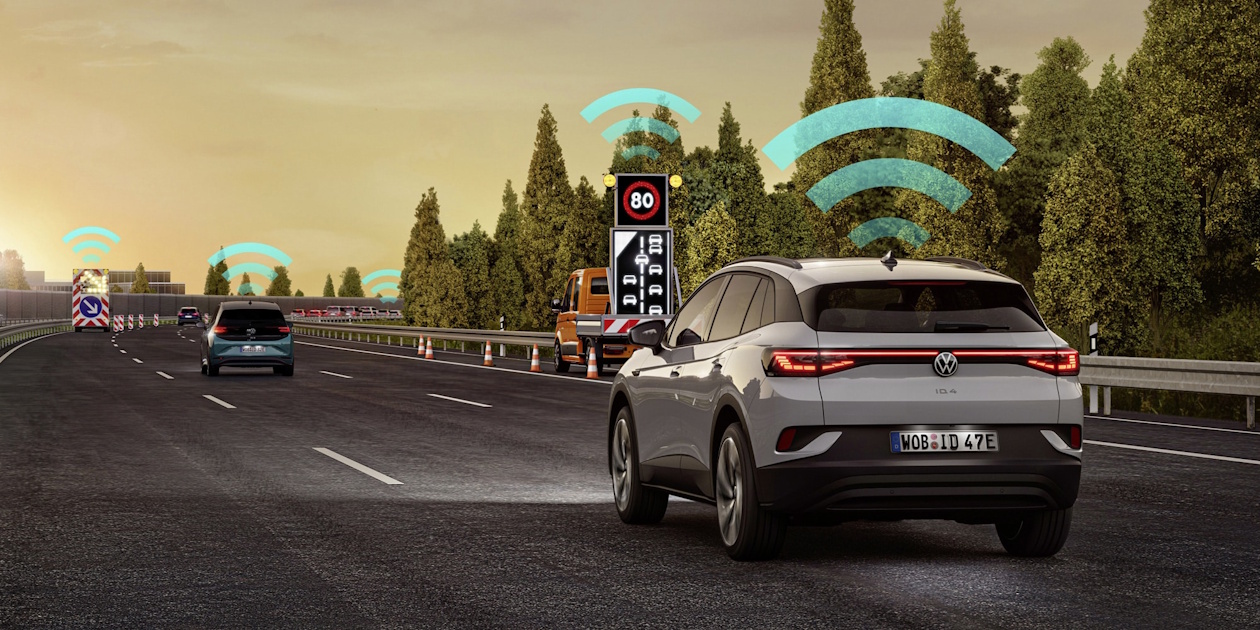
Rather than depending solely on what a car can detect itself, V2X allows vehicles, road infrastructure, pedestrians and networks to share information electronically. A car involved in an accident can immediately send a warning to vehicles approaching from two kilometres away. A traffic management system can alert drivers to roadworks or black ice before they reach the affected section of road. An ambulance can broadcast its approach so that drivers receive an alert before the blue lights appear in their mirrors.

The key word is before. The whole point is that drivers and vehicles receive relevant information earlier than they otherwise would, which gives more time to react. V2X doesn’t replace the driver or take control of the car. It is an additional layer of awareness.
The Four Types of V2X Communication
V2X is not a single technology. It covers four distinct types of communication, each with a different purpose.
- V2V, or Vehicle to Vehicle, is the most direct form. Cars exchange information with each other, without going through any infrastructure. If a vehicle ahead brakes suddenly or is involved in a collision, it can immediately broadcast that event to surrounding vehicles.
- V2I, or Vehicle to Infrastructure, connects cars to the physical road network: traffic lights, motorway control systems, road signs, tunnels, variable speed limit signs, bridges and roadside units. This is how a car could receive a warning about a lane closure, a flooded road or changing speed limits before the signage comes into view.
- V2P, or Vehicle to Pedestrian, focuses on vulnerable road users. Connected devices such as smartphones could allow pedestrians or cyclists to be detected and warned when a collision risk is developing, giving both parties more time to react.
- V2N, or Vehicle to Network, uses mobile data networks and cloud services to exchange broader information: traffic conditions, navigation updates, weather alerts and connected services that go beyond immediate safety warnings.
Together, these four layers form the foundation of what V2X can do.
V2X and C-ITS: What Is the Difference?
This is where people often get confused, understandably.
V2X describes the technical ability to exchange information between road users. C-ITS is the European framework that makes that information useful and consistent across different manufacturers, countries and systems.
Without common standards, a warning sent by a Volkswagen might not be understood by a Renault or an Xpeng. C-ITS defines how messages are structured, what information they must contain, how they are transmitted, and how different systems should respond when they receive them. It is the common language that makes the whole ecosystem work.
Think of V2X as the ability to make a phone call, and C-ITS as the shared language that means both parties can actually understand each other.
The Supporting Technologies That Make It Work
V2X and C-ITS get most of the attention, but they depend on several other technologies to function properly.
Multi-Access Edge Computing
Sending data to a distant cloud server and waiting for a response takes too long when vehicles are approaching an intersection at speed. Multi-Access Edge Computing, or MEC, solves this by placing computing power physically close to the road itself, at mobile network base stations or smart roadside infrastructure. This brings response times down to milliseconds, which is the difference between a useful warning and one that arrives too late. The 5GAA industry roadmap expects advanced MEC use cases to expand significantly from 2026 onwards as part of the broader 5G-V2X deployment timeline.
Sensor Fusion
V2X does not work in isolation. Connected vehicles combine V2X data with their own onboard sensors: cameras, radar, LiDAR and ultrasonic systems. Sensor fusion is the process of merging what the car can see locally with what V2X tells it is happening further ahead or around a corner. A camera detects a vehicle immediately ahead; a V2X message warns of another vehicle hidden behind a building two hundred metres away. Together they create a more complete picture of the driving environment than either source could provide alone. Xpeng’s LOFIC technology is a good example of how a manufacturer is developing this kind of multi-source integration at a software level.
Software-Defined Vehicles
Modern vehicles increasingly derive their capabilities from software rather than fixed hardware. This matters for V2X because communication protocols, C-ITS applications and safety features can be updated remotely through over-the-air software updates, in the same way you update an app on your phone. A car bought today could gain new V2X capabilities in two years without ever visiting a workshop. For EVs in particular, which already rely heavily on connected software platforms, this is a natural fit.
Artificial Intelligence and Agentic AI
AI systems in connected vehicles can analyse the data arriving through V2X communication in real time and use it to predict behaviour before a dangerous situation becomes visible. A pedestrian’s movement pattern, another driver’s likely trajectory at an intersection, the probability of a hazard behind a blind corner: AI can process these inputs simultaneously and help the car or the driver prepare earlier. Researchers are also exploring agentic AI systems, where software pursues specific safety objectives within defined limits, which could eventually allow vehicles to coordinate with each other and with infrastructure more effectively than is possible today. This is still early-stage, but the direction is clear.
PKI and Cybersecurity
None of this works if the information being exchanged cannot be trusted. A fake V2X warning about a non-existent accident could cause traffic chaos or create dangerous braking situations. To prevent this, every V2X message is digitally signed and verified using Public Key Infrastructure, or PKI, a cybersecurity framework borrowed from online banking and secure communications. Verification happens automatically in fractions of a second, confirming that a message genuinely comes from a trusted source before the vehicle acts on it. As V2X deployment expands, cybersecurity will be just as foundational as the communication technology itself.
Where Europe Stands Right Now
Europe has been working on C-ITS deployment for over a decade, and some infrastructure is already in place on selected motorways and urban roads in countries including Austria, the Netherlands, Germany and France. The EU has set a target for V2X to be present in at least 35% of new vehicles by 2027. Mass deployment of 5G-V2X Direct-enabled vehicles is expected to begin in Europe between 2026 and 2029.

The challenge is scale. A connected transport system only becomes truly useful when a large proportion of vehicles and infrastructure are participating. A car that can broadcast a hazard warning is only as useful as the number of approaching vehicles that can receive it. This is the classic network effect: the more participants, the more valuable the system becomes for everyone.
Euro NCAP’s inclusion of V2X in its 2026 testing protocol is expected to accelerate adoption significantly, since 97% of new vehicles sold in Europe carry a Euro NCAP rating, and any technology built into the testing criteria tends to reach nearly all new cars within a few years. That is a faster and more reliable path to widespread adoption than regulatory mandates alone. The European Commission’s C-ITS deployment framework sets out the broader policy direction and the standards being used to harmonise implementation across member states.
Why EVs Are Particularly Well Placed for V2X
V2X is not exclusive to electric vehicles, but EVs are better positioned to adopt it quickly. Most modern EVs already have permanent internet connectivity, powerful onboard computers, over-the-air update capability and software-first architectures. Manufacturers including Volkswagen, BMW, Mercedes-Benz, Xpeng, Nio and Zeekr are already investing heavily in connected vehicle platforms. For many of them, software and connectivity are becoming as central to the product as battery range and charging speed.
As the EV market matures and software-defined vehicles become the norm, V2X connectivity is likely to follow as a natural extension of platforms that are already built for it.
Does This Mean Self-Driving Cars Are Around the Corner?
Not necessarily, and it is worth separating the two.
V2X provides additional information that can support both human drivers and automated systems. It is an extra layer of situational awareness, not a system that makes driving decisions on its own. A self-driving vehicle requires cameras, radar, LiDAR, AI and a great deal more besides. V2X makes it better informed, but it does not replace any of those components.
The more useful way to think about it: V2X helps every driver, including drivers of conventional cars, see further ahead than their own eyes and sensors allow. That benefit does not depend on autonomy. It works today, in cars driven by people. For anyone at the start of their driving life, my guide to the best EVs for new drivers covers which affordable EVs implement best current safety tech.
FAQ
What does V2X stand for?
V2X stands for Vehicle to Everything. It is an umbrella term for technologies that allow vehicles to exchange information with other vehicles (V2V), road infrastructure (V2I), pedestrians (V2P), and mobile networks and cloud services (V2N).
What is C-ITS and how is it different from V2X?
C-ITS stands for Cooperative Intelligent Transport Systems. V2X describes the technical ability to share information. C-ITS is the European framework of standards that ensures all participants, across different brands, countries and systems, can understand and use that information consistently.
Do any cars have V2X today?
Yes, though deployment is still limited. Volkswagen has been fitting ITS-G5 V2X hardware to selected models including the ID.3 and ID.4 for several years. Other manufacturers are at various stages of integration. Infrastructure deployment in Europe, while underway in several countries, is not yet widespread enough for V2X to deliver its full potential.
Is V2X only useful for autonomous vehicles?
No. V2X provides earlier awareness of hazards for any driver, regardless of how automated the car is. A standard car driven by a person can display a warning about an accident around a blind corner just as easily as a semi-autonomous vehicle can.
When will V2X become common in Europe?
The EU has set a target for V2X to be present in at least 35% of new vehicles by 2027. Mass deployment of 5G-V2X Direct vehicles and services is expected to begin between 2026 and 2029. Euro NCAP’s inclusion of V2X in its testing criteria is likely to accelerate adoption across all manufacturers.
Can V2X messages be faked or hacked?
V2X systems use Public Key Infrastructure (PKI) to digitally sign and verify every message before a vehicle acts on it. This happens automatically in milliseconds and is designed to prevent malicious actors from injecting false warnings into the system.
Featured Image: IoT Automotive News
Marko Lubar is the Founder and Editor of ElectricFleet Online, where he covers the latest developments in electric vehicles, battery innovation, autonomous driving, artificial intelligence, and the technologies shaping the future of mobility.
Learn more about Marko and the mission behind ElectricFleet Online on the About Us page.
Latest News