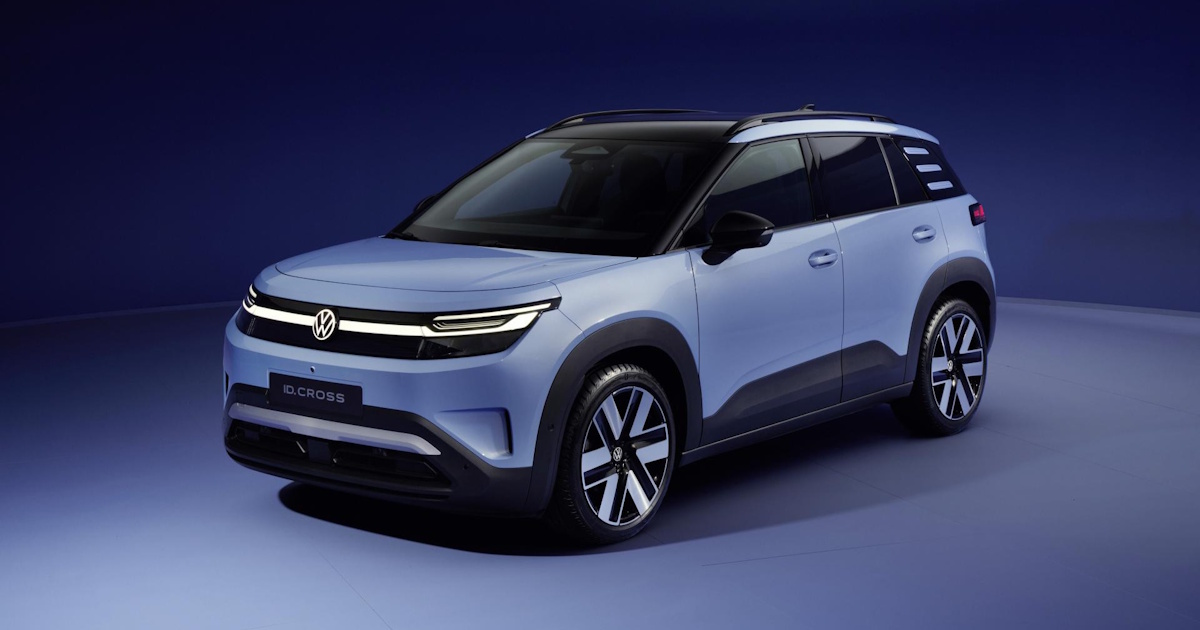
Volkswagen officially unveiled the production ID.Cross on 15 July, confirming an autumn European launch with a starting price of €27,990. The entry Trend trim opens for order in December, though VW notes that published “from” prices may include conditional premiums such as a trade-in bonus, so worth confirming the final figure with your dealer.
VW’s own newsroom describes the ID.Cross as a potential “future success model.” That’s a careful thing to say about a car that has only just launched, but it’s an honest framing given where Volkswagen is right now. The ID.Polo launched alongside it as the entry-level hatchback, and together they represent the most significant affordable EV push VW has ever made. More on the broader context later.
What You Actually Get
The ID.Cross is a compact electric SUV, 4,153 mm long on a 2,601 mm wheelbase. It sits above the ID.Polo and below the ID.4, broadly equivalent to the petrol T-Cross in the VW lineup. Front-wheel drive only, three trims: Trend, Life and Style.
Two batteries, two quite different cars. The entry 37 kWh LFP unit is the value play: 316 km of WLTP range, 90 kW DC charging and a 10-80% time of around 23 minutes. It’s enough for most daily use, but it’s clearly the “get the price down” battery. The 52 kWh NMC pack is where the ID.Cross gets more interesting: 427 km of range, 105 kW DC charging and the same charge window at around 24 minutes. Both support 11 kW AC. If you want to understand what the LFP vs NMC difference actually means in everyday use, that’s worth a read before deciding which to go for.
| Specification | Volkswagen ID.Cross |
|---|---|
| Length / width / height | 4,153 / 1,794 / 1,581 mm |
| Wheelbase | 2,601 mm |
| Boot space | 475 L / 1,340 L |
| Frunk | 25 L |
| Seats | 5 |
Both batteries are identical to those in the ID.Polo, and that’s no coincidence. The ID.Cross, ID.Polo, Skoda Epiq and Cupra Raval all share the same MEB+ platform, the same APP290 motor and now the same battery cells, VW Group’s newly developed Unified Cell produced by PowerCo. Sharing cells across four models simultaneously is how Volkswagen brings costs down enough to hit €27,990. It’s a sensible platform strategy, even if it does mean the ID.Cross and ID.Polo feel closely related in ways that weren’t always obvious from the marketing.

Power outputs follow the same logic: 116 hp on the base Trend, 135 hp on mid-spec and 211 hp on the top 52 kWh variants. The 211 hp version also gets a higher top speed, 160 km/h versus 150 km/h on the lower-powered cars. The boot is 475 litres expanding to 1,340 litres. There’s a 25-litre frunk, though VW is clear that it’s designed for charging cables rather than general storage. The 52 kWh version adds towing up to 1,200 kg and V2L at up to 3.6 kW, which is useful if you need to run power tools or charge devices from the car.
In Germany, the 52 kWh Life and Style versions start at €36,525. The base Trend at €27,990 comes with the 37 kWh LFP battery.
| Specification | Trend (37 kWh) | Top spec (52 kWh) |
|---|---|---|
| Battery | 37 kWh net (LFP) | 52 kWh (NMC) |
| WLTP range | 316 km | 427 km |
| Motor power | 116 hp (85 kW) | 211 hp (155 kW) |
| Drive | FWD | FWD |
| DC charging | 90 kW | 105 kW |
| DC 10-80% | 23 min | 24 min |
| AC charging | 11 kW | 11 kW |
| Top speed | 150 km/h | 160 km/h |
| Towing | n/a | 1,200 kg |
| V2L | n/a | 3.6 kW |
| Starting price | €27,990 | from €36,000 |
Return of Physical Buttons
One thing worth flagging: VW has brought physical buttons back for climate and a rotary volume knob alongside the 12.9-inch touchscreen. The instrument display is a separate 10.25-inch screen. After years of criticism over touch-sensitive controls on the ID.3 and ID.4, this is a direct response to what customers and reviewers have been saying. Life adds 18-inch wheels, dual-zone climate, adaptive cruise and a reversing camera. Style adds Matrix LED headlights, heated seats and keyless entry.

The ID.Cross is noticeably better equipped than early ID models, and there are two reasons for that. First, the original ID.3 and ID.4 earned a poor reputation for spartan, plasticky interiors where basic features sat behind costly option packs. VW learned from that. Second, Chinese brands have reset what buyers expect at this price. Large touchscreens, driver assistance systems and cameras are standard on most Chinese EVs at €28,000, not extras. VW has responded accordingly, with lane-keeping assist, AEB and travel assist standard across the whole range. If you want to see how Chinese alternatives to the ID.3 Neo approach this, the contrast is instructive.
Who It’s Up Against
This is the most crowded segment in European EVs right now, and it’s getting busier. My best-selling EVs in Europe Q1 2026 article covers how competitive it already is.
From European brands: the Renault 4 E-Tech is a natural comparison, priced above the ID.Cross Trend in most markets. The Skoda Epiq sits on the same MEB+ platform with more than 440 km of range and the same 475-litre boot. The Kia EV3 offers up to 605 km of range at a higher price, and the Cupra Raval base trim is due in autumn this year at a starting price below the ID.Cross.

Within VW Group itself, the Skoda Epiq and Cupra Raval share the same platform and overlap in price. That’s intentional, because VW Group wants maximum MEB+ volume even if the models compete for some of the same buyers. The ID.3 Neo is also relevant at this price point, with 417 to 627 km of range and faster 183 kW charging, though its 383-litre boot is smaller than the ID.Cross.
From Chinese brands, the picture is harder to ignore. The BYD Atto 2 is already on sale across Europe at a similar starting price, with up to 430 km WLTP and a six-year vehicle warranty. The Leapmotor B03X opened orders recently from around €24,000, meaningfully below the ID.Cross. Leapmotor has been growing strongly in Germany, with 2,662 registrations in June this year alone. The GAC Aion UT starts at a comparable price in several markets, the Geely E2 arrives later this year, and the Changan Nevo Q05 is confirmed for October 2026. There’s more on what all these Chinese brands mean for the affordable EV segment in Europe.
All of these are in the same price window, with several offering more kit at the entry price than the ID.Cross. At €27,990, the ID.Cross is competitive but not obviously the best value on paper. What it has that Chinese rivals can’t yet match is Volkswagen’s pan-European dealer and service network. That’s not on the spec sheet, but it often decides a family car purchase.
Why This Matters So Much for VW
The ID.Cross isn’t just another new model, it’s arriving at one of the toughest periods Volkswagen has faced in decades.
China deliveries fell 26% in the first half of this year to their lowest level since 2010, Q2 alone down 36.6% year-on-year. I covered VW’s China decline and the Future Plan in detail when the numbers came in. CEO Oliver Blume’s response involves cutting the global model lineup by up to 50% and reducing annual production capacity from 10 million to 9 million vehicles. The ID.Cross is one of the models that’s supposed to prove the affordable EV strategy works.
VW does have reason for some optimism. The combined order book for ID.Polo, Skoda Epiq and Cupra Raval has crossed 54,000 units. The ID.Cross sub-€30,000 price could shift some private purchase numbers, with the pricier versions targeting fleets looking for a practical, less expensive alternative to the ID.4.
The question that doesn’t have a clean answer yet is whether €27,990 is low enough. Chinese brands have a cost advantage VW is closing but hasn’t closed. The Leapmotor B03X at around €24,000 is a direct challenge and comes with 382 km of WLTP range and 133 kW DC charging. The ID.Cross has a stronger brand and better after-sales, but whether that’s worth €4,000 extra is what the market will decide in Q1 2027.
My Take: VW Has a Real Chance Here, But Don’t Expect a Comeback Story
I’ll be direct: I think the ID.Cross can work, and I think it will help VW stabilise in Europe. But I don’t think it’s going to restore Volkswagen to the dominance it had before the EV era, and I suspect that’s not the plan either.
The €27,990 Trend is clearly targeted at buyers for whom price is the first filter. And at that price, I think it’s borderline. €24,000 from Leapmotor for a car with more range and faster charging is a genuinely difficult comparison to dismiss. The ID.Cross wins on brand trust, on service network and on resale value, but those arguments are harder to make in a showroom than a spec sheet comparison.
Where I think VW is actually competitive is at the 52 kWh level. At around €36,000, you’re getting a proper 427 km range, decent charging speed, towing, V2L and the full Volkswagen service ecosystem behind it. That’s a reasonable package. It’s not cheap, and VW knows it, which is why the car is positioned the way it is. This isn’t VW trying to win a price war it can’t win. It’s VW trying to make the case that there are things worth paying slightly more for.

The after-sales argument is real and I don’t think it gets enough credit in spec comparisons. Leapmotor’s piggyback through Stellantis dealerships and GAC Aion’s through Magna Steyr give them dealer locations on paper, but a trained technician and a parts supply chain built over decades are not the same thing. BYD is the one Chinese brand genuinely building its own European infrastructure, and that’s exactly why BYD is the one I’d consider a real long-term threat.
What the ID.Cross does, more than anything, is give VW buyers a reason not to switch. That’s a different ambition from “beating the Chinese” but it’s the right one for where VW is now. The company was on the ropes. This car, alongside the ID.Polo and the wider affordable European EVs coming to market in 2026, gives VW a fighting position it simply didn’t have 18 months ago.
Will it be enough? I think yes, cautiously. Not a triumph, not a comeback, but a solid foundation. The best electric hatchbacks in Europe right now give you a sense of what the ID.Cross is competing against in the wider field, and it holds its own better than most VW EVs have managed at this price point.
FAQ
When is the Volkswagen ID.Cross coming out?
Autumn 2026 for most European markets. The entry Trend trim is expected to open for order in December 2026. UK deliveries are likely to begin in early 2027.
How much does the ID.Cross cost?
The Trend entry trim starts at €27,990 in Europe with the 37 kWh LFP battery. In Germany, the 52 kWh Life and Style trims start at €36,525. Published “from” prices may include conditional premiums, so confirm the final figure with a dealer.
What’s the range of the Volkswagen ID.Cross?
316 km WLTP on the 37 kWh LFP battery and 427 km WLTP on the 52 kWh NMC variant. Both support 11 kW AC charging.
What does the frunk store?
The 25-litre frunk is designated for charging cables rather than general cargo. The main boot holds 475 litres, expanding to 1,340 litres.
Does the ID.Cross have V2L?
Yes, on the 52 kWh variants, at up to 3.6 kW. The 37 kWh Trend does not include V2L.
How does the ID.Cross compare to the BYD Atto 2?
The BYD Atto 2 starts from around €28,990 with up to 430 km WLTP and a six-year vehicle warranty. Similar starting price but more range and a longer vehicle warranty at the entry point. The ID.Cross counters with Volkswagen’s European dealer network and brand recognition. Which makes more sense depends largely on how much after-sales infrastructure matters to you.
What’s the difference between the ID.Cross and ID.Polo?
Both share the MEB+ platform. The ID.Polo is a hatchback from €24,995 with up to 455 km range and a 441-litre boot. The ID.Cross is a compact SUV from €27,990 with a higher ride height, 475-litre boot, towing capability and V2L on top trims.
Is the ID.Cross available in the UK?
UK order books are expected to open in late 2026, with first deliveries in early 2027. UK pricing hasn’t been confirmed but a figure around £24,000-£26,000 is the most credible estimate based on the European price.
Featured Image Source: Volkswagen
Marko Lubar is the Founder and Editor of ElectricFleet Online, where he covers the latest developments in electric vehicles, battery innovation, autonomous driving, artificial intelligence, and the technologies shaping the future of mobility.
Learn more about Marko and the mission behind ElectricFleet Online on the About Us page.
Latest News