In short, if you’re looking for seven seats in an electric car in Europe today, the Kia EV9 and Hyundai Ioniq 9 are the safest all-round picks, while the Škoda Peaq and Peugeot E-5008 give you more than 640 km of range. If adults will sit in the third row every day, then skip the SUVs and buy an electric MPV.
When I first wrote this guide in October 2025, the list was short and half of it was vans. Since then, Škoda, Mercedes, Xpeng, Hyundai and Kia have all added seven-seat EVs, and the Mercedes EQB has been replaced by the new GLB. Every car below can be ordered in Europe with seven seats as of November 2026. Ranges are the manufacturers’ own WLTP figures for the longest-range version, and if you want to know what WLTP actually is, I explained it in my WLTP and CLTC explainer.
If you’re planning to buy a car like this for the third row, the spec sheets alone won’t tell you much about how usable it is. Generally speaking, in most of the SUVs here it works for children and short trips, while in the MPVs adults can sit back there quite comfortably for hours.
Seven-Seat EVs in Europe at a Glance
| Model | Body type | Seats | Max WLTP range |
|---|---|---|---|
| Kia EV9 | SUV | 6 or 7 | 563 km |
| Hyundai Ioniq 9 | SUV | 6 or 7 | 620 km |
| Volvo EX90 | SUV | 7 | 608 km |
| Škoda Peaq | SUV | 5 or 7 | 647 km |
| Peugeot E-5008 | SUV | 7 | 669 km |
| Mercedes-Benz GLB | SUV | 5 or 7 | 631 km |
| BYD Tang | SUV | 7 | 530 km |
| Tesla Model Y | SUV | 5 or 7 | 600 km (7-seat) |
| Mercedes-Benz EQS SUV | SUV | 5 or 7 | 644 km |
| Lucid Gravity | SUV | 5 or 7 | 739 km |
| Cadillac Vistiq | SUV | 6 or 7 | 460 km (estimate) |
| Volkswagen ID. Buzz LWB | MPV | 5, 6 or 7 | 498 km |
| Xpeng X9 | MPV | 7 | 615 km |
| Mercedes-Benz VLE | MPV | 5 to 8 | 714 km |
| Hyundai Staria Electric | MPV | 7 or 9 | 430 km |
| Kia PV5 Passenger | MPV | 5, 6 or 7 | 397 km (7-seat) |
| Maxus Mifa 9 | MPV | 7 or 8 | 435 km |
| Opel Zafira Electric and siblings | MPV | up to 9 | 347 km |
I didn’t expect the range spread to be this wide. A car with 400 km and one with 700 km can both carry seven people, so decide how often you’ll drive long distances fully loaded before you look at anything else.
Kia EV9

Kia’s EV9 is still the car I’d point most families to first. Seven seats are standard in most markets, the battery is 99.8 kWh. Kia’s official specifications give the rear-wheel-drive version on 19-inch wheels up to 563 km WLTP, while all-wheel-drive versions drop to between 505 and 512 km. The 800-volt system keeps fast-charging stops short, which helps when a car full of children is waiting.
Hyundai Ioniq 9

Hyundai’s Ioniq 9 sits on the same E-GMP platform as the EV9 (the dedicated EV base Hyundai and Kia share) but has a longer 3,130 mm wheelbase and a 110 kWh battery. Hyundai quotes up to 620 km WLTP and a 10 to 80 percent charge in 24 minutes in its July 2026 press kit. Seven seats are standard, with two six-seat layouts as options. With all seven seats up, the boot holds 338 litres, which is more than most SUVs here.
Volvo EX90

The EX90 is Volvo’s electric flagship and comes with seven seats as standard. Volvo’s 2026 model year data rates the single-motor version at 557 to 565 km WLTP and the twin-motor version at 599 to 608 km. I’d go for the twin motor, because you get around 40 km more range as well as all-wheel drive for winter.
Škoda Peaq

Škoda’s Peaq is the brand’s biggest car so far, and production started in Mladá Boleslav in August 2026. You can order it with five or seven seats. Škoda lists up to 647 km WLTP for the rear-wheel-drive Peaq 90 with the 91 kWh battery in its press kit. With all seven seats up, the boot drops to 299 litres. I covered the battery and motor options in my Peaq explainer.
Peugeot E-5008

Every E-5008 comes with seven seats. Peugeot rates the E-5008 Long Range with its 97 kWh battery at up to 669 km WLTP, which puts it near the top of this list for range. The third row folds into the boot floor when you don’t need it. I’d choose it if most journeys are with five people and the extra seats are for the occasional school run.
Mercedes-Benz GLB

The new GLB replaced the EQB in December 2025 and moved to a dedicated EV platform. Mercedes rates the GLB 250+ with its 85 kWh battery at up to 631 km WLTP, while the entry GLB 200 with a 58 kWh LFP battery manages 431 km. The challenge is that the third row is an option, so check it’s included when you configure the car. I put it up against its Chinese rivals in a separate comparison.
BYD Tang

BYD’s Tang has been on sale in Europe since 2021, when it launched in Norway as BYD’s first European export. Seven seats are standard, and the European spec sheet lists a 108.8 kWh LFP battery, up to 530 km WLTP and 235 litres of boot space with all seats up. DC charging peaks at 170 kW, slower than the 800-volt cars here, so long trips mean longer stops. The Tang is still in BYD’s German configurator with a list price of €75,000, which BYD currently shows reduced to €47,900.
Tesla Model Y

Tesla brought back the seven-seat Model Y in Europe in February 2026, but only on the Premium Long Range All-Wheel Drive version, as its German configurator shows. With seven seats and the standard 19-inch wheels, it’s rated at 600 km WLTP, 22 km less than the five-seater, and the option adds €2,500. Tesla’s European owner’s manual notes that the third-row seats have no Isofix anchors, so child seats there have to be fitted with the seat belt. Tesla’s Portuguese site also lists a six-seat Model Y L with a longer wheelbase. If you’re shopping around, I listed the main rivals in my Model Y alternatives guide.
Mercedes-Benz EQS SUV

The EQS SUV is the luxury option in this group. Mercedes UK’s current brochure quotes 607 to 644 km (377 to 400 miles) WLTP for the EQS 450 4MATIC with its 118 kWh battery, and seven seats come with the top AMG Line Premium Plus trim in the UK. The EQS saloon got an 800-volt update in April 2026. Mercedes hasn’t confirmed when the SUV follows.
Lucid Gravity

Lucid, the California-based maker of the Air saloon, started European deliveries of the Gravity in February 2026, beginning in Switzerland. The Touring Plus comes with a third row as standard and is rated at 536 km WLTP. The Grand Touring reaches 718 to 739 km. German prices start at €99,900, and I wrote about the delayed European launch when it happened.
Cadillac Vistiq

The Vistiq is Cadillac’s three-row electric SUV for Europe, with six or seven seats. It has a 91 kWh battery, and Cadillac estimates 460 km WLTP in its German specifications, since type approval is still in progress. Prices in Germany start at €99,640 for the seven-seat Luxury trim, and six seats with captain’s chairs cost €1,500 more. That’s the shortest range of the SUVs here, at one of the highest prices.
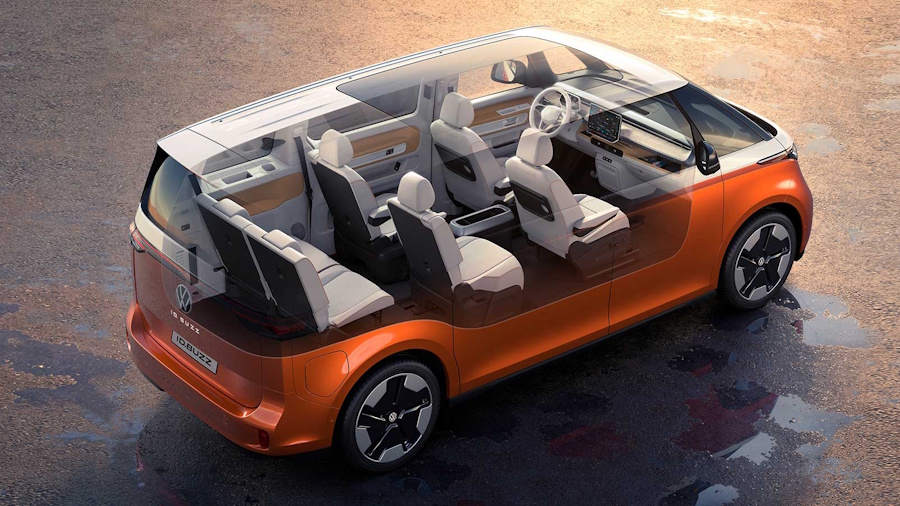
Volkswagen ID. Buzz LWB

Volkswagen’s long-wheelbase ID. Buzz uses an 86 kWh battery, and seven seats are an option on the Pro. Its German technical data lists 460 to 498 km WLTP for the long-wheelbase version, which also gives third-row passengers 16.5 cm more legroom than the standard one. The sliding rear doors make the third row far easier to reach than in any of the SUVs. Anyone who has climbed into the back of a seven-seat SUV in a car park will understand why that matters.
Xpeng X9

Xpeng’s X9 is a large seven-seat MPV with two reclining captain’s chairs in the middle row. The Long Range version reaches up to 615 km WLTP, and Xpeng’s X9 page says every version charges from 10 to 80 percent in 12 minutes on a fast enough charger. German prices start at €77,600, and Euro NCAP awarded it five stars. The full spec table is in my article on the UK launch.
Mercedes-Benz VLE

The VLE is Mercedes’ new electric MPV, unveiled in March 2026 and built on a dedicated electric van platform. You can configure it with five to eight seats. Mercedes Germany lists 641 to 714 km WLTP for the VLE 300 and 607 to 653 km for the all-wheel-drive VLE 400 4MATIC in its technical data. Mercedes’ press materials put the VLE 400’s usable battery at 115 kWh. In Germany, the five-seat VLE 300 starts at €77,896.
Hyundai Staria Electric

Hyundai’s Staria Electric is a van-based MPV, sold in Europe as a seven-seat Luxury or a nine-seat Wagon. Its European product page lists an 84 kWh battery, up to 430 km WLTP and a 10 to 80 percent charge in about 20 minutes. The seven-seater keeps 435 litres of boot space behind the third row. That’s the biggest official figure of any car in this guide.
Kia PV5 Passenger

Kia added six- and seven-seat versions of the PV5 Passenger in June 2026. The seven-seater uses a 2-2-3 layout and the 71.2 kWh battery, and Kia’s European site lists 397 km WLTP for it. That’s 15 km less than the five-seater, which Kia rates at 412 km. A 10 to 80 percent charge takes about 30 minutes, so it’s better suited to regional driving than long motorway trips.
Maxus Mifa 9

Maxus is part of SAIC, the Chinese group that also owns MG. The Mifa 9 comes with seven or eight seats and a 90 kWh battery, and Maxus lists 430 to 435 km WLTP depending on trim on its product page. Fast charging from 5 to 80 percent takes about 50 minutes, which is slow by current standards. The smaller Mifa 7 is still listed in the UK, and I compared both models in an earlier article.
Opel Zafira Electric, Peugeot e-Traveller and Citroën ë-SpaceTourer

Stellantis, the group behind Peugeot, Citroën, Opel and Fiat, sells the same electric van-based MPV under several names. Besides the three in the heading, there’s the Fiat E-Ulysse and the Toyota Proace Verso Electric, which shares the same base. Depending on length and layout, they seat up to eight or nine. With the 75 kWh battery, Opel quotes up to 347 km WLTP in its order launch announcement. Since the drivetrains are the same, I’d choose between them on price and the nearest dealer.
FAQ
What is the best seven-seat electric car in Europe?
For most families, the Kia EV9 is the best all-round choice. It has seven seats as standard in most markets, up to 563 km of WLTP range and 800-volt charging. The Hyundai Ioniq 9 is the closest alternative, with up to 620 km and 338 litres of boot space behind the third row.
Which seven-seat EV has the longest range?
On official figures, the Lucid Gravity Grand Touring leads with up to 739 km WLTP, followed by the Mercedes VLE 300 with up to 714 km. Among mainstream SUVs, the Peugeot E-5008 Long Range (669 km) and Škoda Peaq 90 (647 km) offer the most.
Which seven-seat EVs have room for adults in the third row?
The electric MPVs are the ones built for adults in the back: the Hyundai Staria Electric, Volkswagen ID. Buzz LWB, Xpeng X9, Mercedes VLE, Maxus Mifa 9 and the Stellantis vans. In most SUVs on this list, the third row is best suited to children and shorter trips.
Does the Tesla Model Y have seven seats in Europe?
Yes, but only on the Premium Long Range All-Wheel Drive version, since Tesla reintroduced the option in February 2026. In Germany, the seven-seater is rated at 600 km WLTP and the option costs €2,500. The third-row seats have no Isofix anchors, so child seats there must be secured with the seat belt.
Which seven-seat EV has the biggest boot with all seats up?
Of the cars with official figures in this guide, the Hyundai Staria Electric has the most space, with 435 litres behind the third row. The Hyundai Ioniq 9 offers 338 litres, the Škoda Peaq 299 litres and the BYD Tang 235 litres.
Editor’s note: This guide was first published in October 2025 and fully updated in November 2026 with new models and current WLTP figures.
Featured Image: Volkswagen
Marko Lubar is the Founder and Editor of ElectricFleet Online, where he covers the latest developments in electric vehicles, battery innovation, autonomous driving, artificial intelligence, and the technologies shaping the future of mobility.
Learn more about Marko and the mission behind ElectricFleet Online on the About Us page.
Latest News