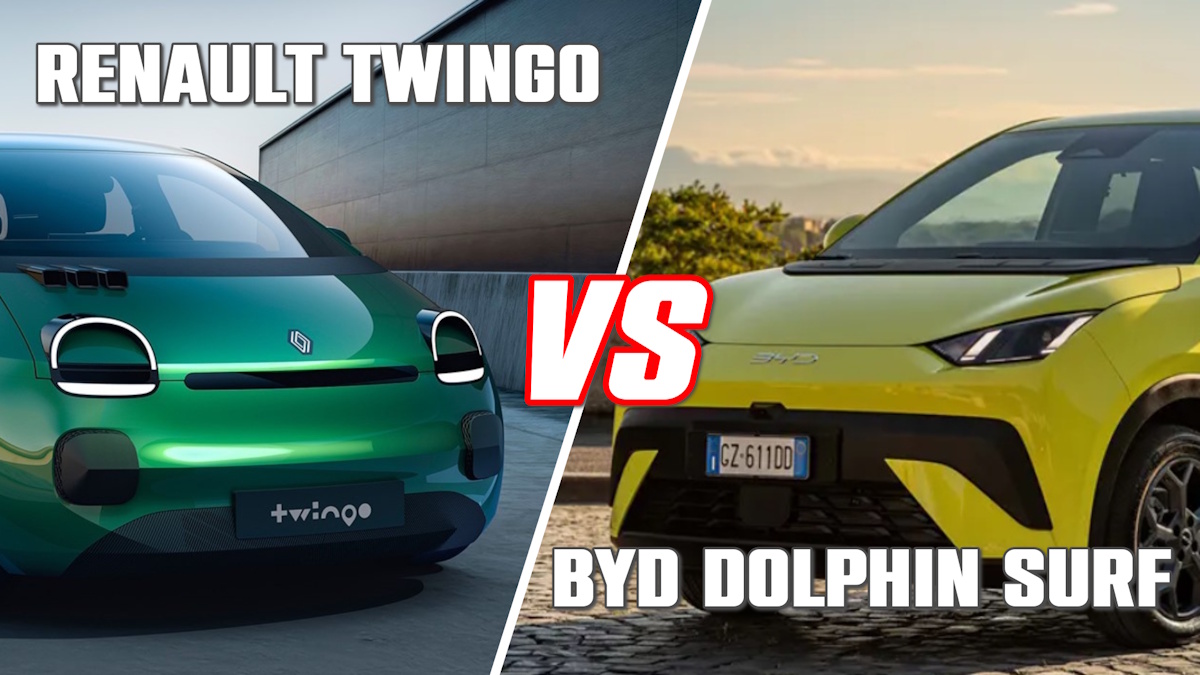
The affordable city EV segment in Europe is getting genuinely interesting. A few years ago, the choice was limited and the quality was variable. Now you have a French icon making its electric comeback and a Chinese newcomer that has quietly become one of the most credible small EVs on the continent. The Renault Twingo E-Tech and the BYD Dolphin Surf are natural rivals: both are compact, both are affordable, both use LFP batteries and both target buyers who want electric mobility without spending €30,000 or more. They are also two of the strongest options in the cheapest EVs available in Europe right now. But they go about it in quite different ways.
The Twingo is built in Slovenia, engineered between France and China, and carries one of European motoring’s most beloved nameplates. Renault recently celebrated one million EVs built in France, which gives some context to the scale of the brand’s electric ambitions. The Dolphin Surf is set to be assembled at BYD’s Hungarian factory for European customers and brings BYD’s Blade Battery technology to the entry level. Which one makes more sense for a European buyer depends on what you’re actually looking for.
Design and Interior
The Twingo E-Tech wears its heritage clearly. The rounded silhouette, the cheerful front end and the compact proportions are all direct references to the original 1992 Twingo, translated into a modern five-door body that is 3,790 mm long. It doesn’t look like a budget car. Carwow described it as “a stellar all-rounder” that feels premium for its price, and the interior backs that up: the standard 10-inch touchscreen, OpenR Link with Google built-in and sliding rear seats are all delivered with more care than you’d expect at this price point. The rear seats, adjustable by 170 mm fore and aft, offer a genuinely clever trade-off between passenger legroom and boot space.

The BYD Dolphin Surf is slightly larger at 3,990 mm long and has a more contemporary crossover-influenced design compared to the Twingo’s retro character. The 10.1-inch rotating touchscreen is a practical piece of differentiation: it can be switched between portrait and landscape orientation depending on whether you want to use navigation or media. Fit and finish is solid for the price, and the inclusion of three ISOFIX points (two rear, one front passenger) is a thoughtful touch for families.
The Dolphin Surf has a five-star Euro NCAP rating, which I’ve covered in detail in my dedicated safety article. The Twingo E-Tech had not yet been formally assessed by Euro NCAP at the time of writing, though Renault has confirmed it was developed to modern safety standards.
| Feature | Renault Twingo | BYD Dolphin Surf |
|---|---|---|
| Length / width / height | 3,790 / 1,720 / 1,490 mm | 3,990 / 1,720 / 1,590 mm |
| Wheelbase | 2,490 mm | 2,500 mm |
| Boot capacity (seats up) | 360 litres | 308 litres |
| Boot capacity (seats folded) | over 1,000 litres | 1,037 litres |
| Underfloor storage | 50 litres | No |
| Sliding rear seats | Yes (170 mm adjustment) | No |
| ISOFIX points | 2 rear | 2 rear + 1 front passenger |
| V2L / V2G | Yes (with 11 kW charger) | Yes, standard all trims (up to 3.3 kW) |
| Euro NCAP | Not yet rated | 5 stars |
Battery and Range
The Twingo E-Tech uses a single 27.5 kWh LFP battery across both trim levels, delivering up to 263 km of WLTP range on the Evolution trim with 16-inch wheels. The Techno trim with 18-inch wheels drops slightly to around 250 km. Real-world mixed driving is likely to return 220 to 240 km, according to multiple independent assessments. In city conditions, the figure will be closer to the WLTP number. Standard AC charging is 6.6 kW, which gives a full charge from 10 to 100% in around four hours and fifteen minutes on a home wallbox.

An optional upgrade to 11 kW AC is available as part of the Advanced Charge Pack (around €490), which also unlocks DC fast charging at 50 kW, allowing a 10-80% charge in approximately 30 minutes. The 11 kW charger also enables V2L and V2G capability.
| Specification | Renault Twingo |
|---|---|
| Battery | 29.0 kWh gross / 27.5 kWh usable (LFP) |
| WLTP range | 263 km (Evolution) / ~250 km (Techno) |
| Real-world range (estimated) | 220-240 km |
| AC charging (standard) | 6.6 kW |
| AC charging (optional) | 11 kW |
| DC charging (optional) | 50 kW (10-80% in ~30 min) |
| V2L / V2G | Yes (with optional 11 kW charger) |
The BYD Dolphin Surf is available in three trims with two battery sizes. The entry Active trim uses a 30 kWh LFP Blade Battery for 220 km WLTP. The Boost and Comfort trims step up to a 43.2 kWh battery, delivering 322 km WLTP on the Boost and 310 km on the Comfort, which uses a more powerful motor optimised for urban efficiency and achieves up to 507 km on the city cycle. It’s also one of the city EVs with the strongest real-world range figures in its class. DC fast charging on the Active tops out at 65 kW; the Boost and Comfort push to 85 kW. AC charging is 11 kW as standard across all trims, which is notably better than the Twingo’s standard 6.6 kW.
| Specification | Active | Boost | Comfort |
|---|---|---|---|
| Battery | 30 kWh LFP | 43.2 kWh LFP | 43.2 kWh LFP |
| WLTP range | 220 km | 322 km | 310 km |
| V2L | Yes, standard | Yes, standard | Yes, standard |
| AC charging | 11 kW | 11 kW | 11 kW |
| DC charging | 65 kW | 85 kW | 85 kW |
| DC 10-80% | ~30 min | ~30 min | ~30 min |
Performance
The Twingo E-Tech uses a 60 kW (82 hp) motor with 175 Nm of torque across both trims. That’s modest, and intentionally so: 0-100 km/h takes 12.1 seconds and the top speed is 130 km/h. It’s not designed to be quick. What it is designed to be is composed and pleasant, and independent reviews consistently note that the Twingo feels more refined than its specification suggests. The 0-50 km/h sprint takes 3.85 seconds, which is the relevant figure for urban use.
| Specification | Renault Twingo |
|---|---|
| Motor power | 60 kW (82 hp) |
| Torque | 175 Nm |
| Drive | FWD |
| 0-100 km/h | 12.1 seconds |
| 0-50 km/h | 3.85 seconds |
| Top speed | 130 km/h |
The Dolphin Surf offers more variation. The Active and Boost use a 65 kW (88 hp) motor, while the Comfort steps up to 115 kW (154 hp). The Comfort is the one that makes the Dolphin Surf feel noticeably more capable, with 0-100 km/h in 9.1 seconds and a higher top speed of 160 km/h.
| Specification | Active / Boost | Comfort |
|---|---|---|
| Motor power | 65 kW (88 hp) | 115 kW (154 hp) |
| Torque | 175 Nm | 220 Nm |
| Drive | FWD | FWD |
| 0-100 km/h | 11.1 / 12.1 seconds | 9.1 seconds |
| Top speed | 150 km/h | 150 km/h |
Warranty
BYD’s warranty terms for the Dolphin Surf follow the brand’s standard European package and are among the more generous in this segment. The vehicle warranty of six years or 150,000 km and a battery warranty of eight years or 160,000 km are both longer than most European rivals.

Renault’s warranty for the Twingo E-Tech is three years or 160,000 km for the vehicle, confirmed on Renault’s official French FAQ page. The powertrain carries four years or 160,000 km of coverage. The battery is covered separately for eight years or 160,000 km, whichever comes first. Paintwork is covered for three years with no mileage limit, and anti-corrosion protection runs for twelve years with no mileage limit. On vehicle warranty length, BYD has a clear advantage at six years versus three. On battery warranty, both are identical at eight years.
| Warranty | Renault Twingo | BYD Dolphin Surf |
|---|---|---|
| Vehicle | 3 years / 160,000 km | 6 years / 150,000 km |
| Battery | 8 years / 160,000 km | 8 years / 160,000 km |
| Powertrain | 4 years / 160,000 km | 8 years / 150,000 km |
| Paintwork | 3 years / unlimited mileage | 3 years / unlimited mileage |
| Anti-corrosion | 12 years / unlimited mileage | 12 years / unlimited mileage |
| Roadside assistance | Included | Included |
Pricing
The Twingo E-Tech starts at €19,490 for the Evolution trim in France, making it one of the most affordable EVs currently available in Europe. In France, national incentives can reduce the effective price significantly: €4,770 for low-income households and €3,620 for others, bringing the Evolution to as little as €14,720 in the most favourable cases. A full breakdown of Twingo pricing across European markets is available in my dedicated Twingo pricing article. UK pricing is expected to start under £20,000 when the car arrives there later this year.
The Dolphin Surf is priced competitively across Europe, and if you’re interested in how BYD pricing and discounts work in practice, my BYD Germany pricing and real costs article covers that in detail. For a wider look at both cars in context, the independent reviews at Electrifying.com are worth reading before you visit a dealer.
| Country | Renault Twingo (from) | BYD Dolphin Surf (from) |
|---|---|---|
| France | €19,490 | €19,990 |
| Germany | €19,990 | €22,990 |
| Netherlands | €20,990 | €22,990 |
| UK | under £20,000 (est., late 2026) | £18,675 |
Conclusion
If range and flexibility are the priority, the Dolphin Surf has the edge: the Boost trim’s 322 km WLTP range is meaningfully more than the Twingo’s 263 km, and the three-trim lineup gives buyers more options. The Dolphin Surf also has a confirmed five-star Euro NCAP rating, which matters if safety certification is a deciding factor. It’s one of the best EVs for new drivers for exactly these reasons, and features in my top best-buy EV picks for 2026. It also sits comfortably within the wider BYD European lineup if you want to compare it against BYD’s other models.
If driving feel, interior quality and interior practicality matter more, the Twingo makes a compelling case. The sliding rear seats, the larger boot at 360 litres, the V2L/V2G capability with the optional charger and the more refined driving experience are all advantages that show up in daily use. Multiple independent reviewers have noted that the Twingo feels significantly better than its price and specification suggest. It’s also worth noting that a next-generation Dolphin Surf is already in development and likely to arrive in Europe within a couple of years, which may be relevant if you’re planning to keep a car for the long term.

The AC charging situation is worth calling out honestly. The Twingo offers only 6.6 kW AC as standard, with 11 kW available as an optional upgrade that also unlocks DC charging. The Dolphin Surf has 11 kW AC as standard across all trims, which is a meaningful advantage for anyone relying on public destination chargers or three-phase home wallboxes. For buyers who charge exclusively at home overnight on a single-phase connection, the difference matters less.
For an affordable city car with more range options and a proven Euro NCAP score, the Dolphin Surf is the pragmatic choice. For the one that feels more considered and complete as a package, the Twingo is hard to ignore at this price. Both are strong enough to feature among the best affordable EVs in Europe in 2026, and both are worth serious consideration if you’re looking at the Volkswagen ID.Polo and its rivals in this segment. If you’re also considering the Dolphin Surf against other alternatives, my Dolphin Surf vs Hyundai Inster comparison covers a different angle on the same car.
FAQ
Which has more range, the Twingo E-Tech or the Dolphin Surf?
The Dolphin Surf Boost delivers 322 km WLTP, significantly more than the Twingo’s 263 km. However, the Twingo’s real-world efficiency is strong for its battery size, returning 220-240 km in mixed conditions.
Is the Renault Twingo E-Tech available across Europe?
Yes. Orders opened in January 2026, with deliveries beginning in spring 2026. The UK launch is expected later in 2026 with pricing under £20,000.
Does the Renault Twingo have V2L?
Yes, but only with the optional 11 kW AC charger upgrade, which also adds DC fast charging capability. The base 6.6 kW AC charger does not support V2L or V2G.
Which has a better Euro NCAP safety rating?
The BYD Dolphin Surf has a confirmed five-star Euro NCAP rating. The Renault Twingo E-Tech had not yet been tested by Euro NCAP at the time of writing.
Are both cars built in Europe?
The Renault Twingo E-Tech is built at Renault’s plant in Novo Mesto, Slovenia. The Dolphin Surf is set to be assembled at BYD’s Hungarian factory for European customers. Both therefore avoid EU tariffs on Chinese-imported vehicles.
What are the main differences between Evolution and Techno trims on the Twingo?
The base Evolution gets 16-inch wheels, a 10-inch central touchscreen with smartphone replication, AEB, lane-keeping assist and rear parking sensors. The Techno adds the OpenR Link with Google built-in, an Arkamys sound system, rear camera, automatic climate control and one-pedal driving mode.
Which is better for a new driver?
Both are manageable city cars suited to new drivers, but the Dolphin Surf’s confirmed five-star Euro NCAP rating and the availability of a parking camera across all trims give it a safety edge. My guide to the best EVs for new drivers covers the full picture including both cars.
Latest News