Some people will read the title of this article and immediately think: this comparison makes no sense. You simply cannot put a Mercedes-Benz in the same sentence as a Chinese car. It is a completely different universe.
But consider this. When Tesla presented the Roadster in 2008, almost nobody took the company seriously. It was seen as a passing trend, a toy for eccentrics and eco-hippies. Then the first Chinese EVs arrived in Europe and served mostly as punchlines. And here we are in 2026: the Tesla Model Y is the best-selling EV, BYD is the largest BEV brand in the UK, and Chinese manufacturers are building factories across the continent.
One thing worth being clear about upfront: the vehicles in this comparison are not all the same type. The Mercedes GLB is a compact premium SUV. The BYD Tang is a larger, heavier mid-size SUV. The Xpeng X9 is a full-size MPV, closer in concept to a Volkswagen Multivan than to a GLB. What they all have in common is seven or more seats and Chinese or German engineering. This is not a like-for-like shootout. It is an overview of what the market actually offers if a seven-seat EV is what you need, regardless of where the badge comes from.
Here is how they stack up.
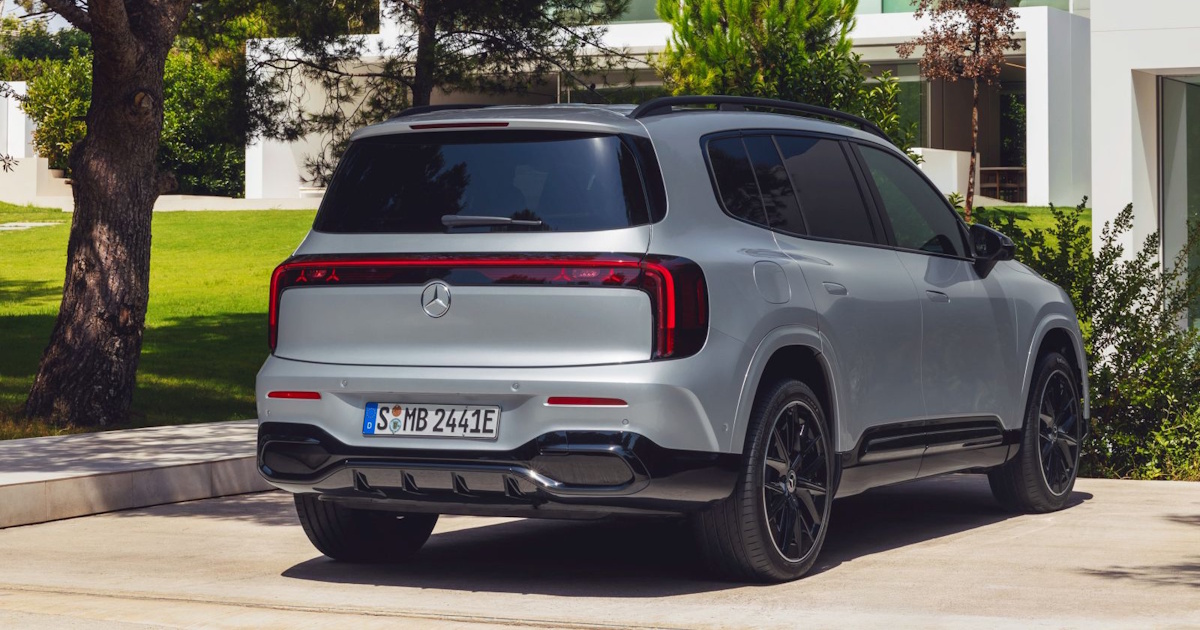
Mercedes GLB Electric
The new GLB Electric was unveiled in December 2025 and represents a significant step forward from the EQB it replaces. It is built on a dedicated EV platform, which immediately makes it more capable than its predecessor in every meaningful way.

The GLB Electric comes in three variants, and understanding the differences between them matters more than it might seem at first glance.
The entry model is the GLB 200, added to the lineup in March 2026. It uses a 58 kWh LFP battery, produces 165 kW (224 hp), and delivers up to 431 km of WLTP range. DC charging tops out at 200 kW, and the 0 to 100 km/h time is 8.2 seconds. Notably, this is the only GLB variant with an LFP battery, which means it can be charged to 100% daily without the degradation concerns that apply to NMC chemistry.
The GLB 250+ is the mid-range variant and the one most buyers will gravitate toward. It uses an 85 kWh NMC battery, produces 200 kW (272 hp) via rear-wheel drive, and delivers up to 631 km of WLTP range, which puts it on my list of EVs with more than 600 km of WLTP range in Europe. The 0 to 100 km/h time is 7.4 seconds.
The top variant, the GLB 350 4MATIC, adds a front motor for all-wheel drive and a combined output of 260 kW (354 hp). Range drops slightly to 614 km WLTP due to the extra weight, and the 0 to 100 km/h time falls to 5.5 seconds.
Both the 250+ and the 350 4MATIC feature 800V charging architecture capable of up to 320 kW, which puts them on my list of 800V electric cars available in Europe and means a 10 to 80% charge in around 22 minutes on a compatible charger. The GLB 200 uses a conventional 400V system with up to 200 kW. One important detail applies to all three variants: using the 800V models on standard 400V DC chargers requires an optional adapter, which must be specified at the time of ordering.
The interior carries over the CLA’s wide screen architecture with a 14-inch infotainment display and a 10.3-inch driver display, with an optional passenger screen on higher trim levels. The third row is an option rather than standard, so buyers who need seven seats need to make sure it is included at configuration. For buyers from in the UK, the 85 kWh variants are the only ones currently on offer.
BYD Tang
The BYD Tang is a larger, heavier SUV than the GLB. At around 4,870 mm in length it sits noticeably above the compact GLB in size, which means it is a closer equivalent to a BMW X5 or Mercedes GLE in terms of footprint, though it is priced considerably below them. It has been in Europe since 2021, when it launched in Norway as BYD’s first European export, giving it something the newer Chinese entries lack: a track record on European roads across multiple winters.

The current Tang for the European market uses a 108.8 kWh LFP battery with up to 530 km of WLTP range. The Tang’s charging tops out at 170 kW DC, which is functional but does not match the GLB’s 800V headline figure.
Performance comes from a dual-motor AWD setup delivering 380 kW (510 hp), making the Tang considerably more powerful than either GLB variant. The 0 to 100 km/h time of 4.9 seconds is brisk for a large seven-seat SUV. The cabin is genuinely spacious in the first two rows, though the third row is best suited to children and shorter adults, much like the GLB.
BYD offers a 6-year vehicle warranty and 8 years or 250,000 km on the battery, which compares favourably with the Mercedes standard warranty terms. V2L (vehicle-to-load) capability comes as standard, allowing you to power external devices directly from the car. If you are curious about how the Tang’s LFP battery compares to NMC battery used in other models, I covered the practical differences between the two chemistries in this guide to LFP vs NMC batteries.
You can find a broader overview of seven-seat EVs available in Europe, including the Tang, in my guide to the best seven-seat EVs in Europe.
Xpeng X9
The Xpeng X9 is a different kind of vehicle from the GLB or the Tang. It is a full-size MPV, closer in concept to a Volkswagen Multivan or a Mercedes V-Class than to a conventional SUV. At 5,316 mm long on a 3,160 mm wheelbase, it is substantially larger than everything else on this list. If you need genuine, unconstrained space for seven adults including comfortable third-row seating, the X9 is the only vehicle here that can genuinely deliver it.

The X9 is not yet officially on sale across Europe as of mid-2026, but a European launch has been confirmed and is expected to roll out progressively through 2026. Xpeng’s CEO confirmed the intention, and given that the G6, G9 and P7+ are now in production at Magna Steyr in Austria, there is good reason to expect the X9 to arrive without the tariff complications that affected earlier Chinese imports.
The 2026 model uses an 800V platform with either a 94.8 kWh LFP or a 110 kWh NMC battery. CLTC range figures of 650 to 750 km translate to an estimated WLTP range in the region of 480 to 580 km depending on variant. Charging capability reaches up to 280 kW on compatible DC chargers, with a 10 to 80% charge achievable in just around 12 minutes. The base model produces 235 kW (315 hp) in front-wheel drive configuration. The AWD variant adds a rear motor for a combined 370 kW (496 hp), with a 0 to 100 km/h time of 5.7 seconds.
The interior is where Xpeng makes its strongest argument. The X9 features a 17.3-inch central screen, a 21.4-inch second-row entertainment screen, rear-wheel steering for surprising agility in urban environments, and Xpeng’s Turing AI ADAS system as standard. The second-row zero-gravity seats are one of its most discussed features. In Chinese markets, the X9 has been compared to a business-class aircraft cabin in terms of passenger comfort, which gives a sense of what Xpeng is aiming for.
Final Comparison
If you strip away the badges and market positioning, what you are really looking at here are three very different takes on a seven-seat EV. The Mercedes GLB Electric starts at €50,782 in Germany, making it the most accessible entry point and the only true premium compact SUV in the group. The BYD Tang moves into a larger SUV class with more power and battery capacity, while the Xpeng X9 shifts the segment entirely into full-size MPV territory with a German starting price of €77,600 and a clear focus on space and charging technology.
| Specification | Mercedes GLB Electric | BYD Tang | Xpeng X9 |
|---|---|---|---|
| Body type | Compact 7-seat SUV | Large SUV | Full-size MPV |
| Battery | 58–85 kWh (LFP / NMC) | 108.8 kWh LFP | 94.8–110 kWh (LFP / NMC) |
| WLTP range | Up to 631 km | Up to 530 km | Up to 615 km* |
| DC charging | Up to 320 kW | Up to 170 kW | Up to 542 kW |
| Power | Up to 260 kW (354 hp) | Up to 380 kW (510 hp) | Up to 370 kW (496 hp) |
| Europe price (from) | €50,782 (Germany) | €57,550 (Denmark) | €77,600 (Germany) |
*Xpeng X9 WLTP figures estimated from CLTC data; official European homologation pending.
What You Actually Get for the Money
The GLB’s strongest arguments are range (631 km WLTP is class-leading for a compact seven-seater), charging speed (320 kW on 800V is exceptional), and the Mercedes brand ecosystem, including dealer network, residual values, and the confidence that comes with buying from an established premium manufacturer in your home market. For buyers who do a lot of motorway mileage, the combination of long range and fast charging makes the GLB one of the most capable long-distance vehicles available, regardless of price tier.
The Tang’s strongest arguments is BYD’s proven track record in Europe, a large 108.8 kWh LFP battery, greater overall size and power, 8-year battery warranty, and V2L capability as standard.
The Xpeng X9 offers something qualitatively different from both: the most interior space, the most advanced technology integration, and rear-wheel steering that makes a very large car surprisingly manageable in city environments.
FAQ
Is the Mercedes GLB Electric a true seven-seater?
Yes, the third row can accommodate adults on shorter journeys, though headroom is tight for taller passengers. Isofix mounts are fitted in both the second and third rows.
What is the range of the Mercedes GLB Electric?
The GLB Electric comes in three variants. The entry-level GLB 200 uses a 58 kWh LFP battery and delivers up to 431 km of WLTP range. The GLB 250+ uses an 85 kWh NMC battery for up to 631 km. The all-wheel drive GLB 350 4MATIC also uses the 85 kWh NMC battery and delivers up to 614 km.
How fast does the Mercedes GLB Electric charge?
The GLB 250+ and GLB 350 4MATIC use an 800V architecture capable of up to 320 kW DC charging, with a 10 to 80% charge in around 22 minutes on a compatible charger. The entry-level GLB 200 uses a conventional 400V system with up to 200 kW. All variants require an optional adapter to charge on standard 400V DC chargers, which must be ordered at the factory.
How does the BYD Tang compare to the Mercedes GLB Electric?
The Tang is a larger SUV than the GLB, more powerful (510 hp vs 268 or 349 hp), and carries a bigger 108.8 kWh LFP battery with an 8-year warranty. Its 530 km WLTP range is shorter than the GLB 250+’s 631 km, and DC charging tops out at 170 kW rather than 320 kW.
Latest News