Car interiors have never had more screen space, and drivers have never spent longer looking at it instead of the road. That’s the uncomfortable conclusion from a new Swedish test that repeated a 2022 experiment on ten current car models, and found that despite four years of bigger, sharper, better-placed screens, the average driver now needs more time and more road to complete the same basic tasks than before.
Vi Bilägare, Sweden’s largest car magazine, ran the test at Lunda airfield near Uppsala, timing how long it took drivers to complete four everyday tasks while driving at 110 km/h (68 mph) in a straight line:
- Turn on the seat heating, raise the temperature by two degrees and start the defroster
- Turn on the radio and switch from Swedish Radio channel P4 to P1
- Reset the trip meter
- Dim the instrument lighting to its lowest level and turn off the centre screen
The 2026 lineup covered ten current models, the Mazda CX-60, Mercedes CLA, Toyota Corolla Cross, BYD Seal U, Nissan Qashqai, Kia EV3, Citroën C3 Aircross, Tesla Model Y, Skoda Kodiaq and Volvo XC60, plus a 2016 Volvo V60 included purely as an old-technology benchmark. Using the completion time, the outlet calculated how far each car travelled while the driver’s attention was split between the task and the traffic ahead. It’s the same method used in the original 2022 test, run specifically so the two results could be compared directly.
The Average Distance Travelled While Distracted Has Gone Up, Not Down
In 2022, drivers covered an average of 756 metres completing the four tasks. In the 2026 retest, that figure rose to 813 metres, roughly two extra seconds per task at motorway speed. Manufacturers have had four years to refine their software, reposition their displays and respond to years of complaints about buried menus, and the collective result still got worse.
Which cars performed best and worst in the 2026 test?
The Volvo XC60 posted the best result at 485 metres, with the Skoda Kodiaq close behind at 542 metres. The Mazda CX-60 finished last at 1,137 metres, just behind the Mercedes CLA’s 1,116 metres, and the CLA’s screen took 19 seconds after unlocking before it would accept input at all.
Vi Bilägare’s original 2022 article published a full results table for all twelve cars in that test, giving both the completion time and the outlet’s own score out of five. Distance travelled is calculated here from that published time at the test’s 110 km/h speed, and the two directly stated distances in the original article, 306 metres for the Volvo V70 and 1,372 metres for the MG Marvel R, match this calculation almost exactly.
| Car (2022 test) | Time to complete tasks | Distance travelled (calculated) | Score (out of 5) |
|---|---|---|---|
| Volvo V70 (2005 model) | 10.0 s | 306 m | 4.5 |
| Dacia Sandero | 13.5 s | 413 m | 3.75 |
| Volvo C40 | 13.7 s | 419 m | 3.5 |
| Subaru Outback | 19.4 s | 593 m | 4.0 |
| Mercedes GLB | 20.2 s | 617 m | 3.25 |
| Tesla Model 3 | 23.5 s | 718 m | 3.75 |
| Nissan Qashqai | 25.1 s | 767 m | 4.25 |
| Volkswagen ID.3 | 25.7 s | 785 m | 2.25 |
| Hyundai Ioniq 5 | 26.7 s | 816 m | 3.5 |
| Seat Leon | 29.3 s | 895 m | 3.25 |
| BMW iX | 30.4 s | 929 m | 4.0 |
| MG Marvel R | 44.9 s | 1,372 m | 2.5 |
Vi Bilägare’s own results chart for the 2026 test gives a complete picture across all eleven cars, plus the 2005 Volvo V70 shown again for reference.
| Car (2026 test) | Distance travelled | Note |
|---|---|---|
| Volvo XC60 | 485 m | Best result among current models |
| Skoda Kodiaq | 542 m | One of the strongest balances between screen and physical controls |
| Tesla Model Y | 608 m | 110 m better than the Tesla Model 3’s 718 m in 2022 |
| Citroën C3 Aircross | 774 m | |
| Kia EV3 | 812 m | Screen partly obscured by the steering wheel |
| Nissan Qashqai | 813 m | Older model scored 767 m in 2022 |
| BYD Seal U | 819 m | |
| Volvo V60 (2016 model) | 863 m | Included as an old-technology comparison car, not a current model |
| Toyota Corolla Cross | 1,024 m | |
| Mercedes CLA | 1,116 m | Took 35 s, 15 s slower than the 2022 Mercedes GLB, screen took 19 s to respond after unlocking |
| Mazda CX-60 | 1,137 m | Worst result in the 2026 test |
| Volvo V70 (2005 model) | 306 m | Tested in 2022, shown again on 2026 chart for reference |
Screens Aren’t Automatically the Problem, and the Volvo XC60 Proves It
The fact is, the car built entirely around a touchscreen actually posted the best result in the whole 2026 test. The Volvo XC60 completed all four tasks in 485 metres, the shortest distance of any model tested, which tells you the display itself isn’t the whole story. What separated the XC60 from the rest was a clear layout and frequently used functions placed within easy reach, not the absence of a screen. The Skoda Kodiaq backs that up too, finishing in 542 metres with what Vi Bilägare called one of the strongest balances between screen and physical controls in the whole lineup.
Tesla’s Model Y told a similar story. It remains one of the most screen-dependent cabins on sale, with climate, mirrors and even the gear selector routed through the display, yet it finished in 608 metres, 110 metres better than the 2022 Model 3’s result. Software refinement and better placement did the work here, even without adding a single physical switch.
Physical Buttons Don’t Guarantee Safety Either
The test’s most useful data point might be the one that cuts against the “bring back buttons” argument. A 2016 Volvo V60, included as a stand-in for an older, button-heavy interior, needed 863 metres to complete the same tasks, worse than seven of the ten current touchscreen-based cars in the 2026 field. Its climate and infotainment functions were spread across dozens of small, similarly shaped switches, which turned out to be just as hard to operate by feel as a poorly organised menu.

That same pattern showed up in 2022, just from the other direction. BMW’s iX, which pairs its touchscreen with more physical switches than most rivals, still needed 929 metres, one of the worst results that year, while the touchscreen-only Volvo C40 finished in 419 metres. Worst of all was the MG Marvel R, at 1,372 metres, a screen-dominated dashboard with no shortage of buttons in the wrong places either.
Compare that with the 2005 Volvo V70 from the original 2022 test, which needed just 306 metres, the best result recorded in either year. Its buttons were large, well defined and spaced far enough apart to find without looking. The difference between the V70 and the V60 isn’t the technology, it’s execution.
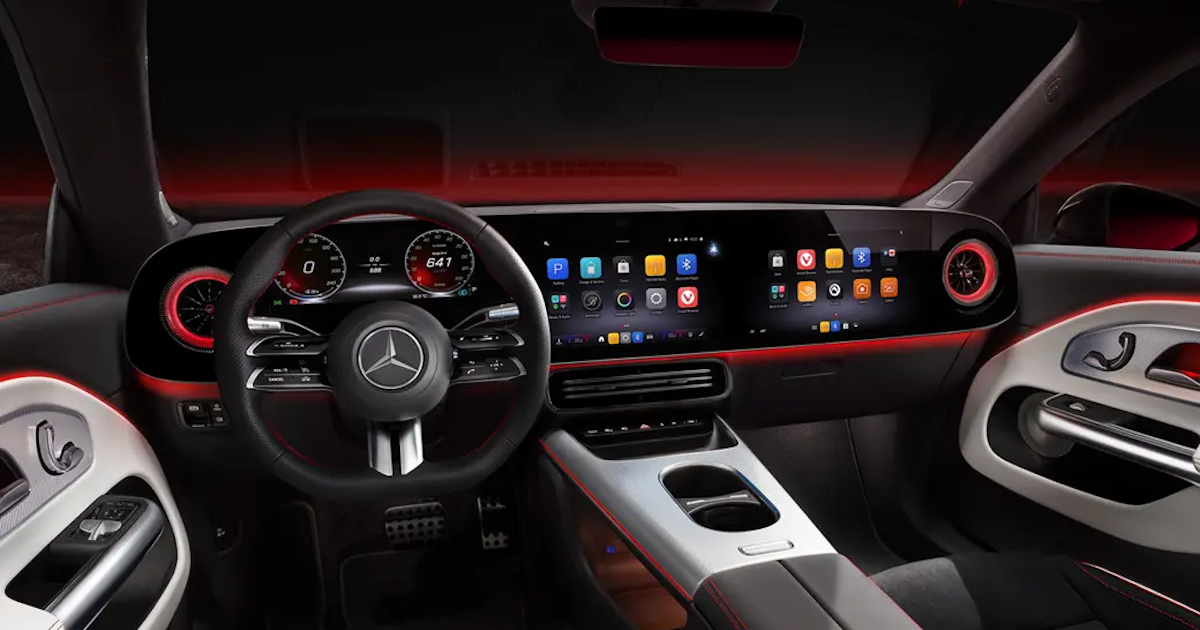
Mercedes had a rougher time of it in 2026: the new CLA, running the brand’s latest MBUX (Mercedes-Benz User Experience) system, took 35 seconds to complete the tasks, 15 seconds slower than the Mercedes GLB tested in 2022, and the screen needed 19 seconds after unlocking before it responded to input at all. That worked out to 1,116 metres travelled, well behind most of the field.
In Vi Bilägare’s separate glove test, simulating a cold winter morning, only the Mercedes and the Volvo responded reliably through thick leather gloves. The Mazda CX-60 finished last of all at 1,137 metres, and the Kia EV3, whose screen is partly obscured by the steering wheel, still managed a mid-pack 812 metres.
The Test Panel Liked Some of the Worst Performers
Vi Bilägare also asked its test panel to score each car’s driver environment on a scale of one to five, separately from the stopwatch. That subjective score doesn’t always agree with the distance figures, and the gap is one of the more interesting details in the whole test.
| Car (2026 test panel) | Panel score (out of 5) |
|---|---|
| Skoda Kodiaq | 4.7 |
| Toyota Corolla Cross | 4.5 |
| Mazda CX-60 | 4.4 |
| Nissan Qashqai | 4.4 |
| Citroën C3 Aircross | 4.1 |
| Volvo XC60 | 4.1 |
| Kia EV3 | 3.9 |
| Mercedes CLA | 3.9 |
| BYD Seal U | 3.8 |
| Tesla Model Y | 3.7 |
| Volvo V60 (2016 model) | 3.7 |
The Mazda CX-60 needed the most distance of any car in the test, yet the panel rated it the third-best driver environment overall, on a par with the Nissan Qashqai. The Toyota Corolla Cross tells a similar story, one of the slower cars on the stopwatch but the second-favourite among the panel. Whatever made those two interiors pleasant to sit in and look at wasn’t the same thing that made their controls quick to operate mid-drive.
Tesla’s Model Y ran the other way. It posted the second-best distance result of any current car, yet the panel liked it least of all, tied with the 2016 Volvo V60 it was supposed to make look outdated.
Euro NCAP Has Built This Into Its 2026 Scoring
Euro NCAP’s own overhaul of its safety protocols, in effect from this year, now scores the placement, clarity and ease of use of a car’s essential controls as part of its Safe Driving stage, and rewards cars that keep frequently used functions on a physical button rather than buried in a menu. Multiple reports on the announcement list indicators, hazard lights, the horn, the wipers and the eCall emergency system as functions that need a hardware control if a car wants to hold onto its full five stars.

The first real-world result is already public: when the BMW iX3 and the Zeekr 7GT became the first cars tested under the new 2026 protocol, the Zeekr outscored the BMW in three of four categories, except Safe Driving, where routing basic vehicle functions through its central touchscreen cost it points against the iX3’s restored physical switches. My breakdown of what changed under the 2026 protocol covers the full scope of that shift.
A good Safe Driving score built partly on physical controls still doesn’t guarantee a car’s other assistance systems behave the way you’d want on the road, though. My take on where the 2026 protocol still falls short covers that gap in more detail.
The Wider Research Points the Same Direction
Vi Bilägare’s test isn’t an outlier, either. A 2020 study by the UK’s Transport Research Laboratory, commissioned by the road safety charity IAM RoadSmart, found that using a touchscreen infotainment system through Apple CarPlay slowed driver reaction times by 57 percent, compared with a 12 percent slowdown at the UK’s legal drink drive limit and 35 percent while texting. The same study recorded drivers taking their eyes off the road for up to 16 seconds at a time, and found that participants consistently underestimated how long they’d looked away by as much as five seconds.
That lines up with older but still widely cited research from the American National Highway Traffic Safety Administration and Virginia Tech Transportation Institute, whose 2006 naturalistic driving study found that a single glance away from the road lasting more than two seconds is enough to double the risk of a crash or near-crash. None of these figures are specific to electric vehicles, but EVs, with their software-first cabins and heavy reliance on one central display, are exactly the kind of car this research is describing.
What This Means If You’re Buying a Car Now
The practical takeaway isn’t touchscreens bad, buttons good. It’s that layout and response speed matter more than which technology a manufacturer chose, and that Euro NCAP ratings from 2026 onward will start reflecting that directly. If a car you’re considering buried its most-used controls three menus deep the last time you tried it in a showroom, that’s a signal to trust over the marketing copy.
Screens in cars aren’t going anywhere, and this test doesn’t argue they should. What it shows is that four years of software updates and bigger displays haven’t fixed the underlying problem on their own, and that the manufacturers now under the most scrutiny are the ones still treating a touchscreen as a shortcut rather than something that needs to be designed as carefully as a button ever was.
FAQ
What did the 2026 touchscreen distraction test actually find?
Drivers needed an average of 813 metres to complete four everyday tasks at 110 km/h in 2026, up from 756 metres in the same test in 2022. That’s roughly two extra seconds per task despite four years of screen and software improvements across the industry.
Are physical buttons always safer than touchscreens?
No. A 2016 Volvo V60 with a dense cluster of small, similar-feeling buttons needed 863 metres to complete the same tasks in the 2026 test, worse than seven of the ten current cars in the field.
Will Euro NCAP penalise cars with touchscreen-only controls?
Yes, from 2026, Euro NCAP’s Safe Driving assessment scores the placement and ease of use of a car’s essential controls, and rewards models that keep functions such as indicators, hazard lights, the horn, wipers and the eCall system on a physical control rather than inside a touchscreen menu.
Featured Image: Mercedes-Benz
Marko Lubar is the Founder and Editor of ElectricFleet Online, where he covers the latest developments in electric vehicles, battery innovation, autonomous driving, artificial intelligence, and the technologies shaping the future of mobility.
Learn more about Marko and the mission behind ElectricFleet Online on the About Us page.
Latest News