The electric pickup truck market in Europe is small, but moving faster than most people realise. A couple of years ago, your only option was the Maxus T90 EV, a Chinese-built two-wheel drive truck that had the segment entirely to itself. Today, you can choose from five fully electric pickup trucks, with more models in development.
That is still a short list compared to the dozens of diesel options available, and none of these trucks is cheap. But the commercial vehicle tax landscape in the UK shifted significantly in April 2025, when double-cab pickups were reclassified as private cars for benefit-in-kind purposes. That change made diesel pickups considerably more expensive for company drivers and fleet operators, while fully electric models gained a clear advantage. Suddenly, the numbers started looking rather different.
It is also worth noting that WLTP range figures quoted throughout this article reflect unladen, European test conditions. If you are comparing figures from other sources that quote CLTC numbers from Chinese market testing, expect a significant difference. I explained how the two standards compare in this guide to WLTP vs CLTC range measurements.
Here is every fully electric pickup truck currently available in Europe, along with the key specifications and pricing you need to know.
At a Glance: Electric Pickup Trucks in Europe
| Model | Battery | WLTP Range |
|---|---|---|
| KGM Musso (2WD) / (4WD) | 80.6 kWh (LFP) | 420 km / 379 km |
| Maxus T90 | 89 kWh | 330 km |
| Maxus eTerron 9 | 102 kWh (LFP) | 430 km |
| Isuzu D-Max | 66.9 kWh (NMC) | 263 km |
| Toyota Hilux | 59.2 kWh | 256 km |
KGM Musso
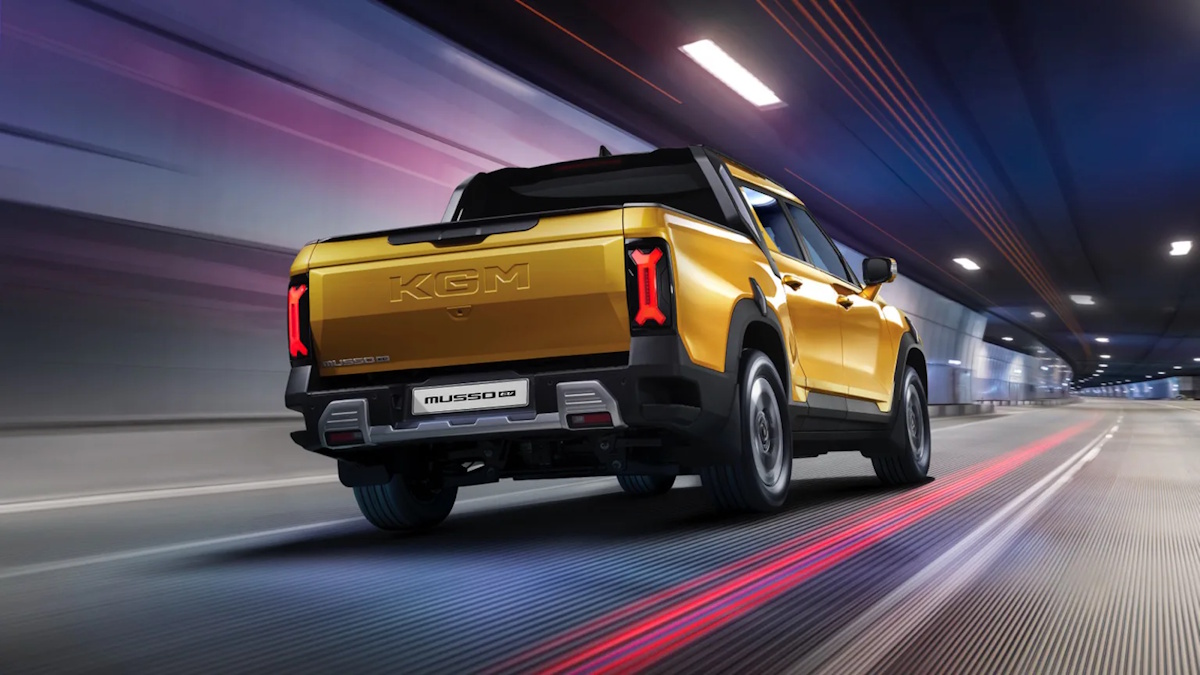
KGM, formerly known as SsangYong before the brand was rescued by South Korean conglomerate KG Group in 2023, has built what might be the most compelling all-round case for an electric pickup in Europe right now. The Musso is priced from €41,990 in Germany and £39,995 in the UK, which already includes the £5,000 Plug-in Van Grant.

The Musso is built on a unibody platform derived from the Torres EVX rather than a traditional body-on-frame ladder chassis. That makes it lighter and more comfortable on-road, closer in feel to an SUV than a conventional work truck. It uses an 80.6 kWh LFP battery, which means charging to 100% daily carries no degradation penalty, as I explained in more detail in this guide to LFP vs NMC battery chemistry.
The 2WD version delivers 420 km of WLTP range and 207 hp, while the optional 4WD variant drops range to 379 km but adds a second motor for better traction in poor conditions. DC fast charging reaches 120 kW for a 10 to 80% charge in around 36 minutes. The cabin seats five and includes a 12.3-inch dual-screen setup, heated and ventilated front seats, rear heated seats, and an Alpine audio system. V2L (vehicle-to-load) comes standard, allowing tools or appliances to be powered directly from the truck. Safety equipment includes eight airbags, adaptive cruise control, autonomous emergency braking, lane keeping assist, blind spot detection, and a 3D around-view monitor.
| Specification | Value |
|---|---|
| Towing | 2,300 kg |
| Payload | 500 kg |
Towing is rated at 2,300 kg and payload is 500 kg, which falls below the one-tonne commercial threshold that matters for VAT recovery in the UK. That is the Musso’s main limitation for commercial operators. For lifestyle buyers and smaller businesses, it is currently the most affordable entry point into electric pickup ownership on the continent.
Maxus T90
The Maxus T90 was the first fully electric pickup truck to go on sale in Europe, arriving in 2022 at a time when nothing else existed in the segment. That pioneering status is both its main claim to fame and, in 2026, its main limitation. Everything that has come since has improved on it in at least one meaningful way.

The T90 uses an 89 kWh battery and delivers up to 330 km of WLTP range. It is rear-wheel drive only, with no 4WD option, which immediately rules it out for buyers who need genuine off-road capability or confident towing in slippery conditions. DC fast charging tops out at 80 kW, meaning a 20 to 80% charge takes around 45 minutes, which is slower than any of its newer rivals. Towing capacity is 2,500 kg braked, and payload reaches one tonne, which is the threshold for commercial vehicle tax classification in the UK. That one-tonne payload remains one of its practical advantages over the KGM Musso.
| Specification | Value |
|---|---|
| Towing | 2,500 kg |
| Payload | 1,000 kg |
Maxus has offered aggressive leasing deals on the T90 from time to time, which has helped it find buyers for whom the commercial tax advantages are the primary motivation. Maxus has a broader EV lineup in Europe beyond just pickups, including several electric delivery vans aimed at urban logistics operators, which I covered in this overview of the full Maxus EV range in Europe.
Maxus eTerron 9
The eTerron 9 is Maxus’s flagship electric pickup and a major step forward from the T90 EV in almost every way. It is built on a dedicated EV platform with semi-monocoque construction using 73% ultra-high-strength steel, designed from the ground up as an electric vehicle rather than a conversion from a combustion chassis. Full specifications and are available on my Maxus eTerron 9 vehicle page.

The battery is a 102.2 kWh LFP unit with a nine-channel thermal management system rated for extreme temperatures. Like the KGM Musso, the LFP chemistry means daily charging to 100% is perfectly fine without accelerating degradation. WLTP range is 430 km, which is the best figure of any fully electric pickup available in Europe.
Dual permanent magnet motors produce a combined 325 kW (436 hp), with 0 to 100 km/h in 5.8 seconds, making it considerably quicker than any diesel pickup at a similar price. Towing capacity reaches 3,500 kg braked with BorgWarner front and rear differential locks for serious off-road use. DC charging tops out at 115 kW for a 20 to 80% charge in around 40 minutes. V2L is standard with up to 6.6 kW output through multiple sockets in the bed and cabin. The load bed measures 1,561 mm in length, and there is a 236-litre powered front trunk.
| Specification | Value |
|---|---|
| Towing | 3,500 kg |
| Payload | 620 kg |
The eTerron 9 is priced from £53,000 excluding VAT in the UK and from €62,990 in Germany, also excluding VAT. It comes with a 5-year vehicle warranty and an 8-year battery warranty.
Isuzu D-Max
The Isuzu D-Max makes a claim that no other fully electric pickup in Europe currently can: it is the first production EV to combine a one-tonne payload, 3,500 kg towing capacity, and full-time four-wheel drive. That combination matters a lot for fleet operators and commercial users who cannot compromise on real working capability.

First UK deliveries arrived in February and March 2026, with left-hand drive European markets receiving the vehicle slightly earlier. It uses a 66.9 kWh battery with dual motors producing 149 kW and 347 Nm. WLTP range is 263 km, the shortest on this list, and DC fast charging is limited to 50 kW, meaning a 10 to 80% charge takes around one hour.
Its 0 to 100 km/h time of 10.1 seconds is the slowest here, although that is rarely a priority for commercial users. Ground clearance exceeds 210 mm, while wading depth reaches 600 mm, preserving the D-Max’s off-road credentials. Isuzu also offers an 8-year battery warranty alongside the 5-year standard vehicle warranty.
| Specification | Value |
|---|---|
| Towing | 3,500 kg |
| Payload | 1,000 kg |
Pricing starts from £59,995 in the UK (excluding VAT), and NOK 789 900 in Norway. Those are significant sums, and the range and charging speed limitations are real trade-offs compared to rivals like the eTerron 9. The D-Max’s case rests almost entirely on its commercial credentials: the combination of one-tonne payload, 3,500 kg towing, and 4WD in a package that meets the practical needs of utility fleets, public sector operators, and rural businesses. The vehicle is available in the UK and Norway initially, with further European markets to follow.
Toyota Hilux
The Toyota Hilux is one of the most recognisable vehicles in the world. The latest generation was unveiled in November 2025, with the electric variant available from launch. In the UK, the Hilux EV is listed as “coming soon”, with orders expected to open in summer 2026. Other European markets, including Germany and Croatia, are also expected to receive the model gradually throughout 2026.

The Hilux BEV uses a 59.2 kWh battery with dual motors and all-wheel drive, producing 144 kW and delivering 256 km of WLTP range. Toyota has kept the body-on-frame ladder chassis and leaf spring rear suspension that have made the Hilux a byword for durability.
| Specification | Value |
|---|---|
| Towing | 1,700 kg |
| Payload | 715 kg |
The Hilux EV is rated for 1,700 kg of towing and a 715 kg payload, both significantly below the diesel Hilux’s 3,500 kg towing capacity and 1,000 kg payload. Toyota has been transparent about the reason: a larger battery pack would not fit between the chassis rails without compromising the structural integrity that defines the Hilux’s toughness.
The interior, meanwhile, is a major upgrade over the outgoing model, featuring dual 12.3-inch screens and Toyota Safety Sense as standard. A hydrogen fuel cell Hilux is also planned for 2028, making this EV the first chapter in what Toyota intends to be a broader multi-powertrain electrification strategy for its most iconic commercial vehicle.
FAQ
How many fully electric pickup trucks are available in Europe in 2026?
Five: the KGM Musso, Maxus T90 EV, Maxus eTerron 9, Isuzu D-Max EV and Toyota Hilux. Availability varies by country, with the UK currently having the broadest selection, though some models are still arriving in certain European markets through 2026.
Which electric pickup truck has the longest range in Europe?
The Maxus eTerron 9 has the longest WLTP range, at 430 km. The KGM Musso in 2WD configuration follows at 420 km. The Toyota Hilux and Isuzu D-Max have the shortest figures at 256 km and 263 km respectively.
Which electric pickup can tow the most?
The Maxus eTerron 9 and Isuzu D-Max both offer 3,500 kg braked towing capacity, matching the benchmark set by diesel midsize pickups.
Which electric pickup has a one-tonne payload?
The Maxus T90 and Isuzu D-Max both meet the one-tonne payload threshold, which is relevant for VAT recovery and benefit-in-kind tax classification under UK commercial vehicle rules.
Why is the Toyota Hilux EV’s towing capacity lower than the diesel?
Toyota has explained that a larger battery would not fit between the ladder frame chassis rails without compromising the structural integrity the Hilux is known for. The 59.2 kWh battery is a deliberate engineering compromise, prioritising durability and off-road capability over matching the diesel’s towing figures.
What is the cheapest fully electric pickup truck in Europe?
The KGM Musso is the most affordable, starting from £39,995 in the UK including the £5,000 Plug-in Van Grant. In Germany it starts from around €42,000.
Are electric pickup trucks more tax-efficient than diesel for UK company use?
Yes, in most cases. Following the April 2025 reclassification of double-cab pickups as private cars for benefit-in-kind purposes, diesel pickups now attract the maximum 37% BiK rate. Fully electric pickups benefit from a much lower BiK rate, generating significant savings for company drivers. The commercial vehicle classification, requiring one-tonne payload, still applies for VAT recovery and capital allowances.
Is the Maxus eTerron 9 available outside the UK?
Yes, the eTerron 9 is available in the UK, Norway, Sweden and Denmark, with broader European market availability planned through 2026. Maxus also produces a wide range of electric delivery vans for European commercial operators.
Marko Lubar is the Founder and Editor of ElectricFleet Online, where he covers the latest developments in electric vehicles, battery innovation, autonomous driving, artificial intelligence, and the technologies shaping the future of mobility.
Learn more about Marko and the mission behind ElectricFleet Online on the About Us page.
Latest News