The EV industry and the humanoid robot industry are starting to look like the same industry wearing two different jackets. Nearly 20 major automakers worldwide are now working on humanoid robots in some form, according to reporting from Gasgoo, and the logic makes sense once you think about it. A lot of the underlying technology, AI perception, motion control, battery systems, manufacturing scale, overlaps directly with what these companies already do to build cars. The tricky part is telling apart a company with a robot doing real work on a real line from a company with a slick stage demo and a promise. Here is where things actually stand, including in Europe, where the approach looks quite different from what China and the US are doing.
Who Is Doing What, At A Glance
| Manufacturer | Robot | Current Stage | Notable Detail |
|---|---|---|---|
| Hyundai Motor Group / Boston Dynamics | Atlas | Entering real factory deployment in 2026 | Over 25,000 units committed to Hyundai and Kia plants by 2028 |
| Renault (with Wandercraft) | Calvin-40 | Committed rollout starting in 2026 | Up to 350 units planned within about 18 months |
| Chery | Aimoga | Already selling to consumers | Roughly €38,000, 2,000+ overseas deliveries |
| Xiaomi | CyberOne | Working inside Xiaomi’s own EV factory | Performs tasks like self tapping nut installation, not for public sale |
| SAIC-GM (SAIC and General Motors) | Nengzai No. 1 | Working on a live production line | Loads over 1,000 battery cells per shift on the Buick Electra E7 line |
| BMW (Europe) | AEON, by Hexagon Robotics | Pilot phase from summer 2026 | First humanoid deployed inside a European car plant |
| Xpeng | Iron | Internal deployment now, mass production targeted end of 2026 | 178 cm tall, Turing AI chip with 2,250 TOPS |
| Mercedes-Benz | Apollo, by Apptronik | Piloting in intralogistics only | Testing in Germany and Hungary |
| Tesla | Optimus | Dedicated production line starting mid 2026 | Musk calls it the hardest manufacturing scale up Tesla has attempted |
| BMW (US) | Figure 02 / Figure 03 | Running since 2025 | Helped build over 30,000 BMW X3 units at Spartanburg |
| BYD | Unnamed, debuting in August 2026 | About to show its first physical prototype | In development since late 2024 under BYD’s 15th Business Division |
| GAC Group | GoMate Mini | Small batch production planned for 2026 | Mass production targeted for 2027 |
| Changan Automobile | Unnamed | Early stage | Invested roughly €58 million in a dedicated robotics subsidiary |
| Li Auto | Nexus, unnamed products | Early stage, still an internal project | Building separate wheeled and bipedal robot teams |
The Ones Already Doing Real Work
Let’s start with the programmes that have moved past demos and are actually doing something, because there are more of them than you would expect.
Chery is the furthest along commercially. Its robotics arm, Aimoga, has been selling both a humanoid robot and a quadruped robot dog directly to Chinese consumers through a JD.com storefront since April 2026, with the humanoid priced at roughly €38,000 (285,800 yuan). By the end of July, Aimoga had passed 2,000 cumulative overseas deliveries across more than 60 countries, and 110 of its police robots were deployed across Chinese cities for traffic control duty in the first half of this year. These are not general purpose robots capable of complex reasoning, they are built for guidance, reception and marketing roles, but they are shipping, and people are paying for them.

Xiaomi’s CyberOne is doing something more technically interesting, even though you cannot buy one. The robot has already been deployed inside Xiaomi’s own EV factory die-casting workshop, performing tasks such as self tapping nut installation. Xiaomi has also detailed a redesigned bionic hand for the robot, cutting hand volume by 60 percent to match human proportions and adding a liquid cooling system inspired by human sweating, according to Interesting Engineering. It is still a research platform rather than a product, but it is doing real factory work, which puts it ahead of several higher profile programmes.
SAIC-GM, the joint venture between SAIC Motor and General Motors, has its own version of this story. In March 2026 it deployed a wheeled robot called Nengzai No. 1, co-developed with Shanghai robotics firm Zhiyuan Robotics (also known as AgiBot), onto the actual battery assembly line for the Buick Electra E7. According to Gasgoo’s Autonews, the robot loads more than 1,000 battery cells per shift, reaching around 80 percent of a human worker’s output, with positioning accuracy of plus or minus 0.1 millimetres. SAIC-GM picked a wheeled design over a bipedal one specifically because it is more stable and reliable at this stage, which is an honest enough admission that bipedal robots still have real reliability problems left to solve.
The Ones Racing Toward Mass Production
Xpeng is the most credible of the pure play EV makers here. Its Iron humanoid robot, 178 cm tall and built around three of the company’s own Turing AI chips delivering a combined 2,250 TOPS of computing power, is already performing sorting, transport and quality inspection tasks at Xpeng’s Guangzhou factory. Xpeng is targeting monthly production capacity above 1,000 units by the end of 2026, with deployment as showroom sales assistants across China starting in the first quarter of 2027, expanding overseas later that year and reaching ordinary households from 2028. Xpeng CEO He Xiaopeng personally took over as head of the robotics business in June, and the company’s physical AI R&D spending is expected to reach roughly €950 million (RMB 7 billion) this year. Elon Musk himself has weighed in on Iron, telling reporters that “Tesla and China companies will dominate the market,” which is a notable thing to hear from a direct competitor.
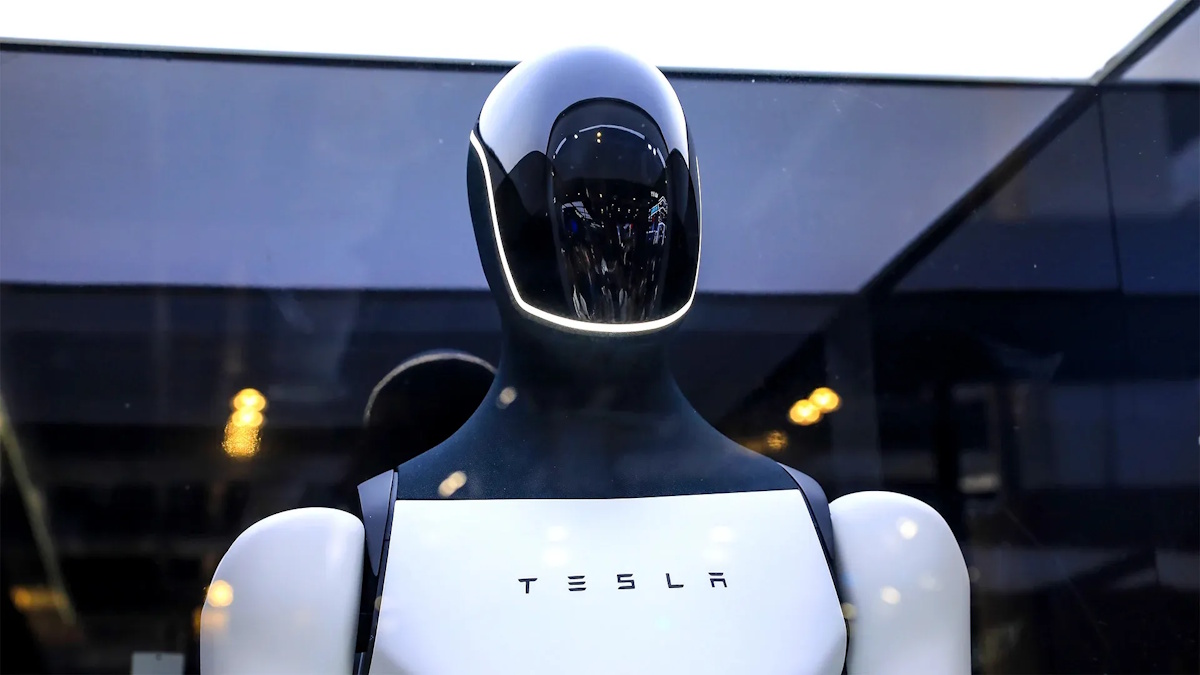
Tesla’s Optimus is the most famous name in this space, and probably the one furthest behind its own hype relative to where it actually stands today. According to Electrek, Musk confirmed on Tesla’s Q1 2026 earnings call that dedicated Optimus production at Fremont would begin around July or August 2026, converting the line that used to build the Model S and Model X. On a more recent earnings call, Musk described scaling Optimus as “the hardest to scale in manufacturing” that Tesla has ever attempted, warning that the early part of the ramp will be slow, since Optimus cannot lean on an already established supply chain the way Tesla’s cars can. Tesla is building much of that supply chain from scratch, with partners including Samsung, TSMC, Panasonic and Micron. Musk first announced Optimus back in 2021, so having the dedicated production line only start around now tells you plenty about how much harder this is turning out to be than building a car.
The Newest Entrants
BYD is the freshest name in the race. The company confirmed that it will show its first humanoid robot in August 2026 at one of its Di Space experience venues, after a teaser image leaked from its Zhengzhou location in late July. BYD has reportedly had a dedicated team working on embodied AI since late 2024, and executive vice president Stella Li has said the company wants an open platform that produces both in house robots and products co-developed with other firms, with an early goal of putting two or three robot sales assistants in every BYD store.

GAC Group and Changan Automobile are a step further back. GAC unveiled its fourth generation GoMate Mini humanoid robot in February 2026 and set up a subsidiary called Huilun Technology to run the business, targeting small batch production this year and mass production by 2027, according to Gasgoo. Changan is playing a longer game, having announced in November 2025 that it would invest around €58 million (450 million yuan) into a new subsidiary, Changan Tianshu Intelligent Robot Technology, without yet showing a public product.
Li Auto is the least far along of the major Chinese EV makers. Its robotics project, codenamed Nexus, is still described as an internal, largely secret effort, with CnEVPost reporting that the company plans two separate products, a two wheeled robot and a bipedal one, with the first expected to reach factory floors later this year. Li Auto CEO Li Xiang has framed 2026 as the last realistic window for the company to establish itself as a serious AI player, which tells you this is as much a strategic pivot away from a difficult car market as it is a genuine robotics bet.
What About Europe?
Europe is in this race too, and one carmaker there is moving faster than most of the headlines would suggest. The approach looks quite different from China’s build it yourself model though, nobody in Europe is building a humanoid from scratch in house, they are all investing in or licensing robots from specialist startups instead.
Renault is the standout. The French carmaker took a stake in Wandercraft, a Paris based startup best known for AI powered exoskeletons, and plans to deploy up to 350 of Wandercraft’s Calvin-40 robots across its factories within roughly 18 months, according to Automotive News. Calvin-40 is deliberately built without a humanlike head, designed to carry loads up to 40 kg rather than to look convincingly human, and Renault Group CEO François Provost made the underlying philosophy pretty clear, pointing out that plenty of companies show off humanoids at trade shows while Renault wants them actually working the line. If Renault hits that 350 unit figure on the timeline it has given, it would be one of the largest real world humanoid rollouts in the entire car industry, ahead of what most Chinese EV makers or Tesla currently have running.
BMW is worth being precise about, because it is running two pilots that get mixed up constantly. In the US, at its Spartanburg plant in South Carolina, BMW has used Figure AI’s Figure 02 and now Figure 03 robots since 2025 to help build more than 30,000 BMW X3 units, according to BMW’s own press release. In Europe, BMW’s actual first deployment is AEON, a wheeled humanoid built by Hexagon Robotics, the physical AI division of the Zurich based Hexagon group. AEON started test work at BMW’s Leipzig plant in December last year, is being evaluated for high voltage battery assembly and other component work, and BMW plans a full pilot with two units by the end of 2026.
Mercedes-Benz has been at this the longest of the three, having partnered with the Texas based robotics company Apptronik since March 2024. According to Mercedes-Benz’s own production network page, Apptronik’s Apollo robot is being tested at the Digital Factory Campus in Berlin-Marienfelde and at Mercedes’ plant in Kecskemét, Hungary, focused specifically on intralogistics, moving components and running initial quality checks, rather than on assembly itself. Mercedes has also taken a small equity stake in Apptronik.
There is also a properly European humanoid robot company worth knowing about, one not tied to a single carmaker. Humanoid, a London based startup, recently became what Humanoids Daily called Europe’s first pure play humanoid robotics unicorn, after raising $152 million at a $1.35 billion valuation. Humanoid ran a six week proof of concept with Ford at its Cologne Innovation Centre in Germany, where its wheeled HMND 01 Alpha robot moved totes and handled sheet metal car body parts, hitting 97 percent reliability on autonomous pick and place tasks and beating its productivity target by 60 percent, according to Euronews. The same robot has since been trialled with Siemens and with automotive supplier Martur Fompak too.
One last detail worth knowing: Volkswagen holds a 4.99 percent stake in Xpeng, so Europe’s biggest carmaker already has some financial skin in one of the most advanced humanoid programmes in China, even without running one of its own.
The One That Might Actually Be Furthest Ahead
Outside Europe and China, the most advanced humanoid robot programme belongs to a name you might not expect: South Korea’s Hyundai. Hyundai Motor Group is the majority owner of Boston Dynamics, and at CES 2026 the two companies unveiled a production ready version of the Atlas humanoid robot, described by Boston Dynamics as “designed for manufacturability, reliability, and serviceability,” built specifically to fit into existing automotive supply chains rather than needing an entirely new one. Hyundai plans to deploy more than 25,000 Atlas units across Hyundai and Kia manufacturing plants, absorbing 83 percent of the 30,000 unit annual production capacity the group is targeting by 2028. All of Boston Dynamics’ 2026 output is already committed to Hyundai and Google DeepMind, with Atlas set to help assemble cars at Hyundai’s EV plant near Savannah, Georgia. This is not a research demo, it is a committed production and deployment plan at a scale nobody else on this list has matched yet, Renault’s fast timeline included.

It has not been friction free, though. The Hyundai Motor branch of South Korea’s Korean Metal Workers’ Union has formally blocked Atlas from entering any Hyundai factory floor without a labour management agreement, citing concerns that management sees the robot as a labour cost reduction tool. It is a useful reminder that the hardest part of this whole shift might not be the engineering at all.
The Robot Makers Outside The Car Industry
Since the question was specifically about EV manufacturers, it is worth setting the pure robotics companies aside, but a couple deserve a mention because they are already ahead of most of the car industry on raw commercial scale. UBTech, the Shenzhen based robotics firm, sold 1,079 full size humanoid robots in 2025 alone, a 23-fold jump from just three units the year before, generating roughly €107 million in humanoid robot revenue. That single year of sales is bigger than what most of the automakers on this list have shipped combined. EngineAI, another Shenzhen firm and one of what local industry circles call the city’s eight great guardians of embodied intelligence, is already selling humanoid robots to Middle Eastern buyers at price points from roughly €11,400 to €24,400. Neither is trying to build cars, but both show that the fastest moving part of China’s humanoid robot industry right now sits outside the automotive sector entirely.
My Take
What strikes me most going through all of this is how uneven the actual progress is compared to the headlines. Tesla and BYD get most of the attention, one for being first to announce and one for being the biggest EV maker in the world, but neither has a robot doing meaningful work on a production line yet. Meanwhile Xiaomi’s CyberOne is quietly screwing in nuts at a die casting plant, SAIC-GM’s Nengzai No. 1 is loading real battery cells on a real Buick line, and Hyundai has tens of thousands of Atlas units already earmarked for its own factories through an established robotics subsidiary rather than a from scratch programme.
Europe’s approach might end up being the most sensible of the lot, buying proven technology from focused startups like Wandercraft, Hexagon and Apptronik rather than trying to build a robotics division from zero, and Renault’s 18 month timeline for 350 units is more concrete than most of what Tesla or BYD have said publicly so far. If I had to bet on which manufacturer ends up with a robot doing useful work at scale first, my money is still on Hyundai, simply because Boston Dynamics has three decades of dedicated engineering behind it and an owner that has committed real production capacity rather than just a press release. But Renault is the one I would watch most closely over the next year.
FAQ
Which EV manufacturers are currently developing humanoid robots?
Tesla, BYD, Xpeng, Chery, Xiaomi, Li Auto, GAC Group, Changan Automobile, Renault, BMW, Mercedes-Benz, and Hyundai Motor Group through its majority owned Boston Dynamics subsidiary are all developing or piloting humanoid robots. SAIC-GM, the joint venture between SAIC Motor and General Motors, has also deployed a wheeled robot on a production line. Nio is the notable exception, having ruled out entering the field for now.
Are any European carmakers building humanoid robots?
Yes. Renault has invested in French startup Wandercraft and plans to deploy up to 350 Calvin-40 robots across its factories within about 18 months. BMW is piloting the AEON robot, built by Swiss based Hexagon Robotics, at its Leipzig plant in Germany, its first humanoid deployment in Europe. Mercedes-Benz has been testing Apptronik’s Apollo robot at plants in Berlin and Kecskemét, Hungary since 2024.
Which EV maker’s humanoid robot is furthest along?
By real world deployment, Hyundai Motor Group’s Boston Dynamics is arguably furthest along, with more than 25,000 Atlas units committed to Hyundai and Kia factories by 2028. Among European carmakers, Renault’s planned 350 unit rollout within 18 months is the most aggressive near term commitment. Chery’s Aimoga is already selling both a humanoid robot and a robot dog directly to consumers.
Is Tesla’s Optimus behind schedule?
Relative to Elon Musk’s original 2021 announcement, yes. Tesla’s dedicated Optimus production line at Fremont was only expected to begin around July or August 2026, and Musk has described scaling the robot as the hardest manufacturing challenge Tesla has attempted.
Are any of these humanoid robots available to buy?
Chery’s Aimoga humanoid robot is sold directly to consumers in China for roughly €38,000 (285,800 yuan). Boston Dynamics’ Atlas is not available to outside buyers, with all 2026 production committed to Hyundai and Google DeepMind. Most European and Chinese carmaker robots remain in internal pilot or pre production stages.
What are non-automotive companies doing in humanoid robotics?
Chinese robotics firms like UBTech and EngineAI are ahead of most automakers in commercial sales volume. UBTech sold 1,079 full size humanoid robots in 2025 alone, a 23-fold increase from the previous year. In Europe, the London based startup Humanoid has run factory trials with Ford, Siemens and automotive supplier Martur Fompak.
Featured Image Source: Tesla
Marko Lubar is the Founder and Editor of ElectricFleet Online, where he covers the latest developments in electric vehicles, battery innovation, autonomous driving, artificial intelligence, and the technologies shaping the future of mobility.
Learn more about Marko and the mission behind ElectricFleet Online on the About Us page.
Latest News