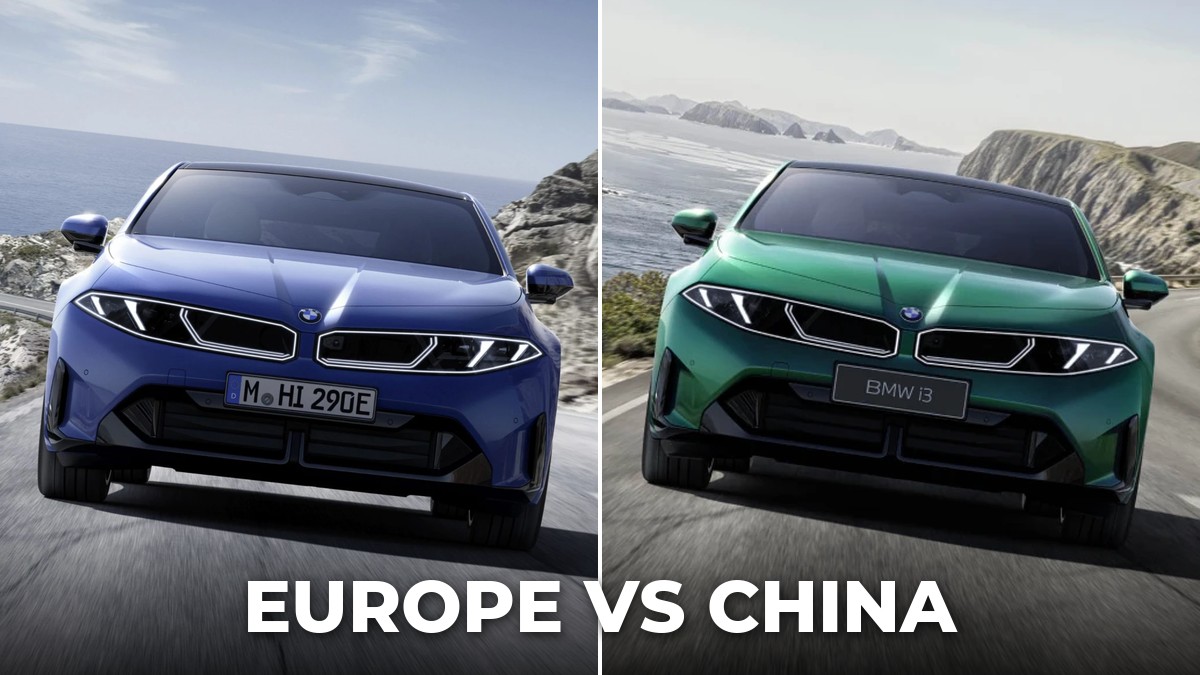
The BMW i3 is the electric counterpart to the 3 Series and the second model in the Neue Klasse generation. However, the version BMW builds for China is more than just a stretched version of the European car. It has a longer wheelbase, different battery technology and its own software, while the price gap between the two markets is wider than many European buyers might expect.
In Europe, the i3 (internal code NA0) has been built in Munich since August 2026, and I went through its battery, motors and software in my deep dive on the i3 Neue Klasse. The Chinese car is the i3 Long Wheelbase (NA8). BMW Brilliance Automotive, BMW’s joint venture with the Chinese carmaker Brilliance, builds it in Shenyang, and it was developed in China for Chinese buyers.
How BMW Has Split the Line-Up in Each Market
Europe got the all-wheel-drive versions first. The i3 50 xDrive has two motors and 345 kW (469 PS), and when orders opened in Germany on 18 June 2026 it started at €65,900, with the First Edition at €75,340, as BimmerToday reported. Below it sits the i3 40 xDrive at €59,900, also with two motors, 275 kW (374 PS) and an 82.8 kWh battery rated at 702 km (436 miles) WLTP, according to the German price list quoted in the first drive by ADAC, Germany’s largest motoring club. The only additions announced so far are an i3 M60 xDrive in spring 2027 and a Touring estate later that year. Every European i3 announced so far has all-wheel drive.
China starts from the other end. The first version in China’s type-approval filings is the i3 40L, listed by the Ministry of Industry and Information Technology (MIIT) in September 2026 with a single 235 kW (320 PS) rear motor, as Gasgoo reported from the filing. Chinese reports of the same filing name CATL as the supplier of its 108 kWh NMC battery. BMW China has also shown an i3 50L, which is rear-wheel drive with a larger 113.4 kWh battery. BMW hasn’t confirmed the full Chinese line-up, so I’d treat the 40L as the entry version and expect more to follow.
My reading is that BMW is pitching each car at what its first buyers want. Early buyers of a premium EV in Europe tend to pay extra for performance and all-wheel drive. In China, buyers in this class compare range figures and rear legroom with rivals such as the Xiaomi SU7, the electric saloon from the smartphone maker.
| Specifications | i3 50 xDrive (Europe) | i3 Long Wheelbase (China) | Difference |
|---|---|---|---|
| Built in | Munich, Germany | Shenyang, China | Separate plants and battery assembly |
| Length / width / height | 4,760 mm / 1,865 mm / 1,480 mm | 4,864 mm / 1,865 mm / 1,490 mm | Chinese car is 104 mm longer and 10 mm taller |
| Wheelbase | 2,897 mm | 3,005 mm | 108 mm longer in China |
| Drive | Two motors, all-wheel drive | One rear motor (40L); rear-wheel drive (50L) | China starts with rear-wheel drive |
| Power | 345 kW (469 PS) | 235 kW (320 PS) (40L) | 110 kW less in the Chinese entry car |
| Battery (usable) | 108.7 kWh | 108 kWh (40L); 113.4 kWh (50L) | Chinese 50L has 4.7 kWh more |
| Cell supplier | EVE Energy, with CATL as second source | CATL (40L, per filing reports) | Different main supplier |
| Cell type | 46 mm cylindrical NMC | 46 mm cylindrical NMC | Same |
| Peak DC charging and plug | 400 kW, CCS2 | 400 kW, GB/T | Same power, different plug |
| Official range | Up to 912 km (567 miles) WLTP | 1,028 km (639 miles) CLTC for the 50L, about 822 to 857 km (511 to 533 miles) WLTP estimated | European figure is higher once converted |
| Door handles | Flush, pop-out | Semi-recessed | Changed for Chinese safety rules |
| Voice assistant | Based on Amazon Alexa+ | DeepSeek, with Alibaba | Different AI provider |
| Assisted driving | SAE Level 2, optional hands-off motorway driving up to 130 km/h | SAE Level 2, address-to-address assistance developed with Momenta | Same level, different features |
| Price | From €65,900 (Germany) | Not announced | Not comparable yet |
Width is identical, and almost all of the extra 104 mm of length goes between the axles, where the wheelbase grows by 108 mm. The space ends up as rear legroom and longer rear doors. ADAC’s testers found the European car’s rear bench flat and uncomfortable, with foot space limited by the battery under the floor and tight headroom for anyone over 1.90 m. That’s the problem the Chinese version solves. Long-wheelbase cars are BMW’s answer to Chinese buyers’ preference for rear-seat space, which I covered when I looked at how European carmakers are fighting back in China.
Same Battery Technology, but Not Always the Same Cells
Both versions use BMW’s sixth-generation (Gen6) battery. It’s made of 46 mm cylindrical NMC cells. NMC is a nickel-rich chemistry that stores more energy per kilo than LFP. The cells sit directly in the pack housing, with no modules in between. In its Shenyang production announcement, BMW says the cells have more than 20% higher energy density than the previous generation, with charging speed and range up by as much as 30%.
The European i3 gets its cells mainly from EVE Energy, a Chinese cell maker, with CATL, the world’s largest battery manufacturer, as a second supplier. The packs are assembled at BMW’s plant in Irlbach-Straßkirchen in Bavaria. Chinese reports of the filing name CATL as the supplier for the 108 kWh pack, and the packs are assembled in Shenyang, where BMW started series production of Gen6 batteries on 15 October 2026. BMW Brilliance put the investment in the site at €1.34 billion when it announced the project in 2023.

That means a European i3 and a Chinese i3 can carry cells from different companies, made in different countries, even though both follow BMW’s design. In theory the owner shouldn’t notice. In practice I’d expect small differences in charging curves and ageing between two cell makers, so I’d wait for independent tests before treating them as interchangeable. With Chinese battery makers supplying almost three quarters of the world’s EVs, it’s no surprise that both versions run on Chinese cells.
Capacity is the other open question. The European i3 50 xDrive has 108.7 kWh of usable capacity, and the Chinese 50L has 113.4 kWh. BMW hasn’t said whether that’s a physically larger pack or the same pack declared differently, and I haven’t found a source that settles it.
The Chinese pack also has to meet a stricter safety standard. GB 38031-2025, drawn up by MIIT, has applied to new type approvals since 1 July 2026, according to the Chinese government’s announcement. It replaced the old requirement of a warning five minutes before a fire or explosion with a rule that the battery mustn’t catch fire or explode at all after thermal runaway, the chain reaction behind most EV battery fires. The smoke also mustn’t harm the occupants. European rules still centre on warning occupants in time to get out. BMW hasn’t said whether its European packs are tested to the Chinese standard, though both use the same Gen6 design.
Range Figures Need Translating Before You Compare Them
Because the two markets use different test cycles, here are the range and charging figures side by side before I explain what they mean.
| Specifications | i3 50 xDrive (Europe) | i3 50L (China) |
|---|---|---|
| Battery (usable) | 108.7 kWh | 113.4 kWh |
| Electrical architecture | 800 V | 800 V |
| Official range | Up to 912 km (567 miles) WLTP, 729 to 912 km depending on specification | 1,028 km (639 miles) CLTC |
| Estimated WLTP equivalent | Not applicable | 822 to 857 km (511 to 533 miles) |
| BMW road test | None published | 1,213 km (754 miles) at 8.8 kWh/100 km |
| Real-world reading | 17.5 kWh/100 km in brisk driving, about 620 km (385 miles) (ADAC, on-board computer) | Not available |
| Peak DC charging | 400 kW | 400 kW |
| 10 to 80% DC | 21 minutes | Not published |
| Range added in 10 minutes | Up to 423 km (263 miles) WLTP | 400 km (249 miles) CLTC |
| AC charging | 11 kW standard, 22 kW for €740 | Not published |
| DC plug | CCS2 | GB/T |
| Bidirectional charging | V2L in the 22 kW package; V2H and V2G according to BMW | Not published |
BMW quotes up to 912 km WLTP for the European i3 50 xDrive. For the Chinese i3 50L, BMW’s rating is 1,028 km on China’s CLTC cycle, and its Auto China 2026 announcement promises more than 1,000 km for the long-wheelbase car. CLTC is a gentler test. As I explain in my guide to WLTP and CLTC, a rough WLTP equivalent is the CLTC figure divided by 1.2 to 1.25, which gives 822 to 857 km. That’s less than the European car manages with a smaller battery and two motors.
To me, that suggests the rule of thumb fits this car poorly. It doesn’t prove the Chinese i3 is less efficient. On 15 October 2026, the day it started battery production in Shenyang, BMW announced that an i3 50L had driven 1,213 km on one charge over motorways, main roads and city streets, arriving with 1% left. BMW hasn’t put the test on its international newsroom, so Electrek’s report is the most accessible English source. Some Chinese reports list 906 and 912 km for the filed version. Those are exactly the European WLTP figures, so I’ve left them out until BMW China publishes its own.
The first independent number for the European car points the other way. During ADAC’s first test drive, the on-board computer of an i3 50 xDrive showed 17.5 kWh/100 km in brisk driving, which works out at roughly 620 km on a full battery. That’s a trip-computer reading from a short drive, not a standardised measurement, but it’s twice the 8.8 kWh/100 km BMW quoted for its Chinese test. The gap tells you more about driving style and route than about the two cars.
Both versions charge at up to 400 kW on an 800-volt system, which puts the European car on the short list of 800-volt EVs you can buy in Europe. Neither has had an independent 10 to 80% test yet. The plug is the practical difference. European cars use CCS2, while Chinese cars use China’s national GB/T standard, so a Chinese-market i3 couldn’t use European fast chargers without an adapter. At home, the European car charges at 11 kW as standard. The 22 kW upgrade costs €740 and includes V2L, so you can power appliances from the car. ADAC calculates that a full charge of the big battery takes about ten hours at 11 kW.
Different Handles, Different Software and Data That Stays in China
From the outside, the door handles give the Chinese car away. China’s mandatory standard GB 48001-2026, published by the country’s State Administration for Market Regulation, requires handles that open mechanically inside and outside every side door. It applies to newly approved models from 1 January 2027 and to every car in production from 1 January 2029. BMW fitted the Chinese i3 with semi-recessed handles in what Motor1 described as a last-minute change, while the European car keeps flush handles that pop out. The Chinese car also has an illuminated M badge on the C-pillar.
Inside, the layout looks the same. Both cars have BMW Panoramic iDrive with a 17.9-inch central screen and the Panoramic Vision display along the base of the windscreen, running BMW Operating System X. What runs underneath differs more than the screens suggest. BMW says around 70% of the Chinese version of the operating system was developed in China. In Europe the voice assistant is built on Amazon’s Alexa+. In China it uses DeepSeek, the Chinese AI company, with Alibaba as a partner. Navigation comes from Amap, Alibaba’s mapping service, and Huawei is also on BMW’s list of Chinese partners.

That split also decides where your data goes. China requires personal information and important data collected by cars in the country to be stored there, and BMW said in 2021 that it runs local data centres for its Chinese fleet, as Automotive News Europe reported. In the Chinese i3, your voice requests go to Chinese AI models, navigation runs through Amap and the assisted-driving software comes from Momenta, so the data stays with BMW China and its Chinese partners. In Europe, the same tasks run on BMW’s own systems and on Amazon’s technology behind the voice assistant, under the EU’s GDPR data protection rules.
Assisted driving differs in what it does, though not in its legal level. In China, BMW developed its system with Momenta, a Chinese company that writes assisted-driving software for several carmakers, and it guides the car from one address to another, city streets included. BMW plans to offer it in 12 models in China by the end of 2027. In Europe, the i3 offers an optional Motorway Assistant that lets you take your hands off the wheel at up to 130 km/h, approved under the UN’s DCAS regulation. ADAC’s testers drove with their hands in their laps and rated the system as smooth, as long as the driver keeps watching the traffic. European approval rules for city-street assisted driving are stricter, as Xpeng found when it tried to bring its own system to Europe.
Both are SAE Level 2 systems, as described in my explainer on SAE driving levels. The car steers, brakes and accelerates, but the driver stays responsible at all times. Labels such as L2+ or L2++ that appear in Chinese coverage are marketing terms, not SAE levels.
What the Price Gap Looks Like in Euros
BMW China hadn’t announced prices for the i3 Long Wheelbase as of 7 November 2026, so the best guide is its SUV sibling. The iX3 Long Wheelbase went on sale in China in August 2026, and its prices compare with the German iX3 like this.
| Specifications | iX3 Long Wheelbase (China) | iX3 (Germany) |
|---|---|---|
| Entry price | €36,200 | €63,400 (iX3 40) |
| Top launch version | €45,600 (50L xDrive) | €70,900 (50 xDrive) |
That makes the Chinese car between 36% and 43% cheaper, depending on the version. Tax explains a small part of it. Chinese prices include 13% VAT against 19% in Germany, although Chinese buyers also pay a purchase tax on EVs. In 2026 and 2027 it’s half the usual 10%, with the discount capped at about €2,000 per car, according to China’s tax administration. Most of the gap comes from competition and a local supply chain that now includes cells and packs. Premium brands have been losing ground to local rivals in China, as my look at the Chinese EV market in April 2026 showed.
The comparison isn’t exact. Equipment differs, and the cheapest Chinese car has only one motor, so the gap at the top of the range is the fairer number. Even there, the same SUV costs about €25,000 more in Germany.
Don’t expect a cheap Shenyang-built i3 in Europe. China-built EVs pay extra EU tariffs on top of the standard 10% import duty, as explained in this overview of EU tariffs on Chinese EVs. The car would also need CCS2 charging, European type approval and BMW’s European software, and BMW already builds the i3 in Munich.
What I’d Take From This as a European Buyer
If I were ordering an i3 in Europe today, I’d look hard at the 40 xDrive before the 50. It costs €6,000 less, keeps all-wheel drive and still has a WLTP range of 702 km. BMW quotes the same 21 minutes from 10 to 80% for both batteries. I’d only pay for the 50 if I regularly drove long motorway stretches, where the extra 26 kWh means fewer charging stops. A single-motor European i3 would be the version I’d want for long trips, but BMW hasn’t announced one, even though the Chinese filing shows the combination exists.
The long-wheelbase body isn’t on sale here, and ADAC’s comments on the rear bench show why that matters. Anyone who regularly carries adults in the back should sit in the European i3 before ordering. The thing I’ll watch for is the first independent charging test of a CATL-celled i3 against an EVE-celled one. If the curves match, the supplier question goes away. If they don’t, it’ll be interesting to see how cells from two different makers hold up in the same car once owners start putting real miles on them.
FAQ
Is the long-wheelbase BMW i3 sold in Europe?
No. BMW sells the i3 Long Wheelbase only in China, where it’s built in Shenyang. European cars come from Munich and have the standard 2,897 mm wheelbase.
Who makes the battery cells for the BMW i3?
In Europe, EVE Energy is the main supplier and CATL the second, and the packs are assembled in Bavaria. Chinese reports of the type-approval filing name CATL for the 108 kWh pack in the i3 40L, which is assembled in Shenyang.
How much bigger is the Chinese BMW i3?
It’s 104 mm longer at 4,864 mm and 10 mm taller, with a wheelbase 108 mm longer at 3,005 mm. The width is the same at 1,865 mm.
Does the Chinese i3 have more range than the European one?
Probably not, judging by the official figures. The i3 50L’s 1,028 km CLTC rating works out at about 822 to 857 km WLTP with the usual conversion, while the European i3 50 xDrive is rated at up to 912 km WLTP.
Can the BMW i3 drive itself in Europe or China?
No. Both versions offer SAE Level 2 assisted driving, so the driver stays responsible at all times. The European car can drive hands-off on motorways up to 130 km/h, while the Chinese car’s Momenta-based system also handles city streets.
Marko Lubar is the Founder and Editor of ElectricFleet Online, where he covers the latest developments in electric vehicles, battery innovation, autonomous driving, artificial intelligence, and the technologies shaping the future of mobility.
Learn more about Marko and the mission behind ElectricFleet Online on the About Us page.
Latest News