Electric vehicles in China are advancing at a pace unmatched anywhere else. Many of these models offer technology, efficiency, and pricing that would fill major gaps in the European EV market. From affordable 800-volt platforms to smart sedans and compact electric crossovers, these cars represent exactly the kind of innovation European buyers are asking for. While some of these models are hits in China, they are still unavailable in Europe, and that’s a missed opportunity. So here’s my pick of the top 5 Chinese EVs that Europe needs right now.
Table of Contents
- Mona M03
- Xiaomi YU7
- Leapmotor B05 (Lafa 5 in China)
- Leapmotor B03X (A10 in China)
- Xpeng P7 (New Generation)
- FAQ
Mona M03
The Mona M03 is a highly successful liftback sedan that already accounts for over 40% of XPeng’s total sales, marking it as the strongest performer in the brand’s portfolio. XPeng plans to bring the model to Europe next year, where it will strengthen the company’s strategy of offering both premium and affordable EVs. The Mona range represents the value-oriented tier, while models such as the P7 sedan and G6 SUV occupy the more premium segment.

The Mona M03 is offered with either a 51.8 kWh battery or a larger 62.2 kWh pack. The long-range 62.2 kWh version delivers up to 600 km CLTC range, positioning it strongly within the competitive mid-size EV segment (in China, it’s 50% cheaper than the Model 3). With its aerodynamic profile (0.194 Cd), efficient motor options, and LFP battery technology, it fits well into Europe’s growing demand for efficient and affordable electric liftbacks.
| Specification | Standard Version | Long-Range Version |
|---|---|---|
| Architecture | 400V | 400V |
| Battery capacity | 51.8 kWh | 62.2 kWh |
| Battery type | LFP | LFP |
| CLTC range | 515 km | 600 km |
| Estimated WLTP range | 420–450 km | 500–530 km |
| Motor power | 140 kW | 160 kW |
In Europe, the Mona M03 would compete directly with established electric sedans and liftbacks such as the Tesla Model 3, Hyundai Ioniq 6, and BYD Seal, making it a compelling alternative for drivers seeking strong value for money. If you want to see how the Model 3 and Seal stack up against each other, make sure to check out my comparison article.
Xiaomi YU7
The Xiaomi YU7 is a large, high-tech electric SUV built on an 800 V silicon‑carbide high‑voltage architecture, a feature that puts it leagues ahead of many European rivals in terms of charging speed and efficiency (500 kW peak DC charging rate! That’s insane!).
It is offered with either a 96.3 kWh battery or a 101.7 kWh battery. According to Chinese CLTC figures, the 96.3 kWh version can reach 835 km, while higher-spec dual-motor versions achieve 770 km. Peak motor output is up to 508 kW (681 hp) in dual-motor trim, offering performance on par with premium electric SUVs.

Charging benefits greatly from the 800 V architecture: under ideal conditions, Xiaomi claims 10–80% DC charging can take around 12 minutes, effectively allowing a “full-tank” recharge in roughly 15 minutes. The interior features a spacious cabin, a large panoramic screen, and an integrated smart ecosystem that connects the car to Xiaomi devices, which there are plenty of. The last time I checked, Xiaomi had several hundred products under its belt, and I can’t stress enough how good their smartphones are. I used to own three different Xiaomi phones, and I’ll get back to them as soon as I’ve ditched my Samsung.
| Specification | Standard / Pro Version | Max / Dual-Motor Version |
|---|---|---|
| Architecture | 800V | 800V |
| Battery capacity | 96.3 kWh | 101.7 kWh |
| Battery type | NCM / high-voltage | NCM / high-voltage |
| CLTC range | 835 km | 770 km |
| Estimated WLTP range | 550–580 km | 600–620 km |
| Motor power | 235 / 365 kW | 508 kW |
Its European competitors include the Tesla Model Y, Audi Q4 e-tron, Kia EV6, and Xpeng G6. I don’t know about you, but looking at the competition, I wouldn’t even hesitate. I’d buy the YU7 outright.
Leapmotor B05 (Lafa 5 in China)
Leapmotor has only been in Europe for two years, but it’s doing things right from the start. Judging by the near-daily news about the Leapmotor B05 (marketed in China as Lafa 5), the company’s new electric hatchback, I expect the B05 to become a true success story here in Europe.

The B05 is a compact electric hatchback offering practicality and efficiency in a small package. It comes with either a 56.2 kWh battery or a larger 67.1 kWh battery pack. With these, the CLTC‑rated range is (overly optimistic) 515 km and 605 km respectively. The rear-mounted electric motor comes in two variants, delivering either 132 kW (180 hp) or 160 kW (218 hp), depending on the chosen version. Charging from 30 to 80 percent reportedly takes about 18 minutes under ideal conditions, and that’s a competitive fast‑charging figure for a compact hatchback.
The company plans to start European production of the B05 at a plant in Zaragoza, Spain, with manufacturing expected to begin in mid to late 2026.
| Specification | Standard Version | Long‑Range Version |
|---|---|---|
| Architecture | 400V | 400V |
| Battery capacity | 56.2 kWh | 67.1 kWh |
| Battery type | LFP | LFP |
| CLTC range | 515 km | 605 km |
| Estimated WLTP range | 430–440 km | 485–515 km |
| Motor power | 132 kW | 160 kW |
The Leapmotor B05 would likely compete in Europe with compact electric hatchbacks such as Volkswagen ID.3, Peugeot e-308, MG4 Electric, and Renault Mégane E‑Tech. Considering its combination of efficient battery options, competitive expected WLTP range, and the planned European production, the B05 could become an attractive, value-oriented hatchback, just like the rest of Leapmotor’s lineup.
Leapmotor B03X (A10 in China)
Okay, here’s another Leapmotor. Just to confirm your doubts, I do have a soft spot for the company and it’s based on the alphabet. A10, B10, C10… anyone? 🙂 Another reason I included the A10 / B03X is my hope of eventually squeezing the T03 out of the lineup, since I find that model annoyingly ugly.

Details about the car are still sparse. Chinese specs indicate up to 500 km CLTC range on its battery pack, likely resulting in approximately 400–430 km WLTP in Europe. According to the manufacturer, the battery can be charged from 30 to 80 percent in just 16 minutes. The car is equipped with 18-inch wheels and a panoramic glass roof, while the cabin runs on Qualcomm’s Snapdragon 8295P chip for infotainment and an additional Snapdragon 8650 dedicated to driver-assistance functions. The vehicle even incorporates lidar technology, although certain visual indicators such as the blue exterior lights used to signal active driver assistance may be restricted depending on European regulations.
The best part? The car is dirt-cheap in China. It won’t be anywhere near that cheap in Europe, that’s for sure, but based on Leapmotor’s pricing strategy here, I expect the B03X will still undercut the competition. European competitors include the Hyundai Kona, Renault 3, Kia Niro EV, Opel / Vauxhall Frontera, and BYD Atto 2. The B03X, t looks kinda like a Mini Countryman, don’t you think?
Xpeng P7 (New Generation)
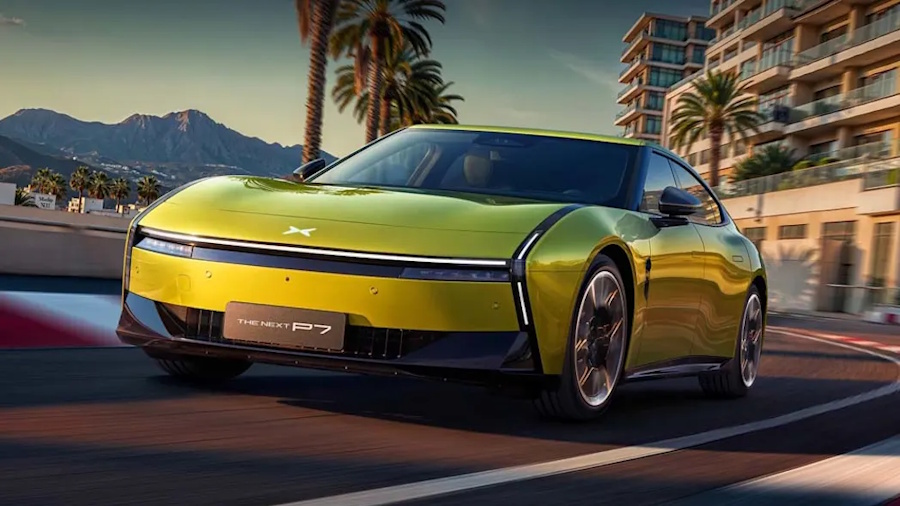
Xpeng really hits the mark with this one. The refreshed XPeng P7 is a fastback liftback sedan combining sleek styling with premium features and advanced technology. It is equipped with 800‑volt silicon‑carbide power electronics, allowing ultra-fast DC charging rates of up to 486 kW, meaning a 10–80% charge can be achieved in under 12 minutes.

Battery options are 74.9 and 92 kWh, offering up to 820 km CLTC, which translates to an estimated 640 km WLTP. Motor output ranges from 270–437 kW, providing strong performance while maintaining high efficiency. The sedan features three of XPeng’s self-developed Turing AI chip, and its sensor suite consists of three 4D mmWave radars, 12 cameras, and 12 ultrasonic sensors.
| Specification | Standard Version | Long‑Range Version |
|---|---|---|
| Architecture | 800V | 800V |
| Battery capacity | 74.9 kWh | 92 kWh |
| Battery type | LFP | NCM |
| CLTC range | 702 km | 850 km |
| Estimated WLTP range | 560 km | 640 km |
| Motor power | 270 kW | 437 kW |
| Max DC charging | 486 kW | 486 kW |
| 10–80% charge time | <12 min | <12 min |
European competitors include the BMW i4, Tesla Model 3, BYD Han, and Polestar 2. And based on basic specs alone, none of them even comes close to the Xpeng P7.
FAQ
Why are Chinese EVs important for the European market?
Chinese EVs often offer advanced technology, long-range batteries, and competitive pricing, filling gaps in Europe’s growing EV segment.
How do Chinese EVs compare to European EVs?
Many Chinese EVs, like XPeng P7 and Xiaomi YU7, offer similar or superior technology and performance compared to European rivals, often at a better value.
Are Chinese EVs cheaper in Europe?
Not necessarily. Import tariffs, shipping, and local production costs can make them more expensive than in China, but they still often undercut premium European EVs.
Which Chinese EVs are expected to launch in Europe soon?
XPeng’s Mona M03 and P7, Xiaomi YU7, and Leapmotor’s B05 and B03X are among the models expected to enter Europe within the next few years.
Do Chinese EVs support fast charging in Europe?
Chinese EVs are equipped either with 400V or 800V architectures, supporting high-speed DC charging.
Latest News