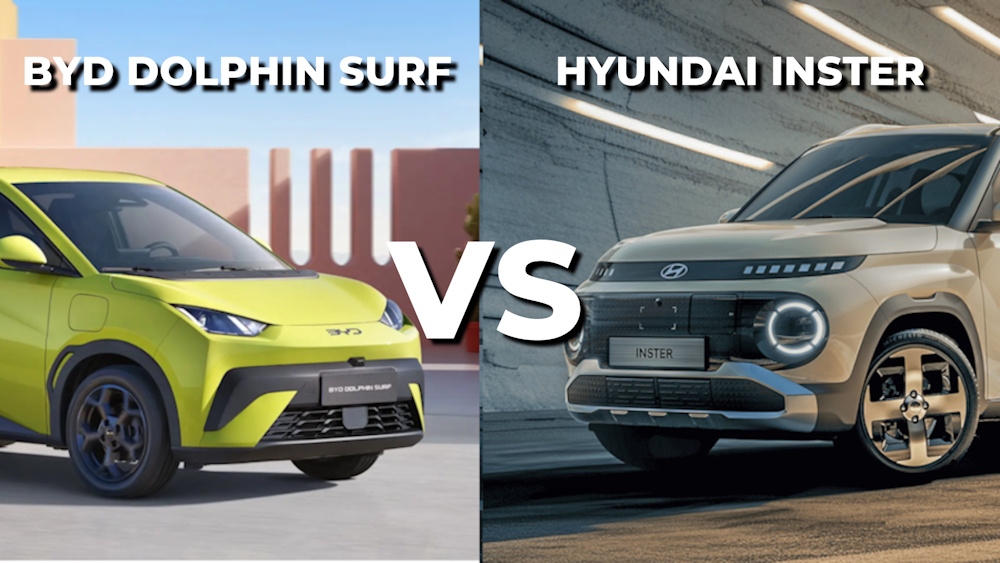
Small electric hatchbacks are making a serious comeback in Europe, and among the most talked-about options right now are the BYD Dolphin Surf and the Hyundai Inster. Both target budget-friendly EV buyers who still expect solid range, practical space, and modern tech. The Dolphin Surf brings Chinese innovation to the mix with BYD’s Blade Battery, while the Inster showcases Hyundai’s proven EV expertise and European polish.
So, how do these two city-friendly EVs really stack up? Let’s take a closer look.
Design and Interior
The BYD Dolphin Surf has a playful, modern look with rounded lines and a compact footprint, measuring about 3.99 metres in length. Inside, the cabin is bright and tech-focused, featuring a rotating 10.1-inch central screen and a high-quality fit and finish for its price point. It feels spacious for a small hatch and includes ISOFIX points for the front passenger seat and both outer rear seats — a thoughtful touch for families.

The Hyundai Inster, on the other hand, borrows much of its design language from the small Casper SUV but gives it an electric edge. Its pixel-style lights, boxy shape, and optional two-tone paint make it feel more distinctive, and Hyundai’s reputation for excellent ergonomics holds true inside. The Inster’s slightly taller stance gives it an SUV-ish practicality advantage for everyday use.

Here’s an overview of space and safety features:
| Feature | BYD Dolphin Surf | Hyundai Inster |
|---|---|---|
| Boot capacity | 308 L | 238 L |
| Boot capacity (rear seats adjustable by 16 cm) | – | 351 L* |
| Boot capacity (rear seats folded) | 1037 L | 1,059 L |
| Frunk | No | No |
| Seating capacity | 4 | 4 or 5* |
| ISOFIX mounting points | 2 rear | 2 rear |
| Euro NCAP safety rating | 5 stars | 4 stars |
*Depending on a trim
Battery and Range
BYD offers three trims for the Dolphin Surf: Active, Boost, and Comfort, each built on BYD’s trusted e-Platform 3.0 using its in-house Blade Battery. The Active trim packs a 30 kWh unit and is good for about 220 km WLTP, while the Boost and Comfort trims step up to a 43.2 kWh battery. Boost delivers 322 km WLTP, and the Comfort offers 310 km WLTP. Interestingly, the Comfort trim is optimized for urban efficiency, reaching up to 507 km in the city cycle. Charging is straightforward with AC at 11 kW and DC fast charging up to 85 kW for the larger battery trims, allowing a 10–80% charge in roughly 30 minutes.
| Area | Dolphin Surf Active | Dolphin Surf Boost | Dolphin Surf Comfort |
|---|---|---|---|
| Battery | 30 kWh | 43.2 kWh | 43.2 kWh |
| Battery Type | LFP Blade | LFP Blade | LFP Blade |
| Architecture | 400 V | 400 V | 400 V |
| Range (WLTP) | 220 km | 322 km | 310 km |
| Real-world range* | 190 km | 270 km | 265 km |
| DC charging peak | 65 kW | 85 kW | 85 kW |
| DC 10–80% (approx.) | ~30 min | ~30 min | ~30 min |
*Source: EV Database
When it comes to the Hyundai Inster, things get a lot more complicated. Basically, every European market has its own naming for the trims — some have three, others have five. If anyone from Hyundai is reading this, I’d just like to say: thanks for making my life miserable. Anyway, despite the chaotic trim situation, there are only two battery packs, and both are available across all trims, so I’ll focus on that instead.
| Area | Inster Standard Range | Inster Long Range |
|---|---|---|
| Battery | 42 kWh | 49 kWh |
| Battery Type | NCM (NiCoMn) | NCM (NiCoMn) |
| Architecture | 400 V | 400 V |
| Range (WLTP) | 327 km | 370 km |
| Real-world/city range* | 255 km | 300 km |
| DC charging peak | 73 kW | 85 kW |
| DC 10–80% (approx.) | ~1 h 16 min | ~1 h 8 min |
*Source: EV Database

Performance
Performance is where the BYD Dolphin Surf shows its versatile character across the lineup. Both the entry-level Active and mid-level Boost trims come with a 65 kW (88 hp) motor, which is perfectly fine for relaxed city driving and light highway use. The range-topping Comfort trim steps up to a 115 kW (154 hp) motor, giving it noticeably stronger acceleration and a more confident feel on highways, reaching 0–100 km/h in about 9.1 seconds. All trims are front-wheel drive, with a top speed capped at 160 km/h.
| Area | Active/Boost | Comfort |
|---|---|---|
| Power | 65 kW (88 hp) | 115 kW (154 hp) |
| Torque | 175 Nm | 220 Nm |
| Drive | FWD | FWD |
| 0–100 km/h | 11.1/12.1 s | 9.1 s |
| Top Speed | 150 km/h | 150 km/h |
The Hyundai Inster’s Standard Range model uses a smaller 42 kWh battery paired with a 71 kW (96 hp) motor, while the Long Range variant boosts output to 84 kW (113 hp). The Long Range Inster feels notably livelier, particularly at mid-range speeds, even if it’s not designed for outright performance. Both versions are front-wheel drive and reach a top speed of up to 150 km/h, which makes sense for its compact crossover role. Hyundai prioritizes smoothness and efficiency over sheer power, a choice that fits its intended city-friendly persona.
| Area | Inster Standard Range | Inster Long Range |
|---|---|---|
| Power | 71 kW (97 hp) | 85.5 kW (115 hp) |
| Torque | 147 Nm | 147 Nm |
| Drive | FWD | FWD |
| 0–100 km/h | 11.7 s | 10.6 s |
| Top Speed | 140 km/h | 150 km/h |
Warranty
Both BYD and Hyundai provide competitive warranty coverage in Europe, reflecting confidence in their EV technology. The BYD Dolphin Surf follows BYD’s standard European EV warranty, offering comprehensive coverage for the vehicle, battery, drive unit, and bodywork. Roadside assistance is also included, which can be useful for urban and suburban drivers.
The Hyundai Inster carries the brand’s familiar European warranty package, which is also comprehensive and includes battery and drivetrain coverage.
| Warranty | BYD Dolphin Surf | Hyundai Inster |
|---|---|---|
| Vehicle | 6 years/150,000 km | 5 years/unlimited mileage |
| Battery | 8 years/160,000 km | 8 years/160,000 km |
| Drive Unit | 8 years/150,000 km | No data |
| Paint Work | 3 years | 5 years |
| Bodywork Anti-Corrosion | 12 years | 12 years |
| Roadside Assistance | Included | Included |

Pricing
Pricing for the Dolphin Surf starts at €11,780 in Spain**, but that’s more of an exception — across most of Europe, the base model hovers around €20,000. The Hyundai Inster starts at €14,130 in Spain, where generous incentives can almost halve the price compared to the rest of Europe. The Inster is generally more expensive across Europe, except in the Netherlands, where its price is almost identical to the Dolphin Surf.
Note: The prices listed in the table reflect only the entry-level models in each market. Prices for other trims in each country can be found in the official configurator.
**The article was written in November 2025.
| Country | Dolphin Surf Price (from) | Inster Price (from) |
|---|---|---|
| Denmark | 149,995 DKK (€20,095) | 169,995 DKK (€22,760) |
| France | €18,990 | €25,000 |
| Germany | €22,990 | €23,900 |
| Netherlands | €22,990 | €22,295 |
| Norway | Unavailable | 244,900 NOK (€21,030) |
| United Kingdom | 18,650 GBP (€21,517) | 23,505 GBP (€26,705) |
Conclusion
So, what’s the verdict on the BYD Dolphin Surf versus the Hyundai Inster? Honestly, it comes down to what matters most to you. The Dolphin Surf stands out with BYD’s Blade Battery tech, the city-friendly Comfort trim, and very competitive pricing, making it a solid pick if you want efficiency and value. The Inster feels smooth to drive, offers good range in the Long Range trim, and comes with Hyundai’s reliable build and warranty. At the end of the day, both are practical, fun-to-drive city hatchbacks, it just depends if you’re leaning toward cutting-edge Chinese EV tech or or tried-and-true Korean polish.
FAQ
What trims are available for the Hyundai Inster in Europe?
Trim names vary by market, but there are two main battery variants: Standard Range (42 kWh) and Long Range (49 kWh), available across different trims in each country.
Which car has better range?
The BYD Dolphin Surf Boost trim offers 322 km WLTP, while the Comfort trim provides 310 km WLTP but optimized urban efficiency can reach up to 507 km. The Hyundai Inster Long Range achieves 370 km WLTP. Real-world range varies with driving style and conditions.
What are the motor outputs for each trim?
The Dolphin Surf Active and Boost trims have a 65 kW (88 hp) motor, while the Comfort trim offers 115 kW (154 hp). The Hyundai Inster Standard Range uses a 71 kW (97 hp) motor, and the Long Range variant produces 85.5 kW (115 hp). All trims are front-wheel drive.
How fast can these EVs charge?
The Dolphin Surf Boost and Comfort trims can charge at up to 85 kW DC, reaching 10–80% in about 30 minutes, while the Active trim peaks at 65 kW. The Inster Standard Range can reach 73 kW, taking roughly 1 hour 16 minutes for 10–80%, and the Long Range trim peaks at 85 kW, taking about 1 hour 8 minutes.
What warranty coverage do these EVs have?
The BYD Dolphin Surf offers 6 years/150,000 km vehicle warranty, 8 years/160,000 km battery, and 8 years/150,000 km drive unit coverage. Hyundai Inster provides 5 years/unlimited mileage for the vehicle and 8 years/160,000 km battery coverage. Both brands include roadside assistance.
What are the starting prices in Europe?
The BYD Dolphin Surf starts around €20,000–€23,000 depending on the market, while the Hyundai Inster generally ranges from €22,000 to €27,000. Specific pricing varies by country and local incentives.
Latest News