Picture this: your arms are full of shopping bags, the keys are buried somewhere at the bottom of one of them, and you’re still a few steps from the car. You say a single word out loud, and the boot pops open on its own to meet you. That’s not a concept video. That’s a real feature on the new Xpeng P7, a car sitting in Chinese showrooms right now that Europe still can’t buy.
Xpeng already sells five models across its core European markets, the L03, X9, P7+, G6 and G9, and none of them is the car I actually want. The one I want wears a completely redesigned body, runs three of Xpeng’s own AI chips, and charges fast enough to make most 800-volt rivals look slow. I covered it briefly in my top 5 Chinese EVs Europe needs roundup last year, and I’ve been waiting for an actual European launch date ever since. It still hasn’t come, so let me make the case properly.
This Isn’t the P7+ You’ve Already Seen
Quick clarification before anything else, because Xpeng’s naming has confused plenty of people already. The P7+ is the fastback family sedan that launched in Europe through the Brussels Motor Show in January 2026 and is now built alongside the G6 and G9 at Magna Steyr’s plant in Graz. It’s a good car, and I’ve written about its European rollout before.

The car I’m talking about here is simply called the new P7, sometimes referred to by its development code E29. It’s the second generation of Xpeng’s original 2020 flagship sedan, a different, sportier, more design-led model built on Xpeng’s newer SEPA 3.0 platform. It launched in China in August 2025 and remains a China-only car as I write this, with production confirmed for China through 2026 and no European date announced.
One more thing worth mentioning: Xpeng’s own global website still lists a plain “P7” alongside the L03, X9, P7+, G6 and G9. That’s not the car this article is about either. It’s the outgoing, first-generation P7, with its older X-Bot face, radar-based driver assistance and no Turing chip in sight, still marketed on some of Xpeng’s international pages even though it doesn’t appear on the dedicated European storefronts I checked. Between the P7+, the old P7 and the new P7, Xpeng has given itself three very similarly named sedans to keep straight.
| Specification | Original P7 | New P7 |
|---|---|---|
| Length | 4,880 mm | 5,017 mm |
| Smart driving hardware | Dual Nvidia Orin X, 508 TOPS | Up to three in-house Turing chips, 2,250 TOPS |
| Sensor approach | LiDAR, radar, cameras | Camera and radar only, no LiDAR |
| Starting price (China) | Roughly on par with Tesla Model 3 | €25,900 (203,800 yuan), following a March 2026 price cut |
Design That Actually Looks Like the Future
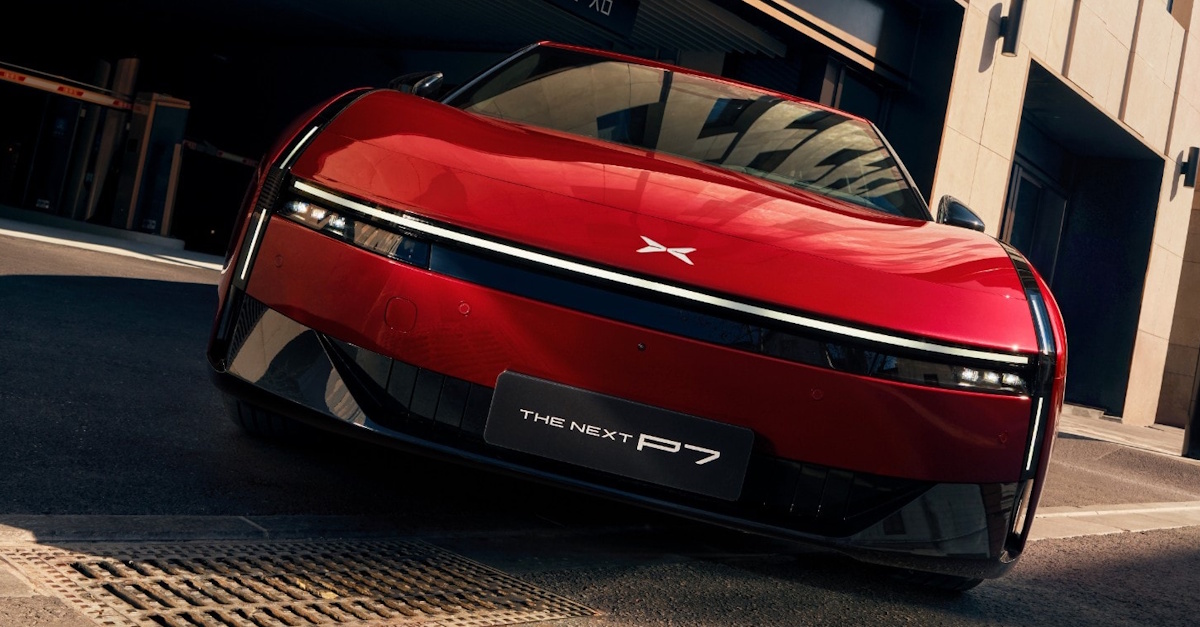
Xpeng calls the front end “Xmart Face”, built around a star-ring light band with a vertical H-shaped element running through it. It’s the kind of design that photographs well and looks even better in person, judging by the crowds it drew at its reveal. The body has grown noticeably over the outgoing P7, up to 5,017 mm long, 1,970 mm wide and 1,427 mm tall on a 3,008 mm wheelbase, and Xpeng likes to point out a length to height ratio of 3.57, its way of saying this car looks low and wide in the metal. A floating number plate mount, a hidden active grille and an active pop-up rear wing all feed into the aerodynamics, and Xpeng’s own figures put the real-world drag coefficient at Cd 0.201, an excellent number for a mainstream sedan, achieved through more than 25 separate aero refinements that the company says are worth over 90 km of extra range on their own.

The flagship trim, officially badged the 750 4WD Wing Ultra and priced at €38,300 (301,800 yuan), earns that “Wing” name honestly: it has proper wing style scissor doors. A mainstream Chinese sedan with scissor doors, sold at a price that undercuts a well specced Volkswagen ID.7, is not something European buyers currently get the option to consider.
Battery, Range and Charging
The new P7 sits on an 800-volt silicon carbide platform, and the numbers back that up. There are actually three range and powertrain tiers, not two. The entry version runs a 74.9 kWh LFP battery good for 702 km CLTC, driven by a single 270 kW (465 Nm) rear motor. Step up to the 92.2 kWh battery, an NMC pack that Xpeng’s own materials just label “ternary lithium”, and CLTC climbs to 820 km on the single motor version. The flagship dual motor, all wheel drive version uses the same NMC pack but trades some efficiency for pace, dropping to 750 km CLTC while putting out 437 kW and 695 Nm, enough for a 3.7 second 0-100 km/h time and a 230 km/h top speed.
Translating those Chinese test cycle figures into something closer to European WLTP reality, I’d estimate roughly 560 km, 650 km and 600 km respectively. If you’re unfamiliar with why that gap exists between the two standards, my CLTC versus WLTP explainer covers it in detail, but the short version is that CLTC testing involves more low speed, stop start driving than WLTP, so it consistently produces higher numbers for the same car.
Charging numbers look strong on paper too. Peak DC input reaches 486 kW, Xpeng claims a 10 to 80% charge in as little as 11.3 minutes on the ternary battery versions, and the car can reportedly add 525 km of range from just 10 minutes on a suitable charger. There’s also a Sport+ mode with stiffer suspension damping and reduced body roll, a 20 second Boost button for a temporary power surge, launch control, and, slightly bizarrely, two selectable synthetic engine sounds. Xpeng also says an independently witnessed 24 hour endurance test covered 3,961 km, a serious result if it holds up outside the test track.
| Specification | Standard | Long Range | Performance AWD |
|---|---|---|---|
| Architecture | 800V | 800V | 800V |
| Battery capacity | 74.9 kWh | 92.2 kWh | 92.2 kWh |
| Battery type | LFP | NMC | NMC |
| CLTC range | 702 km | 820 km | 750 km |
| Estimated WLTP range | 560 km | 650 km | 600 km |
| Motor power | 270 kW (465 Nm) | 270 kW (465 Nm) | 437 kW (695 Nm), AWD |
| Max DC charging | 486 kW | 486 kW | 486 kW |
| 10-80% charge time | Under 12 minutes | Under 12 minutes | Under 12 minutes |
The Chassis Underneath
This is the part that actually surprised me. Xpeng is describing the dual motor layout as a supercar style mid-mounted arrangement, with front to rear weight distribution at 50:50 and 81% of the car’s mass sitting between the axles, the kind of number you’d expect a sports car brand to boast about, not a mainstream Chinese sedan maker. It backs that up with a front double wishbone and rear five link independent suspension, plus an optional dual chamber air suspension that adjusts ride height from -20 mm to +30 mm, varies spring stiffness between 100 and 140%, and can change damping up to a thousand times a second. Brembo calipers handle the braking, and Xpeng quotes a 33.16 metre stop from 100 km/h.

The flagship dual motor version also has a claimed lap time of 1:38.767 around the Zhejiang International Circuit, set with an optional track package of upgraded brake fluid, low metal brake pads and high performance track tyres, sold separately through Xpeng’s own online store for closed circuit use. It’s a small detail, but it tells you Xpeng wants this car taken seriously by people who actually care about how a car handles, not just how fast its chips can think.
The Smart Driving Hardware Is Ahead of Most Rivals
At launch in August 2025, every version came standard with three of Xpeng’s own Turing chips, delivering a combined 2,250 TOPS of computing power, two dedicated to driving and one to the cabin. That’s a serious jump from the dual Nvidia Orin X setup that powered the outgoing P7. Since a March 2026 refresh, though, the hardware has been split into tiers: the base Max trims now ship with a single Turing chip, and the full three-chip setup is a paid upgrade, more on that in a moment.
What’s notable is what’s missing rather than what’s there. The new P7 drops LiDAR entirely and relies on twelve cameras, twelve ultrasonic sensors and three millimetre wave radar units, following the same camera-only philosophy Tesla uses. The March 2026 update also brought Xpeng’s second generation VLA system to the Ultra and Ultra SE trims, which the company describes as a “physical world large model” aimed at eventually reaching Level 4 capability. Xpeng claims this second generation model reasons around 12 times more efficiently than its predecessor and runs roughly 10 times more parameters than what it calls the industry mainstream, drops an intermediate language translation step for more human-like decisions, handles unusual vehicles and unmapped roads more confidently, and lets the driver smoothly override the system by simply turning the wheel or touching the accelerator rather than switching it off outright.
I’d take all of that framing with a pinch of salt, though. As I explained in my guide to SAE autonomous driving levels, every system on sale to consumers today, including this one, is legally Level 2+. The driver remains legally responsible at all times, no matter how the marketing describes the underlying technology. Getting from L2+ to genuine L3 or L4 in Europe depends far more on regulators accepting manufacturer liability than on chip counts.
An Interior That Feels Premium
The cabin is where the new P7 stops feeling like a value play and starts feeling like a flagship should. Sport seats are trimmed in Nappa leather and Dinamica microfibre with active side bolsters and extendable thigh support. A 1.84 square metre panoramic glass roof uses a triple silver coating that blocks 99.99% of UV and 99.58% of infrared radiation, which should comfortable to anyone who’s sat in a black car under a glass roof in July. As someone who lives in a part of Europe where summer temperatures regularly climb close to 40°C, I’d honestly take a solid roof over a glass one any day.

Rear passengers get an 8-inch entertainment screen, a 30-degree reclining seatback, a 513 mm rear cushion and 120 mm of knee room, more lounge than back seat. A 23-speaker system handles the audio, paired with a three-scent fragrance system offering floral, woody and tea profiles. Storage is practical too, with a 575-litre boot, a 56-litre frunk and up to 1,929 litres with the rear seats folded.
A Few Cabin Features Worth Highlighting
The voice command feature mentioned earlier also extends to parking. Pull up to a tight space, the kind that would normally take a few attempts to reverse into, and the driver can step out and ask the car to park itself, without opening an app or reaching for a key fob. Voice assistants in cars often struggle with basic commands, so a system that reliably handles a common, everyday scenario like this is a more meaningful feature than it might first sound.
The rest of the cabin technology is similarly well specified. The head-up display projects an 87-inch image onto the windscreen, which Xpeng claims is the largest in its class, overlaying navigation, driver assistance status, speed and suspension settings directly onto the road ahead rather than requiring a glance down at the dashboard. The central touchscreen sits on a three-axis mount that tilts through roughly 25 degrees of travel, adjusting to the optimal viewing angle depending on the driver’s seating position.
Then there’s the part I’d file under gimmick rather than genuine innovation, at least through a European lens. In annoying driving moments, getting cut off, sitting in traffic, the car can throw random AR animations onto the windscreen, hearts, smiley faces, fireworks, purely to lighten the mood. It’s a very online, very Chinese-market kind of playfulness, and I can see it landing well with younger buyers there. I’m just not convinced it travels. European drivers tend to want their car to feel calm and competent, not to throw emoji at the windscreen when someone cuts them up, and I’d bet this is one of the first things to quietly disappear if the car ever gets a proper European launch.
The Safety Numbers Behind the Fun
The new P7 hasn’t been tested by Euro NCAP yet, since it isn’t sold in Europe. What Xpeng does quote is a five-star rating under China’s C-NCAP protocol and the top “3G+” rating from China’s insurance-backed C-IASI testing body, covering occupant protection, pedestrian safety and driver assistance separately. Seven airbags come as standard across the range. Automatic emergency braking and automatic emergency steering are both rated to work at speeds up to 130 km/h, and Xpeng quotes battery protection figures well ahead of China’s own updated national standard, including impact resistance nearly five times the requirement and a thermal runaway observation window twelve times longer than mandated. None of these Chinese ratings map directly onto Euro NCAP’s own scoring, so I’d treat them as a good sign rather than a guarantee of how the car would score if it’s ever tested in Europe.
Why I’d Be Cautious About What Actually Reaches Europe
Here’s where I need to temper expectations. I’ve seen this pattern before with Chinese manufacturers, and Xpeng is no exception. Since the March 2026 refresh, the Chinese lineup runs three base Max trims (702 Max, 820 Max and 750 4WD Max), each with a single Turing chip as standard. From there, buyers pay roughly €1,500 extra (12,000 yuan) to upgrade any Max trim to Ultra SE spec with two chips, or about €2,500 (20,000 yuan) for the full Ultra with three chips and the complete second-generation VLA suite. The standalone 750 4WD Wing Ultra flagship sits above all of that, with its wing doors and full smart driving hardware built in from the start. Xpeng is effectively already selling its most capable AI software as a paid extra to its own domestic customers.

That kind of stratification rarely survives the trip to Europe intact, and I have a direct example from Xpeng’s own lineup. When the P7+ launched in Europe in January 2026, it arrived as a BEV only. The China market gets an EREV version with a combined range of 1,550 km, but the company’s powertrain chief confirmed Europe is staying exclusively battery electric. That’s not a hardware limitation, it’s a deliberate product decision, and it’s exactly the sort of thing that tends to happen quietly whenever a Chinese model crosses into Europe.
I’d expect something similar with the new P7 if and when it arrives here. The Wing Ultra flagship and the full three-chip VLA package feel like prime candidates to stay in China, while European buyers get a simplified trim range with base hardware and whatever driver assistance features actually clear European type approval. That doesn’t make the car any less worth having. It just means the spec sheet you read about today isn’t necessarily the one you’ll be able to order.
Even Xpeng Isn’t Sure Where This Car Is Going Next
This is fresh news, and it stings my own case a little. Xpeng relaunched in Australia in late July 2026 as a proper factory backed operation, bringing five models to local showrooms over the next six months, four SUVs and a people mover. The new P7 was on display in Melbourne too, but it was the only production model there that Xpeng hadn’t committed to selling locally. Vice chairman and president Brian Gu told journalists the company is still weighing it up, pointing to sedans losing ground as a body style in markets like Australia.
That’s a useful reality check. If Xpeng is still undecided about bringing the new P7 to a right hand drive market it already sells four other models in, a firm European date feels further away than I’d like to admit. My hope is that Xpeng’s much deeper commitment to Europe, production, dealers, an R&D centre, tips the decision the other way. But I’d rather be honest about the uncertainty than pretend a launch is imminent.
Bringing It All Together
The new P7 is the kind of car that should make European manufacturers nervous, not because it’s cheap, but because it isn’t. It’s a premium, fast-charging, well-equipped sedan that happens to come from a brand already building cars a few hundred kilometres from most of its potential European customers. I’d take one over a BMW i4 or a Polestar 2 without much hesitation, Wing Ultra doors or not. Whether Xpeng brings the full Chinese spec sheet along for the ride, and whether Europe even gets a firm date before Australia does, is the part I’m honestly unsure about. It’s worth watching closely once an actual European launch date finally shows up.
FAQ
Is the new Xpeng P7 the same car as the P7+?
No. The P7+ is a family-oriented fastback that already launched in Europe and is built Austria. The new P7 is a separate, sportier second-generation sedan built on Xpeng’s SEPA 3.0 platform, sold only in China as of mid-2026.
When will the new Xpeng P7 launch in Europe?
No date has been confirmed. A European debut sometime in 2027 would be a reasonable guess rather than a confirmed plan.
Will European versions of the new P7 get the same features as the Chinese version?
Based on how Xpeng has handled the P7+ launch in Europe, I wouldn’t assume so. The Chinese lineup already splits its most advanced smart driving software behind paid upgrades, and Europe has historically received a simplified trim range with only the powertrains and features that clear local type approval.
Featured Image Source: Xpeng
Marko Lubar is the Founder and Editor of ElectricFleet Online, where he covers the latest developments in electric vehicles, battery innovation, autonomous driving, artificial intelligence, and the technologies shaping the future of mobility.
Learn more about Marko and the mission behind ElectricFleet Online on the About Us page.
Latest News