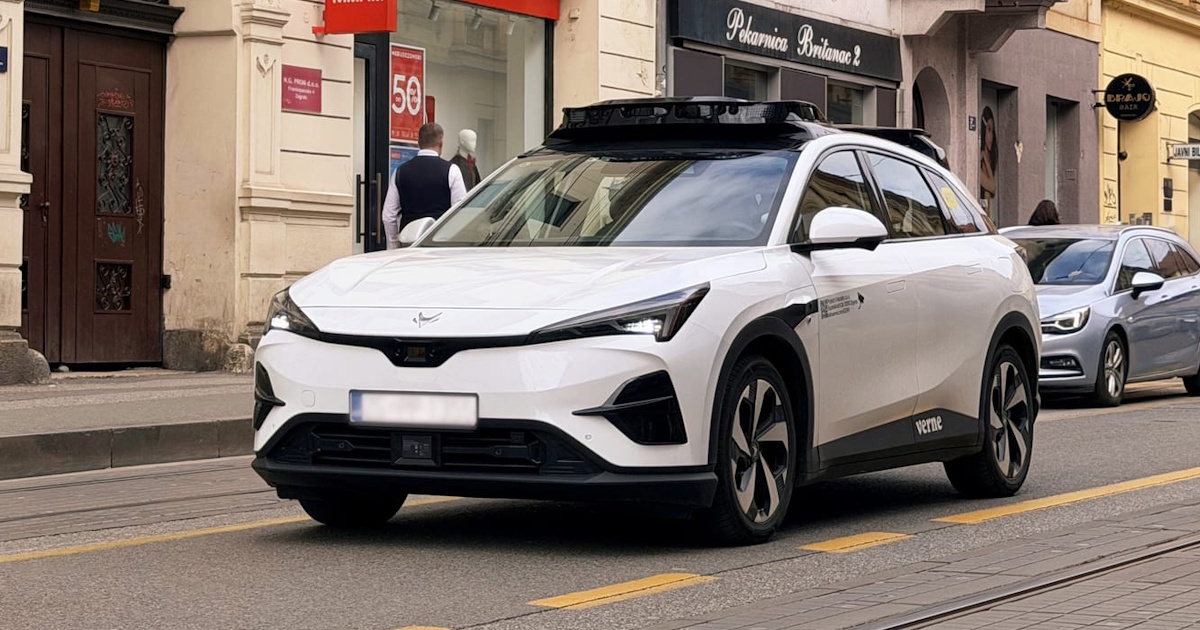
The robotaxi pilot I covered when Verne finished its first sixty prototypes just turned into something much bigger. Pony AI and Uber announced on Friday that they’re growing their partnership to put more than 2,000 robotaxis on European roads, building directly on the commercial service now running in Zagreb.
This next phase adds four more European cities to the current Zagreb service, though neither company has named them or given a date yet. Pony AI and Uber said more details will come in phases, and the same deal reaches into the Middle East too. It’s the clearest sign yet that Uber wants Pony AI’s Level 4 driving technology running well beyond the one Croatian capital where it started, according to the companies’ joint statement.
How the Partnership Actually Works
It’s the same setup that works in Zagreb. Pony AI brings the self driving tech and the experience it’s built running fully driverless taxis in four Chinese cities, where it says several have hit breakeven already. Uber brings the app: booking, payment and customer support, plus its huge rider base. A local partner handles the day to day work in each market, things like charging, cleaning and maintenance, and who actually owns the cars can change from city to city.
Is the Zagreb robotaxi service already running? Yes. Verne, a Croatian company using Pony AI’s technology, launched Europe’s first commercial robotaxi service in Zagreb in spring 2026, though a safety driver still sits in every vehicle for now.
That formula came together first in Zagreb, and how far the local project has come explains why Uber and Pony AI feel ready to scale it up. Croatian company Verne built more than sixty prototypes of its own robotaxi and only started carrying real passengers in spring 2026, running Pony AI’s seventh generation system in a small fleet of Arcfox Alpha T5 SUVs. I covered that milestone in my piece on Verne’s prototype fleet and testing program, and a safety driver still sits behind the wheel of every Verne car today. Taking that same formula to four more cities and over 2,000 vehicles is a much bigger bet than anything either company has tried in Europe so far.
Uber isn’t betting on Pony AI alone. It backs Wayve’s supervised robotaxi service in London, is testing a separate program there with Baidu, and recently upped its stake in Momenta after the Chinese firm got approval to test robotaxis across Germany. Pony AI’s rivals aren’t standing still either: WeRide just entered Denmark through a partnership with GreenMobility, and Uber’s Japanese arm signed a deal with a local taxi operator to run a Tokyo pilot later this year. Uber’s chief executive Dara Khosrowshahi has said he wants the company to become the “world’s leading commercialization platform for autonomous vehicles,” and this deal fits that pattern of signing up self driving suppliers instead of building the tech itself, as electrive.com reported.
Safety is the question that’ll only get louder as the fleet grows past a single pilot city. I looked at what independent crash data actually says about robotaxis in my coverage of the IIHS study on Waymo’s safety record, where Waymo posted 68% fewer crashes than human drivers, but with a long list of caveats around sample size and how crashes get reported. Verne is still years away from Waymo’s fifty million driverless miles, and every one of those caveats will matter just as much once Pony AI’s cars are running through five or more European cities instead of one.
Who owns and operates the robotaxi fleet? It varies by city. Pony AI supplies the autonomous driving technology, Uber handles booking and payment through its app, and a local partner manages the day to day fleet work, like charging and maintenance, in each market.
None of the four cities are confirmed yet, and until Pony AI names them, this reads more like a statement of intent than an actual operating plan. But the direction is clear. Zagreb stops being an interesting one off experiment the moment a second or third European capital gets its own fleet, and Uber and Pony AI now have a playbook, a mobility platform and a growing list of local partners ready to run the cars. Whether regulators in those new markets move at the same pace Croatia did is the real test, and that’s the one to watch over the coming months.
Featured Image Credit: Pony.ai
Marko Lubar is the Founder and Editor of ElectricFleet Online, where he covers the latest developments in electric vehicles, battery innovation, autonomous driving, artificial intelligence, and the technologies shaping the future of mobility.
Learn more about Marko and the mission behind ElectricFleet Online on the About Us page.
Latest News