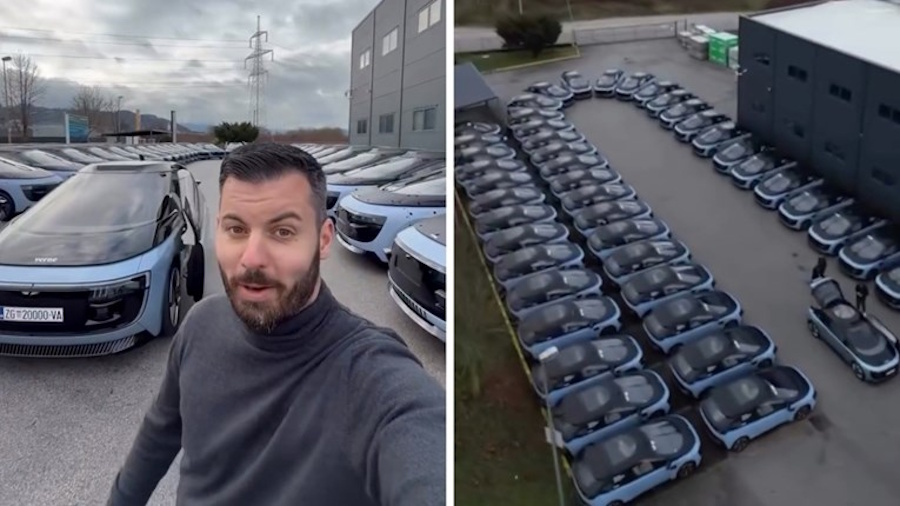
In a new video (in Croatian) released by founder Mate Rimac, creator of the Nevera hypercar, his mobility venture Project 3 Mobility (P3M) announced that more than 60 prototype units of the Verne robotaxi have been built, reaching the target set for the end of the year.
“We were supposed to show 60 prototypes by December. Here they are, all of them, plus a few more,” Rimac says in the footage.
The fleet reportedly consists of vehicles in various stages of development, destined for different types of tests: safety and crash tests, aerodynamics (wind‑tunnel) trials, comfort and vibration testing, durability, consumption metrics, and more.

Rimac emphasised that while autonomous driving promises higher safety compared to human drivers, risks cannot be entirely eliminated, thus the extensive testing regime, including some prototypes that have already undergone crash tests.
Table of Contents
- Why 60 prototypes, and what happens next
- Funding and financial framing
- From skepticism to progress, but questions remain
- What this means for electric mobility & robotaxi future in Europe
Why 60 prototypes, and what happens next
The decision to build dozens of prototypes reflects the rigorous process required to bring a robotaxi into real-world service. As Rimac explained, whether one builds a conventional car or a fully autonomous robotaxi, large numbers of prototypes are needed to validate safety, durability, reliability, and compliance with regulatory standards.

At present, the prototypes are intended for testing only, not for deployment to passengers. According to Rimac, the initial goal is to launch Verne robotaxi operations in his home city of Zagreb, but with much broader ambitions: after Zagreb, the plan is to expand into other European cities and beyond.
Funding and financial framing
Rimac addressed ongoing speculation about public funding for the project. He clarified that his company has drawn €89.7 million from the European Union for the robotaxi program, not the larger sums cited in some media reports. Private investors, he says, injected €104 million specifically into the robotaxi project; in total, the broader Rimac Group has attracted over €1 billion in private investment. Less than 10 % of total investments in Rimac Group came from public sources.

Looking forward, Rimac reaffirmed that all future scaling (mass‑production, deployment, expansion) will rely on private capital, not EU grants.
From skepticism to progress, but questions remain
When Verne was first presented in mid‑2024, the debut was criticized because the robotaxi failed to respond to Rimac’s command on stage. Critics also pointed out that by early 2025, there were no verified prototypes yet, casting doubt on whether the company would meet its obligations under EU‑funded projects.

The current update (60+ built prototypes) represents the most concrete progress to date and may help defuse some of that criticism. But it remains to be seen when Verne will achieve certification, pass regulatory approval, and, most importantly, begin actual autonomous operations. For now, the fleet exists only as a “test park”.
What this means for electric mobility & robotaxi future in Europe
Rimac’s reveal of over 60 Verne prototypes marks a significant step forward for robotaxi development in Europe. It demonstrates that autonomous electric mobility can be advanced even outside traditional automotive hubs, showing how a smaller country and a younger EV startup can push the boundaries of urban transportation.
The extensive testing of these vehicles, including crash, durability, and other rigorous trials, could help establish benchmarks for robotaxi safety standards. Additionally, meeting the 60-unit target may attract future investors and generate interest from other European cities beyond Zagreb.


While it remains uncertain whether Verne will become the “Uber-on-autopilot” of European metropolises, this milestone moves the conversation from promises to observable progress, highlighting a development worth following closely.
Frequently Asked Questions
Q1: What is the Rimac Verne robotaxi?
The Rimac Verne is an autonomous electric vehicle designed to operate as a robotaxi. Developed by Mate Rimac’s Project 3 Mobility, it aims to provide safe, self-driving urban mobility in European cities.
Q2: How many Verne prototypes have been built?
As of November 2025, more than 60 Verne prototypes have been completed. These vehicles are in various stages of testing, including crash, durability, vibration, aerodynamics, and energy consumption trials.
Q3: Are these robotaxis already operating commercially?
No. The current fleet exists only for testing purposes. They are not yet approved for passenger transport or deployed in public operations.
Q4: Where will the Verne robotaxis be used first?
The initial focus is on Mate Rimac’s home city of Zagreb. Plans exist to expand operations to other European cities once testing, certification, and regulatory approval are complete.
Q5: How is the Verne project funded?
The robotaxi project has received €89.7 million in EU grants and €104 million in private investment. Overall, the broader Rimac Group has attracted over €1 billion in private funding, with less than 10% coming from public sources.
Q6: Why are so many prototypes needed?
Developing a safe, reliable autonomous vehicle requires numerous prototypes to test durability, crash safety, system performance, and compliance with regulations. This ensures the final vehicles meet strict safety and operational standards.
Q7: When can we expect Verne robotaxis to start carrying passengers?
There is no confirmed timeline yet. The fleet is still in the testing phase, and full deployment will depend on successful certification, regulatory approval, and further validation of autonomous systems.
Latest News